BioCentral IBBioCentral IB
IB Biology · Theme A · A1.1

Water

The medium of life
Guiding questions

What physical and chemical properties of water make it essential for life?

What are the challenges and opportunities of water as a habitat?

Part one

Chemical properties of water

A1.1.1 – A1.1.5
A1.1.1

Life began in water

  • The first cells are thought to have arisen in water, and it remains the medium where most of the chemistry of life still happens today.
  • The cytoplasm of every cell is mostly water, and enclosing a small volume of it inside a membrane — separating "inside" from "outside" — is what let the first cells concentrate the molecules of life and control the reactions happening within them.
Why it mattersWater is still where most metabolic reactions occur: enzymes collide with substrates dissolved in an aqueous cytoplasm, and multicellular organisms retain that same aqueous environment as interstitial fluid and blood plasma.
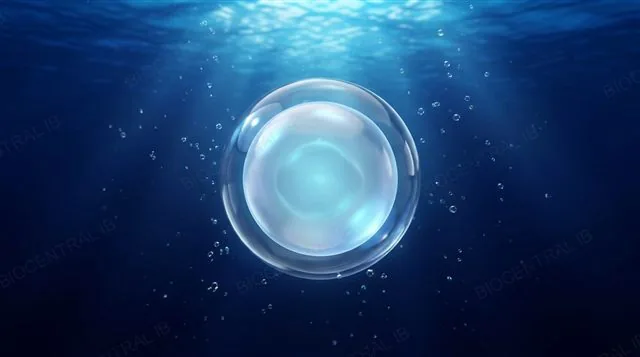
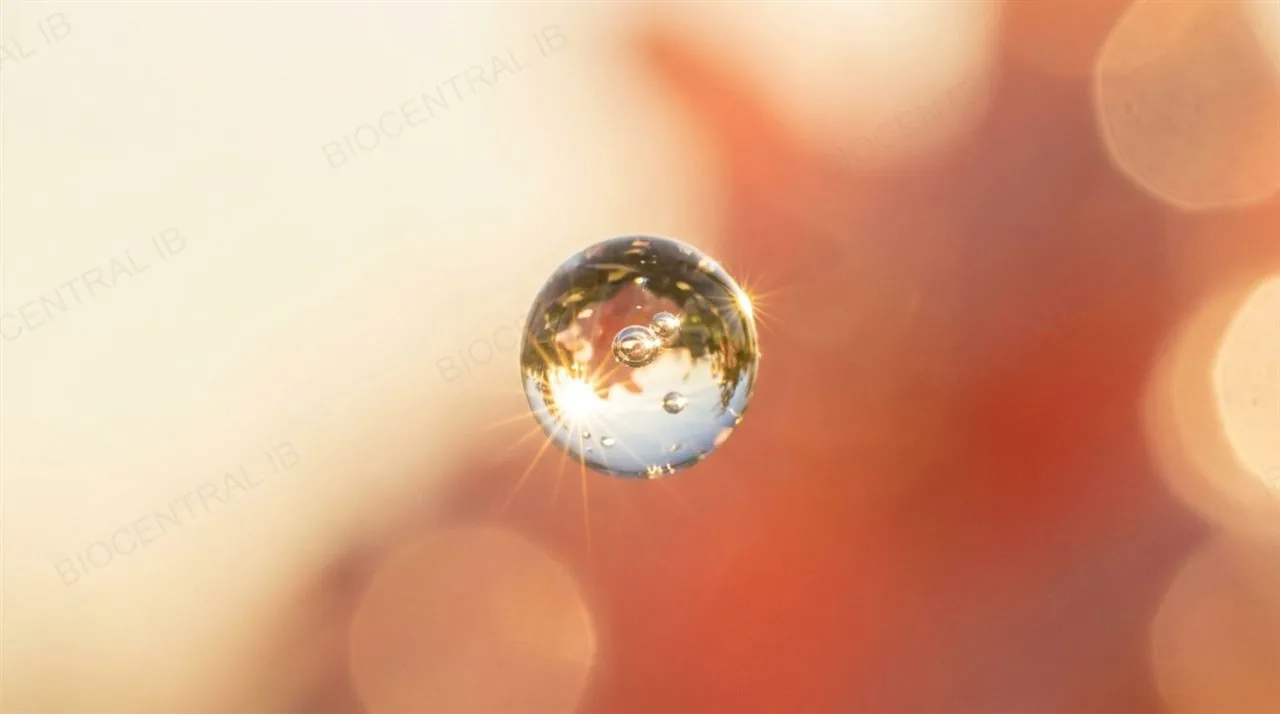
A simple cell-like vesicle glowing beneath the surface of Earth's primordial ocean
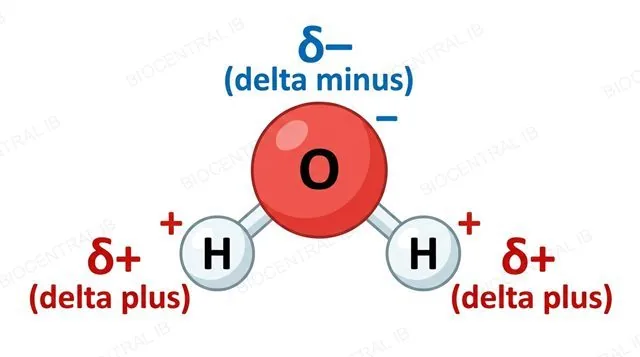
A single bent water molecule with delta-plus and delta-minus partial charges labelled
A1.1.2

Polar covalent bonds

A polar covalent bond shares electrons unevenly between two atoms.
  • Oxygen is more electronegative than hydrogen — it pulls the shared electrons closer to itself.
  • Oxygen ends up slightly negative (δ−), and each hydrogen ends up slightly positive (δ+), exactly as labelled opposite.
Why it mattersThis uneven charge — the polarity of the water molecule — is the single fact that every other property in this lesson traces back to.
A1.1.2

Hydrogen bonds

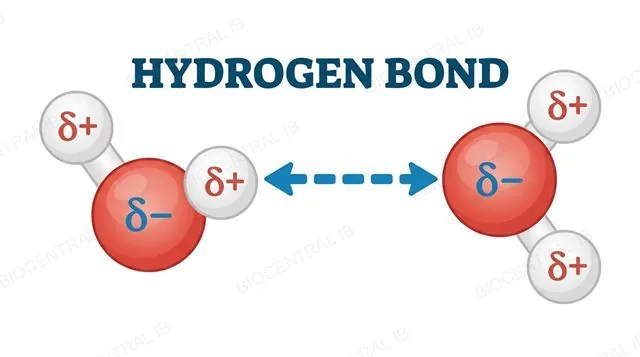
A hydrogen bond is the attraction between a δ+ hydrogen on one molecule and a δ− oxygen on a neighbouring molecule.
  • Opposite partial charges pull neighbouring water molecules together, exactly as shown opposite.
  • Each individual bond is weak — far weaker than the covalent bonds inside a water molecule — but water forms an enormous number of them at once.
Why it mattersThis single fact — huge numbers of weak hydrogen bonds acting together — explains almost every property covered in this lesson: cohesion, adhesion, viscosity, thermal conductivity, and specific heat capacity all trace back to it.
Two water molecules joined by a hydrogen bond, each showing delta-plus and delta-minus charge
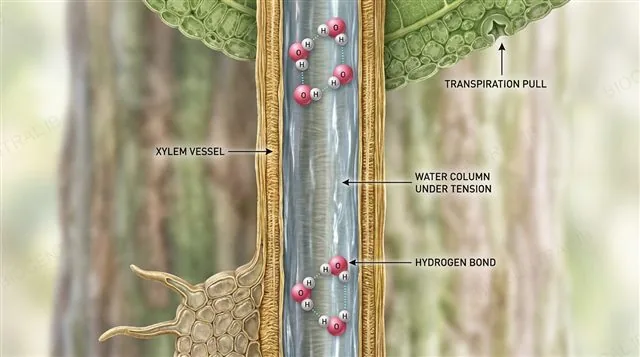
Cross-section of a plant xylem vessel showing an unbroken column of water molecules linked by hydrogen bonds, under tension as it is pulled upward toward a leaf
A1.1.3

Cohesion in the xylem

Cohesion is the mutual attraction between water molecules themselves, caused by hydrogen bonding.
  • Each water molecule can hydrogen-bond to up to 4 neighbours, so the molecules cling together strongly.
  • This is strong enough to pull an unbroken column of water up a plant’s xylem vessel against gravity — molecules at the top, pulled up by transpiration, drag the whole column with them via cohesion.
Why it mattersWithout cohesion, the water column would snap under tension, and transpiration could not pull water all the way from root to leaf.
A1.1.3

Cohesion at the surface

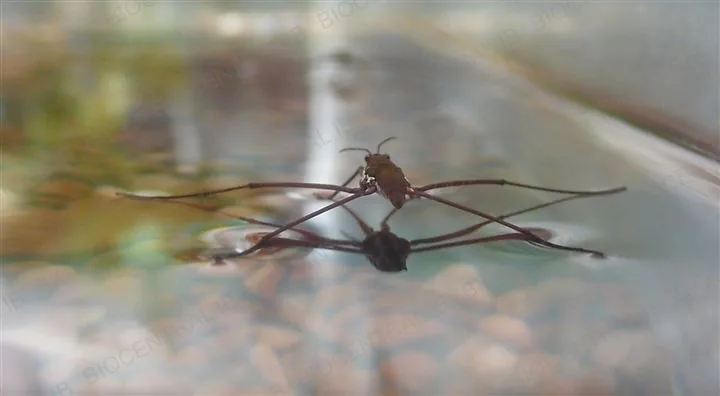
Surface tension is a “skin-like” effect at a liquid’s surface, produced by cohesion between molecules.
  • At the water’s surface, molecules have no neighbours above them to bond with, so they’re pulled sideways and down more strongly than molecules in the bulk liquid.
  • This creates a taut “skin” strong enough to support small, lightweight organisms without breaking.
Real habitatA water strider’s weight is spread across the surface by long, water-repellent legs — cohesion at the surface supports it without breaking, letting it walk, hunt, and mate entirely on top of the water.
A water strider standing on the surface of a pond, supported by surface tension
A1.1.4

Adhesion

Adhesion is the attraction between water and a different, polar or charged surface.
  • Water clings to cellulose in plant cell walls and to soil particles the same way it clings to itself — through hydrogen bonds to any surface carrying a partial or full charge.
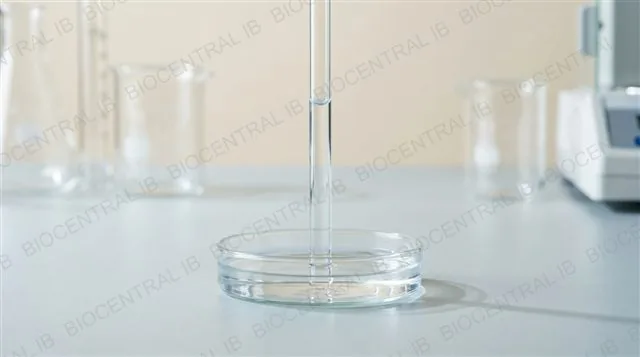
Capillary actionThe narrower the gap, the stronger the pull — this is how water climbs up narrow soil channels and into a plant's roots, and how it rises inside the narrow cell walls of xylem vessels, working together with cohesion to move water against gravity.
Water rising up a narrow glass tube above the surrounding water level — capillary action
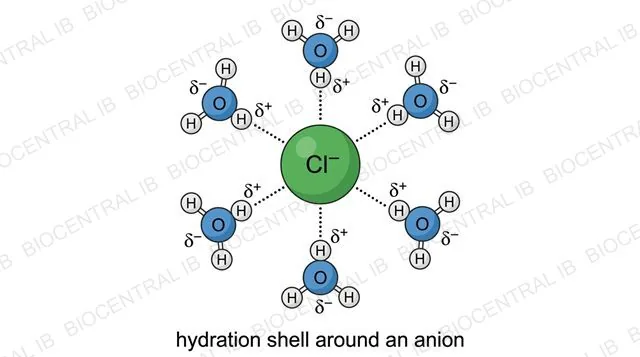
Water molecules surrounding a chloride ion, oxygen ends oriented outward
A1.1.5

The universal solvent

A solvent is a substance that dissolves other substances (solutes) to form a solution.
  • Water's δ− and δ+ ends surround a charged ion, weakening the ion's own lattice forces until it's pulled apart — dissolved, and free to react.
  • A wide variety of hydrophilic molecules dissolve this way.
Why it mattersThis is why most enzyme-catalysed reactions happen in aqueous solution, and why water is the medium for transport in both plants (xylem, phloem) and animals (blood plasma).
A1.1.5

Except what it excludes

Hydrophobic means "water-fearing" — unable to dissolve in water.
  • Non-polar molecules like fats carry no charge to attract water.
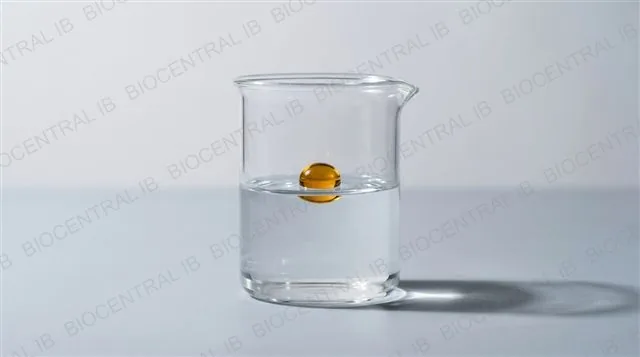
  • Water would rather hydrogen-bond to itself — so it pushes non-polar molecules together instead, excluding them from solution.
ExamplePhospholipid tails stay insoluble on purpose — that's exactly what makes a cell membrane a barrier. The functions of some molecules in cells depend entirely on their being hydrophobic and insoluble.
A small oil droplet floating undissolved on the surface of water

Key vocabulary — chemical properties

Worth being able to define in a single sentence each

Polar
an uneven spread of charge across a molecule.
Hydrogen bond
the weak attraction between one molecule's δ+ and another's δ−.
Cohesion
water molecules attracted to each other.
Adhesion
water attracted to other polar or charged surfaces.
Hydrophilic
"water-loving" — dissolves readily in water.
Hydrophobic
"water-fearing" — does not dissolve in water.
Quick check

A water strider can stand on the surface of a pond without breaking through. Which property of water is most directly responsible?

High specific heat capacity
Cohesion between water molecules (surface tension)
Water's ability to dissolve ions
Low viscosity
Correct answer: cohesion. Hydrogen bonding lets each water molecule pull on up to four neighbours. At the surface, molecules have no neighbours above them, so they're pulled sideways and down more strongly — creating a "skin" (surface tension) strong enough to support a light insect.
Part two

Physical properties of water

A1.1.6 — always measured against air
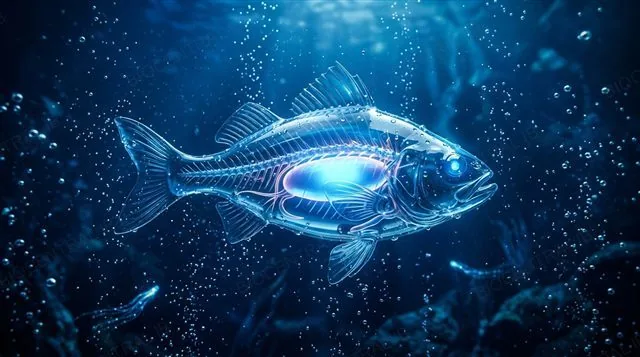
A1.1.6 · Buoyancy

Held up by density

Buoyancy is the upward force a fluid exerts on a body within it.
  • A denser fluid exerts a much larger upthrust on a submerged body.
  • Because water is roughly 800× denser than air, aquatic animals need far less skeleton to fight gravity than land animals do.
Air ≈1.2 → Water ≈1000 kg/m³
A translucent fish with a visible glowing swim bladder, illustrating buoyancy
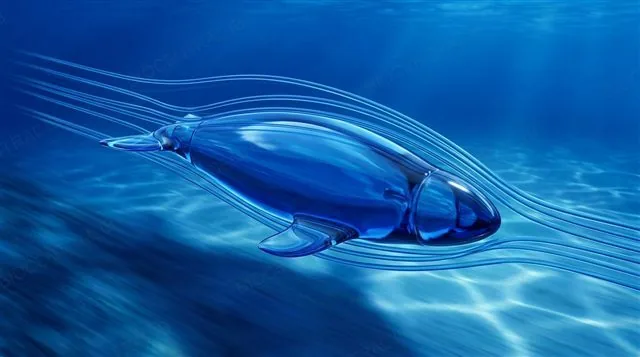
A streamlined torpedo-shaped body moving through water with flow trails, illustrating viscosity and drag
A1.1.6 · Viscosity

Resistance to flow

Viscosity is a fluid's internal resistance to flowing.
  • Hydrogen bonds resist water molecules sliding past each other — more drag than air offers, which favours a streamlined body shape for anything moving through it quickly.
Air 0.018 → Water 1.0 mPa·s
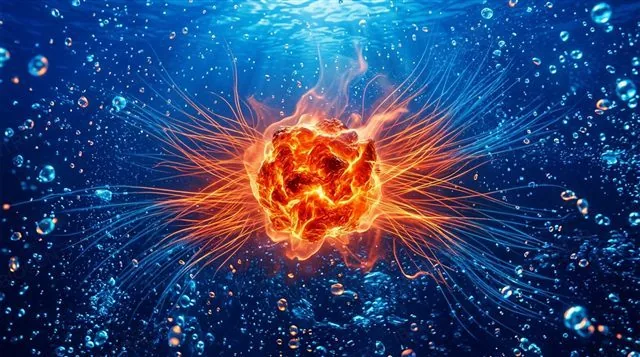
A1.1.6 · Thermal conductivity

Heat leaves fast

Thermal conductivity is how quickly a material transfers heat.
  • Water molecules sit close together, held by hydrogen bonds, so heat passes molecule to molecule quickly.
  • A wet, cold body loses heat far faster than the same body in air.
Air 0.024 → Water 0.58 W/m·K
A glowing fireball rapidly dissipating heat, illustrating thermal conductivity
A calm lake at sunset with snow on the shore, illustrating specific heat capacity
A1.1.6 · Specific heat capacity

Slow to change

Specific heat capacity is the energy needed to raise 1 g of a substance by 1°C.
  • Hydrogen bonds must break before molecules can move faster, and that takes real energy — so large bodies of water resist changing temperature and stay thermally stable habitats.
ApplicationThe same energy cost is why sweat cools you — evaporating it draws heat from the skin.
Air ≈1.0 → Water 4.18 J/g·°C
Real adaptation

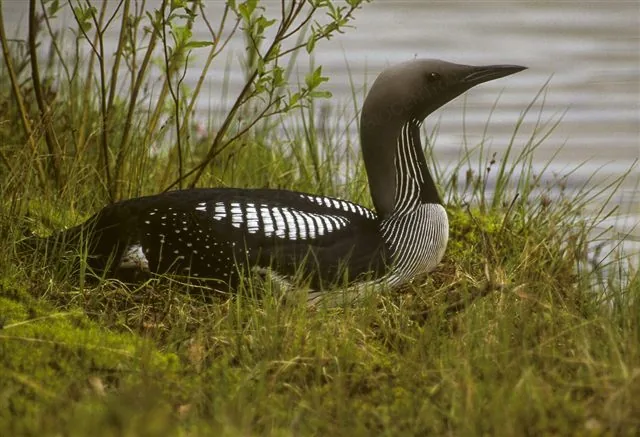
The black-throated loon

  • Gavia arctica — a diving bird that lives on both water and land, and must cope with all four physical properties at once.
Buoyancy
Lighter, less dense bones let it float — though they're not hollow, so it can still dive.
Viscosity
Legs set far back on the body give powerful propulsion through water, at the cost of walking on land.
Thermal
Interlocking feathers form a barrier that limits heat loss in cold water.
Specific heat
Water's thermal stability makes it a reliable, unchanging habitat to return to between dives.
A real photograph of a black-throated loon resting on a lakeshore
Francesco Veronesi · CC BY-SA 2.0
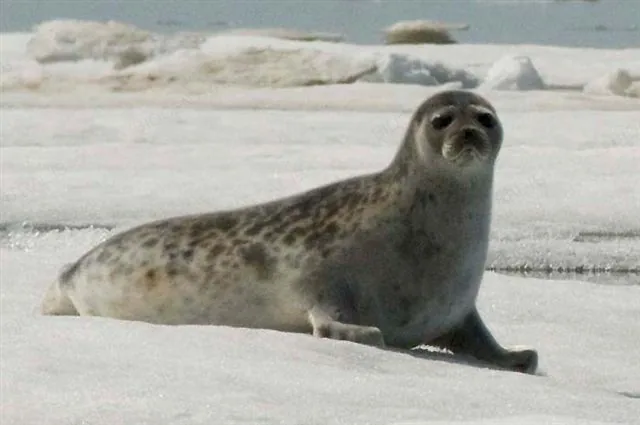
A real photograph of a ringed seal resting on Arctic ice
NOAA · Public domain
Real adaptation

The ringed seal

  • Pusa hispida — the same four properties, solved a completely different way.
Buoyancy
Denser bones than the loon let it stay submerged for longer while diving.
Viscosity
A streamlined body shape cuts drag when swimming through viscous water.
Thermal
A thick blubber layer plus a fur coat that traps air insulates against rapid heat loss in cold water.
Specific heat
The same stability that keeps the habitat constant also limits how it sheds excess heat.
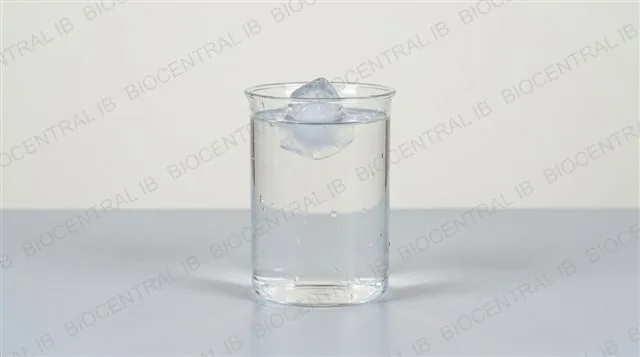
An ice cube floating on top of liquid water in a glass
Beyond the syllabus

Ice floats

  • Hydrogen bonds lock water molecules into a spaced-out lattice as they freeze, making ice less dense than liquid water.
  • Floating ice insulates the water below from freezing air — without this, lakes and oceans would freeze from the bottom up, and most aquatic life could not survive winter.
Quick check

Water's high thermal conductivity means a warm-blooded animal loses heat much faster in water than in air. Which adaptation directly counters this in the ringed seal?

Lighter, less dense bones
Legs set far back on the body
A thick blubber layer plus a fur coat that traps air
A larger lung volume
Correct answer: blubber plus a fur coat. Both act as insulation, slowing the rate at which heat conducts from the seal's warm body into the surrounding water — directly countering water's high thermal conductivity (0.58 vs air's 0.024 W/m·K).
Higher Level

Where did it all come from?

A1.1.7 – A1.1.8 · not on the SL course
A1.1.7 · HL

Where did Earth's water come from?

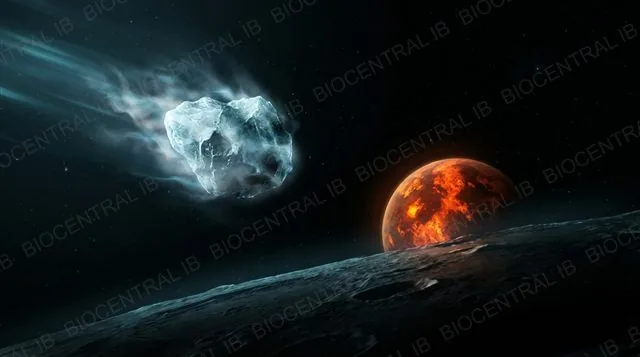
  • One leading hypothesis: icy asteroids, colliding with the young Earth over its first few hundred million years, delivered much of its water.
  • For water to be retained rather than lost to space or boiled off, a planet needs strong enough gravity to hold onto water vapour, and temperatures low enough for it to condense into liquid.
Nature of scienceThe abundance of water over billions of years of Earth's history is what allowed life the time to evolve.
An icy asteroid streaking toward the young early Earth
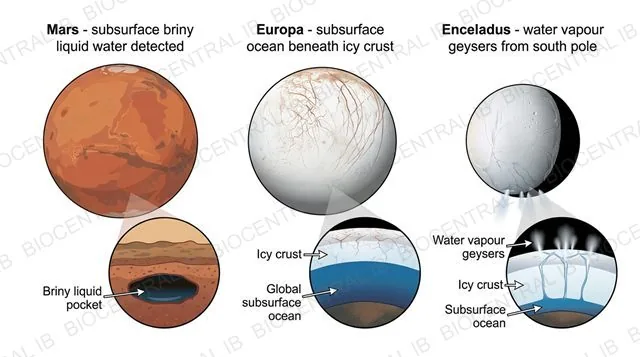
Three solar-system bodies with evidence of liquid water: Mars, Europa, and Enceladus
A1.1.8 · HL

Looking for life, looking for water

  • Because every known form of life needs it, liquid water is the first thing scientists search for beyond Earth.
  • A planet's habitable zone — nicknamed the "Goldilocks zone" — is the orbital distance from a star where temperatures allow liquid water to persist on the surface: not so close that it boils, not so far that it freezes.

Key vocabulary — physical properties

Worth being able to define in a single sentence each · terms marked HL are Higher Level only

Buoyancy
the upward force a fluid exerts on a body within it.
Viscosity
a fluid's internal resistance to flowing.
Thermal conductivity
how quickly a material transfers heat.
Specific heat capacity
energy needed to raise 1 g of a substance by 1°C.
RetentionHL
a planet keeping water rather than losing it to space.
Goldilocks zoneHL
the orbital distance where liquid water can persist.

Where this shows up again

B2.1 · Membranes
How do the solvent properties of water underpin transport across cell membranes?
D2.3 · Water potential
How does water potential (osmosis) depend on water acting as a solvent and medium?
B3.2 · Transport
How is the cohesion of water essential to transport in plants?
A2.1 · Origins of cells
Why is liquid water central to discussions of the origin of the first cells?

A1.1 Water — one-page recap

Screenshot this slide to revise from

Structure
  • Polar bond: O pulls electrons → δ− O, δ+ H
  • Hydrogen bond: δ+ of one molecule to δ− of another
Cohesion & adhesion
  • Cohesion: water-to-water → surface tension, xylem columns
  • Adhesion: water-to-surface → capillary action
Solvent
  • Hydrophilic dissolves; hydrophobic excluded
  • Enzymes react in aqueous solution
Physical properties
  • Buoyancy: water ≈800× denser than air
  • Viscosity: water ≈50× more viscous
Thermal
  • Conductivity: water 0.58 vs air 0.024 W/m·K
  • Specific heat: water 4.18 vs air ≈1.0 J/g·°C
HL · Origins
  • Water delivered by icy asteroids; retained by gravity + temperature
  • Goldilocks zone: where liquid water can persist

Water didn't just enable life.

It's still what life is made of.
A1.1 Water · BioCentral IB
Use ↓ ↑ or click to navigate
01 / 20