BioCentral IBBioCentral IB
IB Biology · Theme A · A2.1 · HL only

Origins of cells

From simple chemistry to the first living thing
Guiding questions

What plausible hypothesis could account for the origin of life?

What intermediate stages could there have been between non-living matter and the first living cells?

A hypothesis, not settled history

  • Nobody watched life begin.
  • Every idea in this topic — Miller-Urey chemistry, self-assembling vesicles, the RNA world, the hydrothermal-vent environment — is the current best evidence-supported explanation, not a proven, single pathway.
  • The exact mechanism, sequence, and even the environment remain genuinely debated among origin-of-life researchers.
  • Treat this as a plausible, evidence-supported sequence, not a solved case.

A note on this course and personal belief

  • This course explains the current scientific model.
  • You are not required to personally believe it — you are required to know and explain it accurately, the same way you'd learn any model in this course.
  • What you believe about ultimate questions of origin and meaning is your own, and separate from what the model says.
Part one

From chemistry to compartments

A2.1.1 – A2.1.6
A2.1.1

Conditions on early Earth

  • Earth formed about 4.54 billion years ago.
  • Its earliest atmosphere had little or no free oxygen — nothing like today's air.
  • Without oxygen there was no ozone layer, so high-energy ultraviolet radiation reached the surface unfiltered.
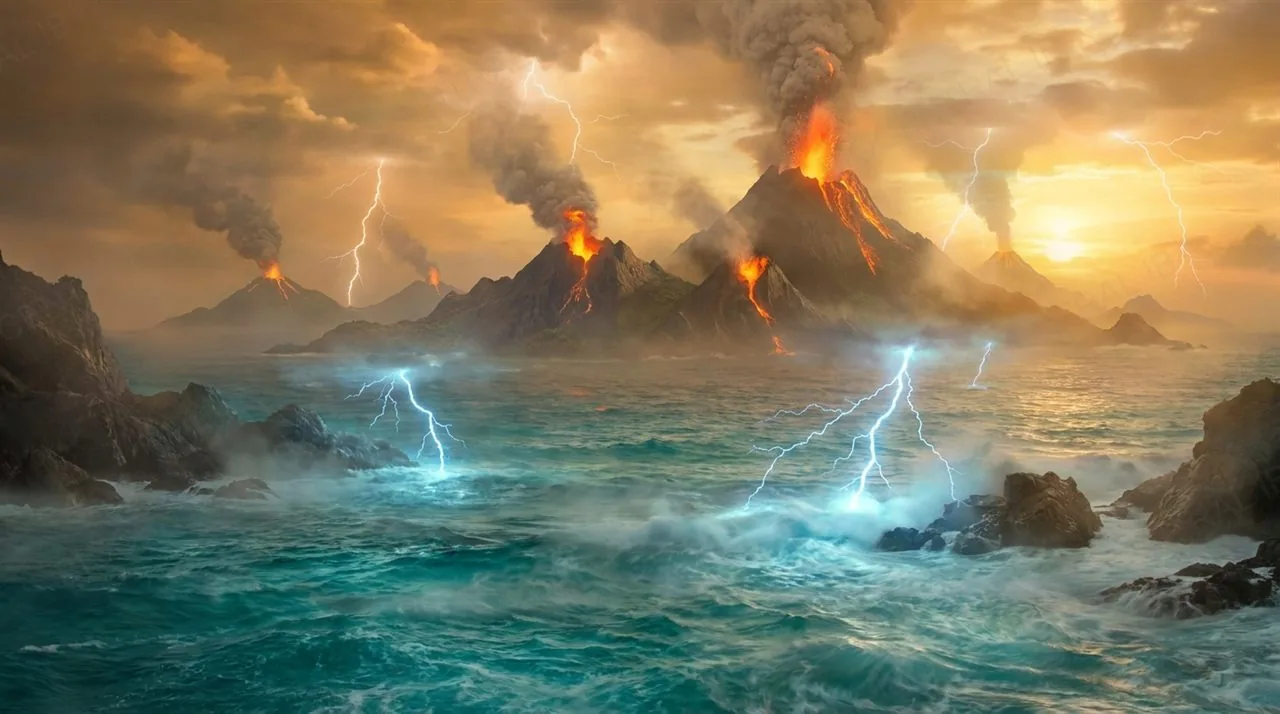
  • Along with lightning and heat from volcanic activity, that UV energy could drive chemical reactions between simple gases such as CO₂ and methane.
  • Given enough energy and enough time, simple gases can rearrange into carbon compounds — the building blocks of life, such as amino acids and sugars — forming spontaneously, without any living thing involved.
Direct testStanley Miller and Harold Urey (1953) sealed a mixture of these gases in a flask, sparked it to simulate lightning, and found amino acids had formed within days.
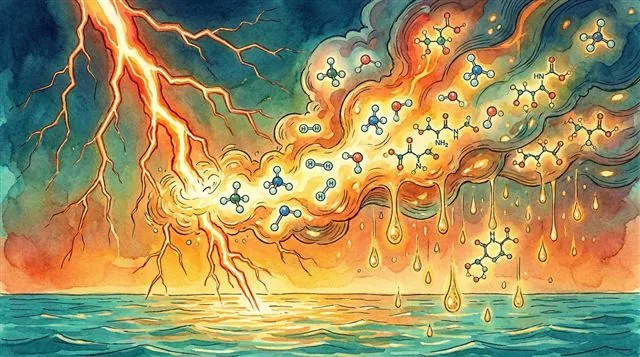
Lightning striking a mixture of glowing gas molecules, transforming into amino acid molecules
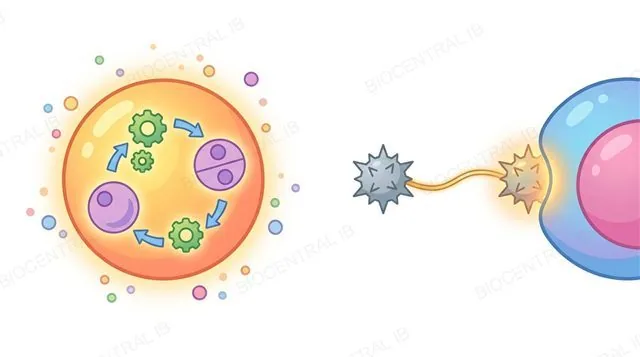
A comparison of a living cell carrying out metabolism and reproduction versus an inert virus that must hijack a host cell
A2.1.2

What makes something alive?

A cell is the smallest unit that can carry out all the processes of life — metabolism, growth, response, and reproduction — on its own.
  • A single protein, a strand of RNA, or a membrane fragment can take part in some of these processes, but none can sustain all of them unassisted.
  • A cell is self-sustaining: it doesn't depend on borrowing another organism's machinery to survive.
Why viruses don't countA virus has genetic material and a protein coat, but cannot metabolise or reproduce alone — it must hijack a host cell's ribosomes and enzymes. This sets the target for the whole topic: however life began, the end point had to be a bounded, self-sustaining cell.
A2.1.3

The chicken-and-egg problem

  • Modern cells are deeply interdependent.
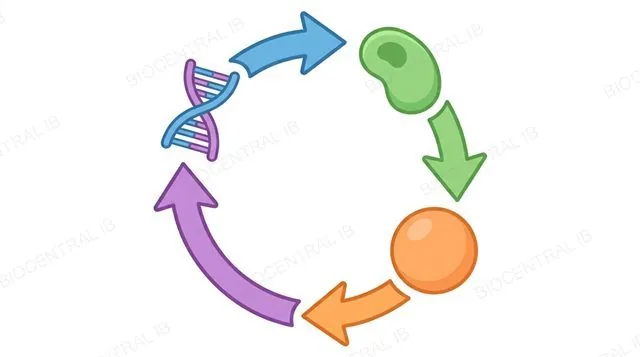
  • DNA carries the instructions for proteins — but building and copying DNA requires proteins (enzymes).
  • Which came first?
  • A cell also needs a membrane to hold its contents together, but assembling that membrane needs molecules a cell's own metabolism normally supplies.
  • Information needs catalysts; catalysts need information; both need a compartment.
  • This circular dependency is why the origin of the first cell is one of the hardest open questions in biology.
  • No single scenario is proven — several plausible, partial explanations exist and are still being tested: vesicles, RNA, and hydrothermal vents, which you'll meet next.
Nature of scienceThis is a good example of how science actually works: instead of one confirmed answer, there's a set of competing, evidence-supported hypotheses, and confidence shifts as new evidence arrives.
A circular diagram showing DNA pointing to a protein, pointing to a membrane, pointing back to DNA
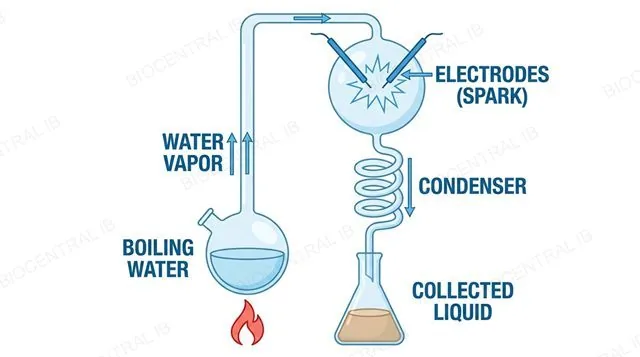
Diagram of the Miller-Urey apparatus with labelled electrodes, condenser, and collected liquid
A2.1.4

The Miller-Urey experiment

  • Miller and Urey sealed gases thought to resemble the early atmosphere in a flask of boiling water.
  • Sparking electrodes simulated lightning; a condenser cooled the vapour back into liquid, which collected in a trap for analysis.
  • Within days, that collected liquid contained amino acids and other organic molecules.
Evaluate itThis is direct experimental evidence that carbon compounds can form abiotically under early-Earth-like conditions — but it's a laboratory model, not a record of what actually happened billions of years ago.
A2.1.4

More evidence: meteorites

  • A second, independent line of evidence comes from space.
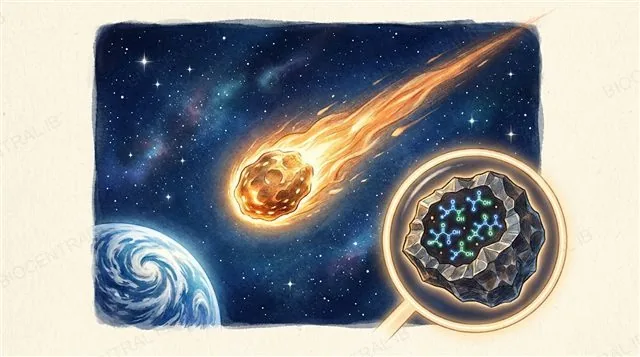
  • The Murchison meteorite, which fell in Australia in 1969, contains amino acids that formed in space, long before it reached Earth — showing carbon compounds can form abiotically with no biological input at all.
A third checkRepeating Miller-Urey with a gas mixture closer to today's oxygen-rich atmosphere produces far fewer organic molecules — real evidence, not just an assumption, that the early atmosphere really was very different from the one we breathe now.
A glowing meteorite streaking toward Earth with amino acid molecules visible inside a cross-section
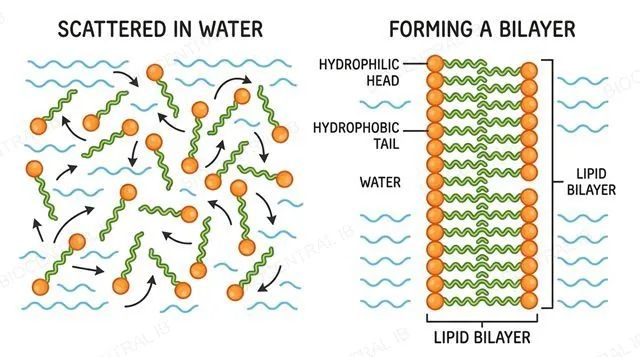
Fatty acid molecules with labelled hydrophilic heads and hydrophobic tails, scattered then forming a bilayer
A2.1.5

Fatty acids self-assemble

Amphipathic means having both a water-attracting (hydrophilic) head and a water-repelling (hydrophobic) tail.
  • Mixed into water, fatty acid molecules spontaneously arrange into a bilayer — two layers with tails pointing inward, away from water, and heads pointing outward, into it.
  • This is simply the most stable arrangement energetically — no enzyme or template required.
Solves A2.1.3Unlike modern phospholipid membranes, which are built by enzymes, a fatty-acid membrane can assemble itself — a way around the membrane problem raised earlier.
A2.1.5

From sheet to vesicle

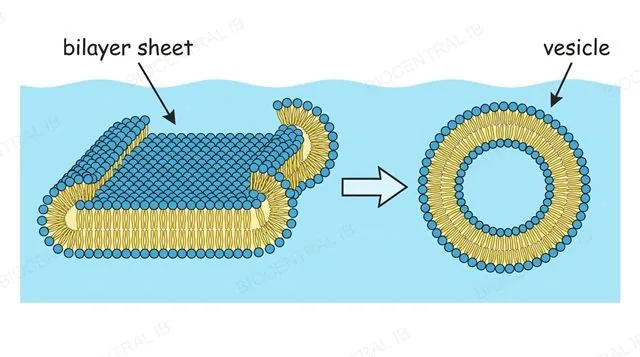
  • A flat bilayer sheet will spontaneously curl up and close into a hollow sphere, called a vesicle — because a closed sphere has no exposed edge, making it even more stable than a flat sheet.
Why it mattersA vesicle creates an enclosed compartment, separating an "inside" from the environment. This could concentrate molecules that would otherwise be too dilute to react, and protect a self-replicating molecule — such as early RNA — from the wider environment. A plausible first step toward a membrane-bound cell.
A flat bilayer sheet curling up and closing into a hollow spherical vesicle
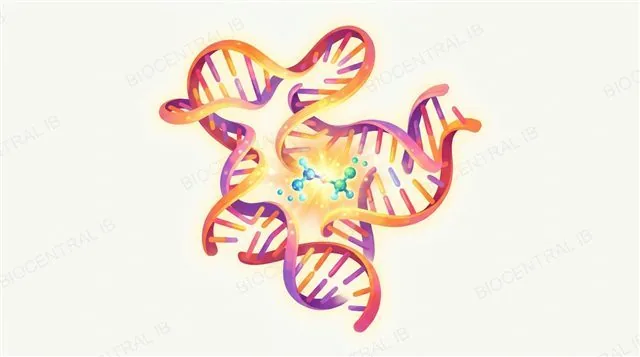
A folded RNA molecule acting as a ribozyme, catalyzing a chemical reaction
A2.1.6

RNA: messenger and machine

  • In modern cells, DNA stores information and proteins catalyse reactions — two separate jobs.
  • But RNA can do both.
  • Like DNA, it stores information as a base sequence; but it can also fold into complex 3D shapes and catalyse reactions — a catalytic RNA molecule is called a ribozyme.
The RNA worldBecause one molecule could carry information and catalyse its own replication, RNA breaks the DNA-needs-protein-needs-DNA deadlock. Self-replicating RNAs that copied themselves with different success would face a very early, purely chemical form of natural selection.
Quick check

A vesicle made of fatty acids assembles itself, with no enzyme or template needed. Why not?

Enzymes would destroy fatty acids on contact
A closed sphere is simply the most stable arrangement for amphipathic molecules in water
Vesicles are built by ribozymes instead
Fatty acids are chemically identical to modern phospholipids
Correct answer: it's the most stable arrangement. Amphipathic fatty acids spontaneously form a bilayer (tails hidden, heads exposed to water), and a bilayer sheet spontaneously curls into a sphere because a closed sphere has no exposed edge — self-assembly, driven purely by chemistry.
Part two

Tracing life's origin through evidence

A2.1.7 – A2.1.9
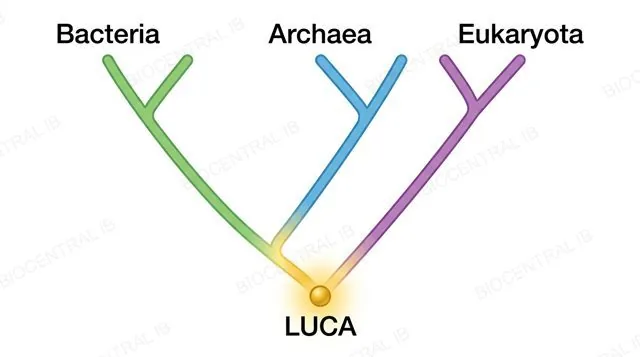
A phylogenetic tree with Bacteria, Archaea, and Eukaryota converging into LUCA
A2.1.7

What is LUCA?

The last universal common ancestor (LUCA) is the most recent single population from which every organism alive today is descended.
Be preciseLUCA was not the first living cell. It already had a genetic code, ribosomes, and ATP — a fair amount of evolution happened before LUCA existed. It's simply the last ancestor shared by everything alive today; earlier lineages existed but left no surviving descendants.
A2.1.7

The evidence: a shared toolkit

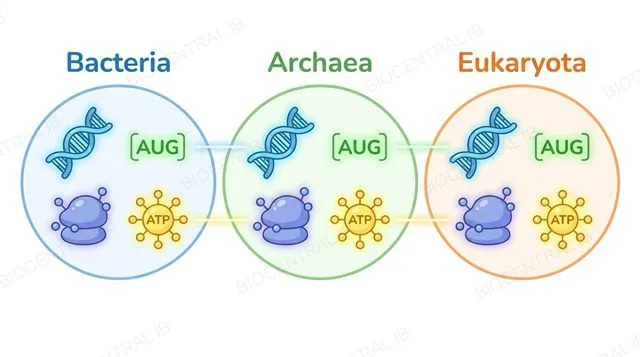
  • Every domain of life — Bacteria, Archaea, and Eukaryota — shares the same molecular toolkit:
    • DNA as its genetic material
    • An almost universal genetic code
    • Ribosomes built along the same basic plan
    • ATP as its energy currency
Why it's evidenceNone of these features is chemically forced — there's no reason the code has to assign a particular triplet to a particular amino acid. If life arose independently more than once, unrelated lineages wouldn't share such specific, arbitrary details. The simplest explanation is common inheritance from one shared ancestor.
Bacteria, Archaea, and Eukaryota each shown sharing the same DNA, genetic code, ribosome, and ATP icons
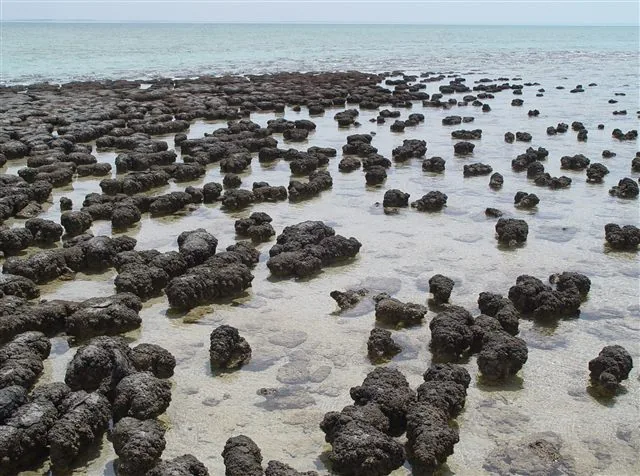
Real photograph of stromatolites at Shark Bay, Western Australia
A2.1.8 · Dating method 1

Fossil evidence

  • Stromatolites — layered rock structures built up by mats of ancient microorganisms — are among the oldest direct fossil evidence of life, with some dated to about 3.5 billion years ago.
  • These living examples at Shark Bay, Australia, still form the same way today.
LimitationStromatolites only form under particular conditions, so their absence elsewhere doesn't mean life was absent — they set a minimum age, not a precise one.
A2.1.8 · Dating method 2

Chemical (isotopic) evidence

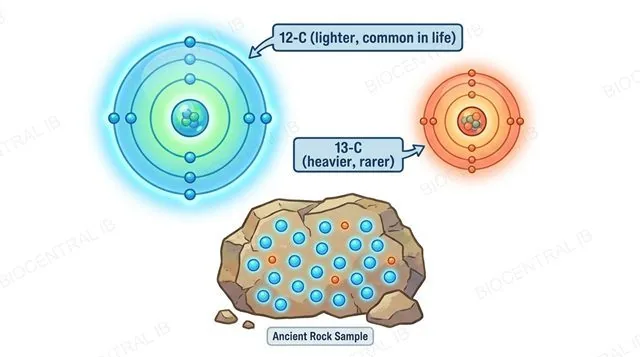
  • Living organisms preferentially use the lighter isotope of carbon, ¹²C, in their biochemistry.
  • Ancient rocks with an unusually high proportion of ¹²C relative to ¹³C are taken as chemical evidence of biological activity, even where no visible fossil survives.
LimitationThis evidence is indirect — it shows something biological was probably present, not what the organism looked like.
Comparison of lighter carbon-12 and heavier carbon-13 isotopes, with an ancient rock sample
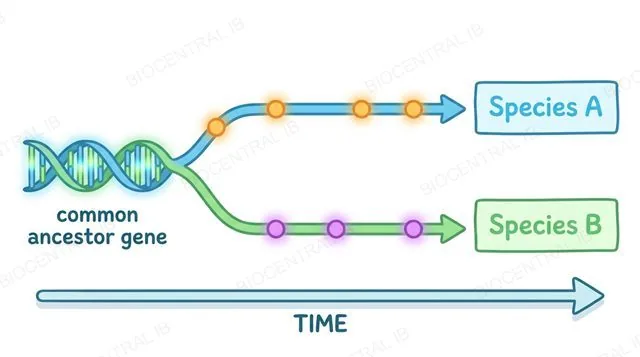
A gene sequence diverging into two species over time, accumulating mutations
A2.1.8 · Dating method 3

The molecular clock

  • If the rate at which a gene accumulates mutations can be calibrated against a known divergence event, the number of differences between two species' versions of that gene can calculate how long ago they shared a common ancestor.
LimitationMutation rates aren't perfectly constant, so molecular-clock dates carry real uncertainty and don't always agree exactly with fossil-based dates.
The takeawayEach method has its own limitations, so scientists look for agreement between independent methods as the strongest kind of evidence — exactly the reasoning behind the hydrothermal-vent hypothesis next.
A2.1.9

LUCA near hydrothermal vents

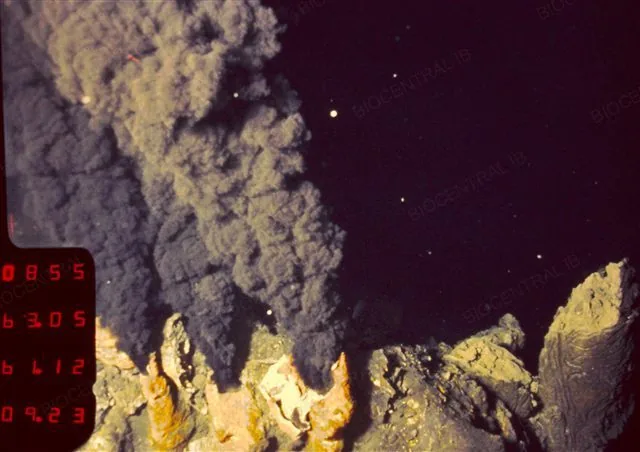
  • Hydrothermal vents are fissures on the ocean floor where mineral-rich water, heated by Earth's interior, meets cold seawater.
  • Some (alkaline vents) naturally maintain a chemical gradient across thin mineral walls — a ready-made energy source, plus constant heat, hydrogen, carbon dioxide, and iron-sulfur mineral catalysts.
Two lines convergeComparing genes shared by all three domains suggests LUCA's metabolism depended on hydrogen gas, CO₂, and iron-sulfur proteins — the same chemistry found at vents today. Geochemistry (what vents provide) and comparative genomics (what LUCA's genes imply) converging on the same answer is what makes this hypothesis persuasive, not merely speculative.
Real photograph of a black smoker hydrothermal vent on the ocean floor, East Pacific Rise
Quick check

Two completely different types of evidence — geochemistry and comparative genomics — point to the same environment for LUCA. Why does that matter scientifically?

It doesn't add anything since both ultimately come from rocks
Independent lines of evidence converging on the same answer make a hypothesis far more persuasive than either alone
It proves LUCA definitely lived at hydrothermal vents
It shows the fossil record for this period is complete
Correct answer: convergence of independent evidence. Geochemistry (what vents naturally provide) and comparative genomics (what LUCA's shared genes imply about its metabolism) are unrelated methods — when they agree, that's real scientific weight, though never absolute proof.

A plausible sequence of events

None of A2.1.1–A2.1.9 is a single proven pathway — but together they sketch one. Dates below are estimated and carry real uncertainty.

~4.54 Gya
Earth forms; reducing atmosphere, no ozone
~4.2–4.0 Gya
Carbon compounds form abiotically; vesicles self-assemble
~4.0–3.8 Gya
RNA world: self-replicating, catalytic RNA
~3.5–4.2 Gya
LUCA, near hydrothermal vents
~3.5 Gya
Oldest stromatolite fossils
Today
Three domains, one shared toolkit

Key vocabulary

Worth being able to define in a single sentence each

Prebiotic
before life existed; chemistry occurring without any living organism.
Amphipathic
having both a hydrophilic head and a hydrophobic tail.
Vesicle
a hollow sphere enclosed by a self-assembled membrane.
Ribozyme
an RNA molecule that can catalyse a chemical reaction.
LUCA
the last population all living things are descended from — not the first cell.
Hydrothermal vent
an ocean-floor fissure releasing mineral-rich, heated water.

Where this shows up again

D3.2 · Inheritance
How does variation in self-replicating molecules connect to natural selection acting on inherited traits?
D1.1 · DNA replication
How does the RNA-world hypothesis relate to how DNA replication and repair work today?
A3.2 · Classification
How does evidence for LUCA support the three-domain classification of life?
D4.1 · Natural selection
How might early chemical "selection" among self-replicating RNAs foreshadow natural selection in populations?

A2.1 Origins of cells — one-page recap

Screenshot this slide to revise from

Early Earth
  • No O₂/ozone → UV + lightning + volcanic energy
  • Miller-Urey: amino acids form abiotically
What is a cell?
  • Smallest self-sustaining unit of life
  • Viruses can't metabolise/reproduce alone
The chicken-and-egg problem
  • DNA needs protein; protein needs DNA
  • Vesicles, RNA, vents: three partial answers
Compartments & RNA
  • Fatty acids self-assemble into vesicles
  • RNA world: ribozymes carry code + catalysis
LUCA
  • Last shared ancestor — not the first cell
  • Evidence: shared DNA/code/ribosomes/ATP
Dating & vents
  • Fossils, isotopes, molecular clock
  • LUCA's chemistry matches hydrothermal vents

Not a solved case — a plausible sequence.

Chemistry, compartments, and time.
A2.1 Origins of cells · BioCentral IB
Use ↓ ↑ or click to navigate
01 / 20