BioCentral IBBioCentral IB
IB Biology · Theme A · A2.3 · HL only

Viruses

A whole topic outside the SL course — small, borrowed, and everywhere
Guiding questions

How can viruses exist with so few genes?

In what ways do viruses vary?

Part one

What every virus has — and how they vary

A2.3.1 · A2.3.2
A2.3.1

Every virus, stripped to two parts

Every virus, however different its shape or genome, shares exactly two structural features: a capsid — a protein coat built from repeating subunits — and a genome of nucleic acid enclosed inside it.
  • Beyond that, a virus has none of the features of a cell: no cytoplasm, no ribosomes, no metabolic pathways.
  • It cannot generate ATP or build proteins unassisted — almost everything a free-living cell must encode for itself, a virus simply borrows from its host.
  • Outside a host it is biologically inert; it only shows any behaviour of life once inside a suitable cell.
Why it mattersThis is exactly why a virus can survive with so few genes, and why it sits awkwardly between living and non-living.
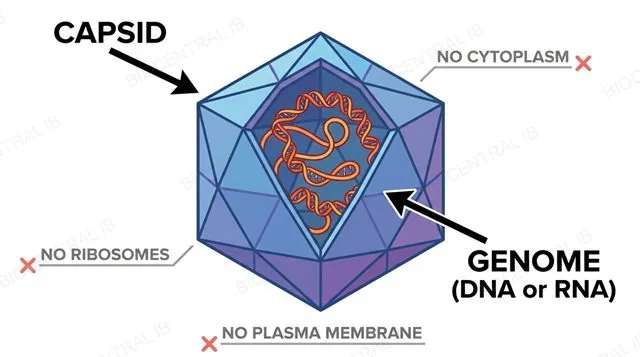
Labelled diagram of a generalised virus showing only a capsid and a genome, with no cytoplasm, ribosomes, or plasma membrane
A2.3.2

Genome and envelope diversity

Within that shared plan of capsid plus genome, viruses vary enormously in genome type and in whether they carry an envelope.
  • A virus carries either DNA or RNA, never both, and it may be single- or double-stranded, one molecule or several separate segments.
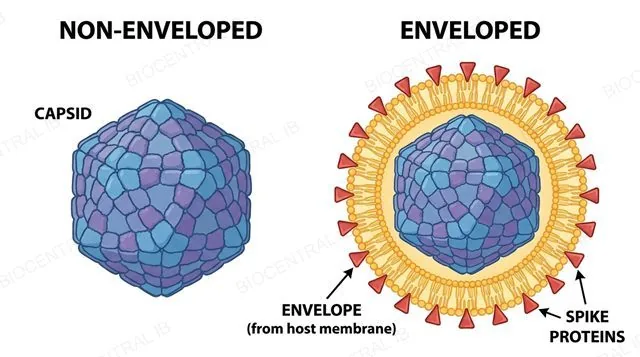
  • Some viruses — influenza, coronaviruses, HIV — are wrapped in an extra lipid envelope, a piece of host membrane picked up on leaving an earlier host cell, studded with viral spike proteins.
  • Others, such as bacteriophages and tobacco mosaic virus, have no envelope at all — just a bare capsid.
Why it mattersThe envelope is host-derived, not virus-made — one more sign of how much a virus depends on the cell it infects.
Comparison of a non-enveloped virus (bare capsid) and an enveloped virus with a lipid envelope and spike proteins
A2.3.2 continued

Shape, and a molecular lock and key

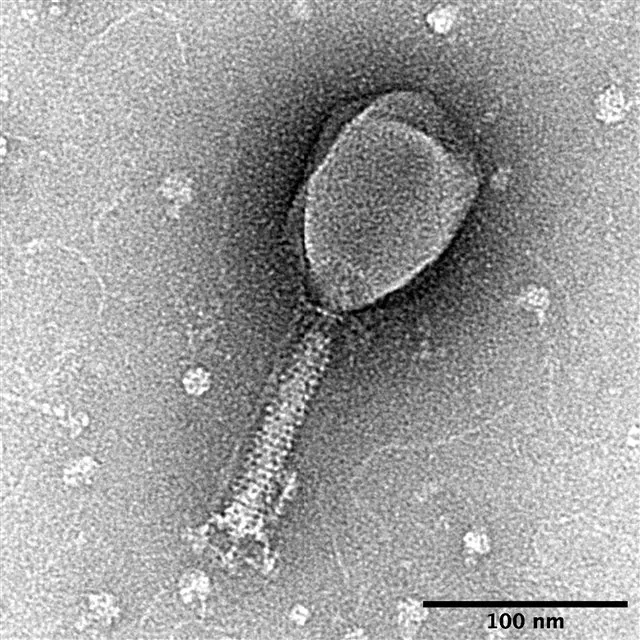
Capsid shape varies too: helical (tobacco mosaic virus, influenza), icosahedral — roughly spherical, many phages — or a complex head-and-tail structure typical of many bacteriophages, such as T2 and lambda.
  • A virus can only attach to and enter cells whose surface receptors fit its own attachment proteins — spikes, or tail fibres in a phage.
  • This molecular lock-and-key matching, not body size or any other factor, is what restricts a given virus to a particular range of host species and cell types.
Why it mattersHost specificity explains why a virus that infects bacteria cannot infect a human cell, and vice versa — the receptors simply don't match.
Transmission electron micrograph of bacteriophage T2, showing its head-and-tail structure with a 100 nm scale bar
SnaxMikn / Wikimedia, CC BY-SA 4.0
Quick check

A virus's spike proteins only fit receptors on certain host cells. What does this explain?

Why viruses are smaller than cells
A virus's host specificity
Why viruses have DNA or RNA but not both
Why some viruses have an envelope
Correct answer: host specificity. Attachment proteins — spikes, or tail fibres in a phage — must match a host cell's surface receptors like a lock and key. This molecular fit, not body size, restricts a virus to particular host species and cell types.
Part two

Two ways to replicate

A2.3.3 · A2.3.4
A2.3.3

The lytic cycle: five stages, one outcome

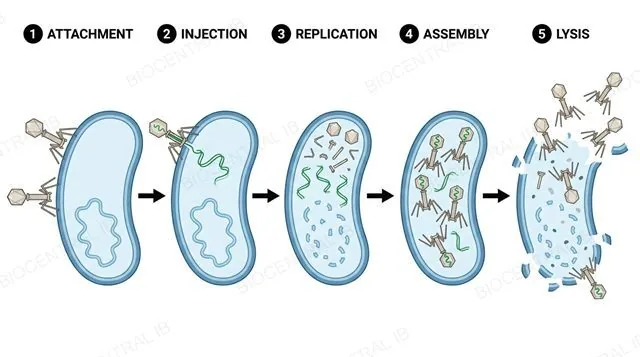
A bacteriophage ("phage") is a virus that infects bacteria; the syllabus example is bacteriophage lambda, which infects Escherichia coli.
  • In the lytic cycle it hijacks the host completely, in five stages:
    • Tail fibres attach to specific receptors on the bacterial surface
    • The phage injects its nucleic acid while the capsid stays outside
    • The host's own enzymes, nucleotides, ribosomes and amino acids are redirected to copy the viral genome and build capsid proteins
    • New capsids self-assemble around genome copies
    • The host cell lyses, releasing the new phages to infect further cells
Why it mattersThe phage supplies no energy, nutrition, or protein-synthesis machinery of its own — every one of those comes from the host.
Five labelled stages of the lytic cycle: attachment, injection, replication, assembly, and lysis
A2.3.4

The lysogenic cycle: a quieter route

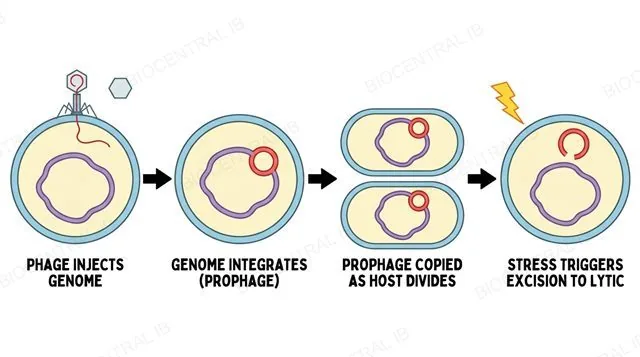
Instead of replicating immediately, an injected viral genome can integrate into the host chromosome, becoming a prophage — the lysogenic cycle.
  • In this state it produces no new virus particles at all.
  • Each time the host divides by binary fission, the prophage is copied along with the rest of its DNA — replicating passively, for many generations, at no cost to the virus.
  • Environmental stress that damages host DNA, such as UV radiation, can trigger the prophage to excise itself and switch into the lytic cycle.
Why it mattersHIV shows an analogous latency: its genome can integrate into a host T-cell's chromosome and stay transcriptionally silent for long periods before active replication resumes.
Four labelled stages of the lysogenic cycle: genome injection, integration as a prophage, passive copying as the host divides, and stress-triggered excision to the lytic cycle
Part three

Where viruses come from, and where they're going

A2.3.5 · A2.3.6
A2.3.5

Cells came first

Viruses could not have come first: they depend entirely on a host cell's ribosomes, enzymes and energy supply to replicate, so cells must have existed before the first viruses could evolve.
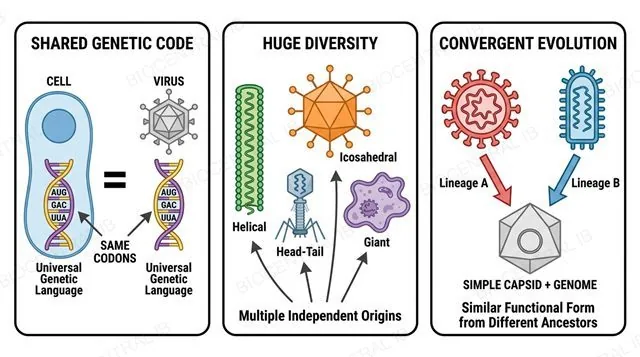
  • Three lines of evidence support this:
    • Viruses use essentially the same genetic code as living cells — expected if viral genomes were derived from cellular material, not arising independently.
    • Their huge structural diversity suggests they arose more than once, from different host organisms, rather than sharing one common ancestor.
    • Unrelated viral lineages all face the same narrow demands of obligate intracellular parasitism, so they've converged on the same basic solution — a capsid enclosing a genome.
Why it mattersThis last point is convergent evolution: similar problems producing similar solutions independently.
Three panels: shared genetic code between cells and viruses, huge diversity of virus shapes suggesting multiple origins, and convergent evolution toward the same capsid-plus-genome form
A2.3.5 continued

Two competing hypotheses

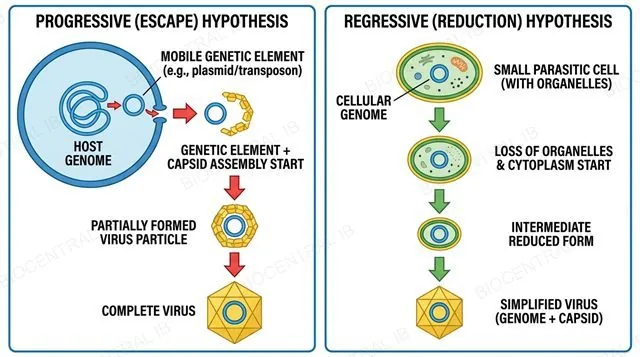
Two hypotheses attempt to explain how any individual viral lineage arose from cellular life, and both remain under active discussion.
  • The progressive (escape) hypothesis proposes viruses arose from small mobile genetic elements — plasmids or transposons — that escaped from cells and gradually acquired a protective capsid; some viral genes closely resemble host genes.
  • The regressive (reduction) hypothesis proposes viruses arose from small, free-living parasitic cells that progressively lost genes once fully dependent on a host, ending as a stripped-down genome plus capsid.
Why it mattersNeither hypothesis is settled — and different viral lineages may even have arisen by different routes.
Comparison of the progressive (escape) hypothesis and the regressive (reduction) hypothesis for the origin of viruses
A2.3.6

Drift and shift: two speeds of change

RNA viruses such as influenza and HIV evolve unusually fast because RNA replication is error-prone, lacking the proof-reading that DNA replication has.
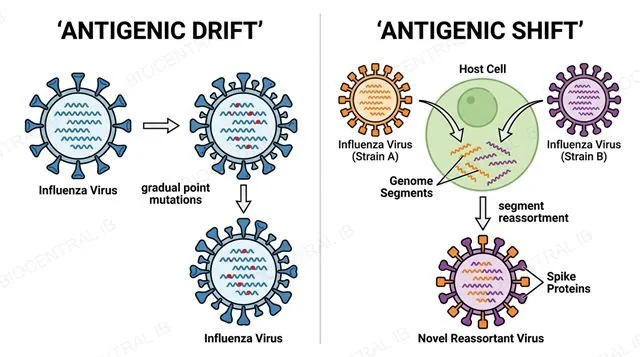
  • Antigenic drift is the gradual accumulation of small point mutations in a virus's surface proteins; each season, drift can make circulating strains different enough from the vaccine strain that some immunity is lost.
  • Antigenic shift is an abrupt, larger change: two strains infecting the same host cell swap whole genome segments — possible only because influenza's genome is segmented — producing a strain the population has never met.
Why it mattersShift, not drift, carries real pandemic potential — it can outrun existing immunity in one step rather than many.
Comparison of antigenic drift, gradual point mutations, and antigenic shift, an abrupt swap of whole genome segments between two co-infecting strains
A2.3.6 continued

Why HIV needs several drugs at once

Whatever the source of viral variation, any mutant that happens to resist a drug or escape existing immunity is favoured by natural selection and spreads.
  • New resistant variants appear constantly by chance, before any drug is even given — the drug doesn't cause the mutation, it selects for whichever variant already resists it.
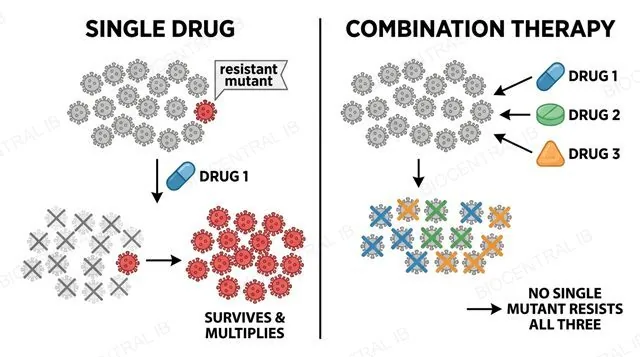
  • This is why HIV is treated with several drugs at once, combination therapy, rather than one: resistance to a single drug can otherwise evolve and spread quickly through the viral population within one host.
Why it mattersA mutant resistant to all drugs at once is vastly less likely to arise by chance than one resistant to just one.
Comparison of single-drug treatment, where a resistant mutant survives and multiplies, versus combination therapy, where no single mutant resists all drugs at once
Quick check

Why does combination drug therapy work better than a single drug against HIV?

It kills the virus faster
A mutant resistant to every drug at once is far less likely to arise by chance
It boosts the immune system directly
It slows down RNA replication errors
Correct answer: a mutant resistant to every drug at once is far rarer. It would need multiple independent resistance mutations simultaneously, which is far less likely than a single mutation resisting one drug. This is why combination therapy suppresses resistance far more effectively than any single drug.

Key vocabulary — viruses

HL only — worth being able to define in a single sentence each

Capsid
The protein coat, built from repeating subunits, that encloses a virus's genome.
Envelope
An extra lipid layer, derived from host membrane, surrounding the capsid in some viruses.
Bacteriophage
A virus that infects bacteria, often with a head-and-tail structure.
Lytic cycle
The pathway in which a virus immediately replicates inside the host and lyses it.
Lysogenic cycle
The pathway in which a viral genome integrates as a prophage, replicated passively.
Prophage
A viral genome integrated into, and replicated as part of, the host chromosome.
Antigenic drift
The gradual accumulation of point mutations in viral surface proteins over time.
Antigenic shift
An abrupt change in viral surface proteins from segment reassortment between two strains.

Where this shows up again

A1.2 · Nucleic acids
How does a virus that uses RNA as its genetic material differ from the DNA found in cellular organisms?
A2.2 · Cell structure
In what ways do viruses challenge the idea that all living organisms are made of cells?
C3.2 · Defence against disease
How does the body's immune system respond to and defend against viral infection?
A4.1 · Evolution and speciation / D4.1 · Natural selection
How does natural selection acting on mutations account for the rapid evolution of viruses such as influenza and HIV?

A2.3 Viruses — one-page recap

Screenshot this slide to revise from

What every virus has
  • Capsid + genome only — no cytoplasm, no ribosomes, no membrane.
  • Tiny, fixed size, below light-microscope resolution.
Diversity
  • DNA or RNA, never both; enveloped or not; helical, icosahedral, or head-tail.
  • Host specificity: attachment proteins must fit host receptors.
Lytic cycle
  • Attachment → injection → replication → assembly → lysis.
  • Ends with the host cell bursting, releasing new phages.
Lysogenic cycle
  • Genome integrates as a prophage, copied passively with the host.
  • Stress can trigger excision and a switch to lytic.
Origins
  • Cells came first; shared genetic code, diversity, and convergent evolution are the evidence.
  • Progressive (escape) vs regressive (reduction) hypotheses.
Rapid evolution
  • Drift = gradual point mutations; shift = abrupt segment reassortment.
  • Combination therapy resists chance mutation better than a single drug.

Small enough to borrow everything else.

Next: how the immune system fights back.
A2.3 Viruses · BioCentral IB
Use ↓ ↑ or click to navigate
01 / 20