BioCentral IBBioCentral IB
IB Biology · Theme A · A3.1

Diversity of Organisms

What makes a species — and why do genomes vary the way they do?
Guiding questions

What is a species?

What patterns are seen in the diversity of genomes within and between species?

Part one

What makes a species?

A3.1.1 – A3.1.5
A3.1.1

Variation is a defining feature of life

No two organisms — not even close relatives — are exactly alike, and variation follows recognisable patterns. The first is continuous variation.
  • Continuous variation produces a whole range of values with intermediates, usually shaped by many genes acting together plus environmental influence.
  • Human height is the standard example — a continuous spread from short to tall with no natural breaks, and no way to sort people into a small number of distinct height categories.
Why it mattersMany genes plus environment usually means continuous variation — the pattern a trait follows is often the first clue to how many genes control it.
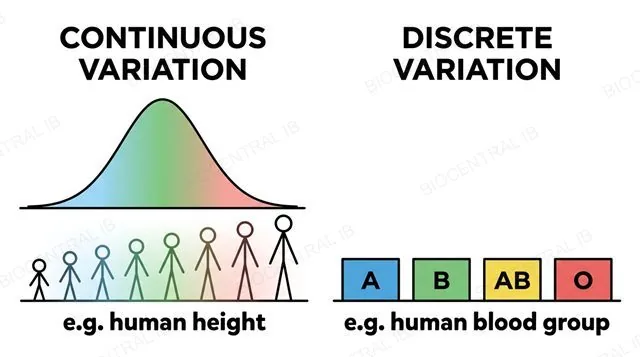
Diagram comparing continuous variation (human height, a bell curve) with discrete variation (human ABO blood group, four separate categories)
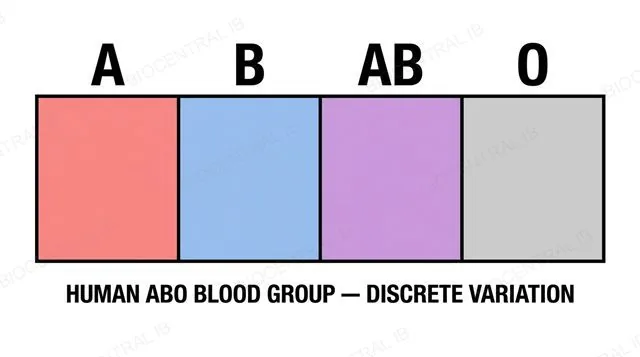
Diagram of discrete variation in human ABO blood group as four separate categories, A, B, AB and O, with no intermediates
A3.1.1

…and some traits fall into categories

The second recognisable pattern is discrete variation: a trait sorts cleanly into a small number of separate categories, with no intermediate values possible.
  • Discrete variation is usually controlled by one gene or a small number of genes, and is largely unaffected by environment.
  • Human ABO blood group is the standard example: every person is A, B, AB or O — never something in between, and never a continuous blend of two groups.
Why it mattersFew genes, sharp categories: discrete variation is usually the signature of one or two genes with a large effect, unlike continuous variation's many small contributors.
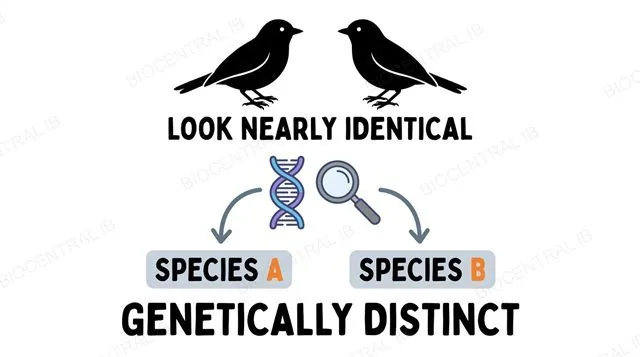
Two birds that look nearly identical but are labelled as genetically distinct species
A3.1.2

Grouping species by appearance

Before DNA sequencing existed, biologists needed a workable species definition based on what could actually be observed.
  • The morphological species concept groups organisms mainly by shared physical features — body shape, structures, appearance.
  • It's a practical, historically important starting point, and still useful for a first classification in the field today.
LimitationOrganisms that look near-identical can still be genetically distinct species — appearance alone isn't always a reliable guide to true relatedness.
A3.1.3

One name, recognised worldwide

Carl Linnaeus's binomial system gives every species one internationally recognised two-part scientific name.
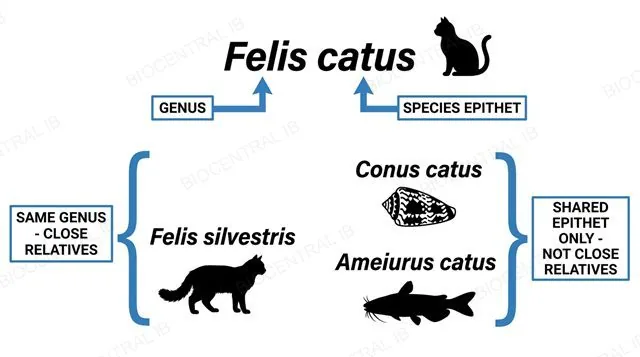
  • The first word is the genus (capitalised) and the second the species epithet (lower case) — e.g. Panthera leo, the lion, both conventionally italicised.
  • This avoids the confusion of different common names across languages and regions.
  • The genus itself carries real information: Felis catus (domestic cat) and Felis silvestris (wildcat) share a genus and are close relatives, while Conus catus (a cone snail) and Ameiurus catus (a catfish) merely share the epithet "catus" and aren't related at all.
Why it mattersA shared genus signals real relatedness — a shared species epithet alone does not.
Binomial nomenclature diagram: Felis catus and Felis silvestris share a genus and are close relatives; Conus catus and Ameiurus catus only share a species epithet and are not close relatives
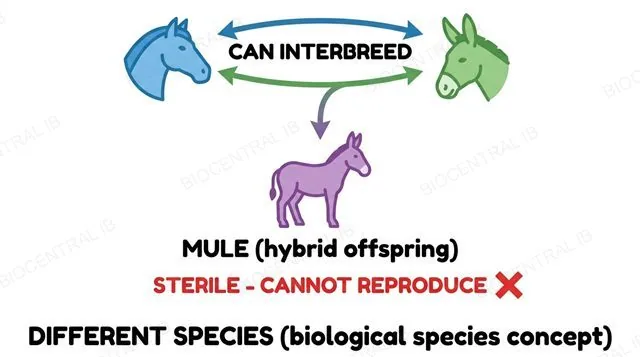
Diagram showing a horse and donkey can interbreed to produce a mule, which is sterile and cannot reproduce, so they count as different species under the biological species concept
A3.1.4

The biological species concept

A species is a group of organisms that can interbreed to produce fertile offspring — the biological species concept (BSC), biology's standard working definition.
  • Fertile is the operative word.
  • A horse and a donkey can mate and produce a mule — but the mule itself is sterile.
  • Because the offspring can't go on to reproduce, horses and donkeys count as separate species under the BSC, even though they can interbreed at all.
Why it mattersThe BSC is the most widely used working definition of species in biology, and the benchmark the next idea tests against.
A3.1.5

Where the boundary blurs

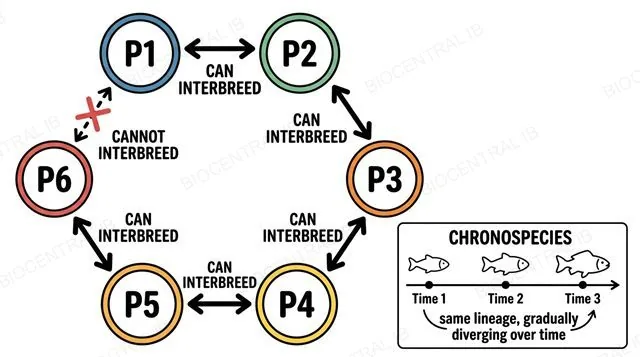
Speciation isn't instantaneous — populations diverge gradually, so there's often no single clean moment when one population becomes two species. A ring species shows this happening across geography.
  • A ring species is a chain of neighbouring populations looping around a geographic barrier; each population interbreeds successfully with its immediate neighbours all the way around — except where the ring closes, where the two end populations meet but can no longer interbreed.
  • There is no single point anywhere in the ring where a line can honestly be drawn between "same species" and "different species".
Ring species diagram showing populations P1 to P6 arranged in a loop, each interbreeding with its neighbours except where the ring closes, plus a chronospecies inset showing gradual change over time
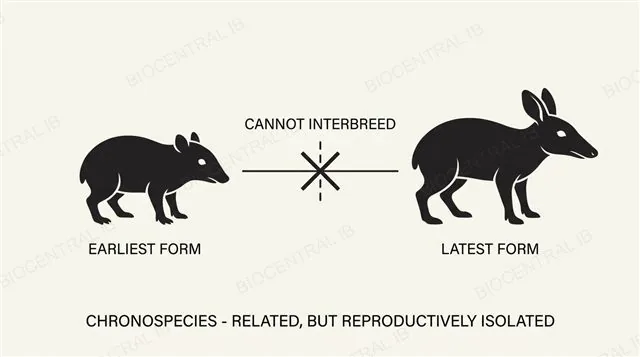
Two similar-looking related forms from one fossil lineage, earliest and latest, connected by a line marked with an X to show they could not have interbred
A3.1.5

Related, but reproductively isolated

A chronospecies is what the biological species concept (the BSC from the previous slides — the rule that a species can interbreed to produce fertile offspring) runs into when the same fuzzy boundary shows up along time instead of geography.
  • The earliest and latest members of one continuous fossil lineage are directly related — each descended from the last — yet they would almost certainly not have been able to produce fertile offspring together, had they ever coexisted.
  • The interbreeding test can never actually be applied across time — the two forms never coexist to be tested — so drawing a line between one named chronospecies and the next is unavoidably somewhat arbitrary.
Why it mattersRing species (space) and chronospecies (time) both show that close relatives don't always pass the interbreeding test — a real limitation of the biological species concept.
Quick check

A horse and a donkey can mate, and their mule offspring is healthy and strong. Under the biological species concept, are horses and donkeys the same species?

Yes — they can mate successfully
No — the mule is sterile, so no gene flow continues between them
Yes — mules can eventually reproduce with each other
It depends which parent is the mother
Correct answer: No, separate species. The BSC requires fertile offspring, not just successful mating — a sterile hybrid means no gene flow crosses the species boundary.
Part two

Chromosomes and genomes

A3.1.6 – A3.1.11
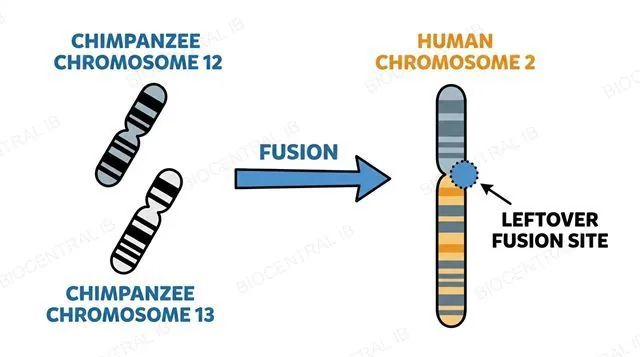
Diagram showing chimpanzee chromosomes 12 and 13 fused end to end to form human chromosome 2, with the leftover fusion site labelled
A3.1.6

Chromosome numbers differ by species

Different species characteristically carry different numbers of chromosomes — humans have 46, while chimpanzees have 48.
  • The diploid number is normally even, since chromosomes occur in homologous pairs, one from each parent.
  • Human chromosome 2 provides strong evidence for shared ancestry with other great apes: its banding pattern matches, end to end, two separate smaller chromosomes found in chimpanzees, gorillas and orangutans (labelled 12 and 13 in the ancestral numbering).
  • The best explanation is an ancient fusion event — those two ancestral chromosomes joined together in the human lineage, cutting the count from 48 to 46 without losing any genetic material.
A3.1.7

Reading a karyogram

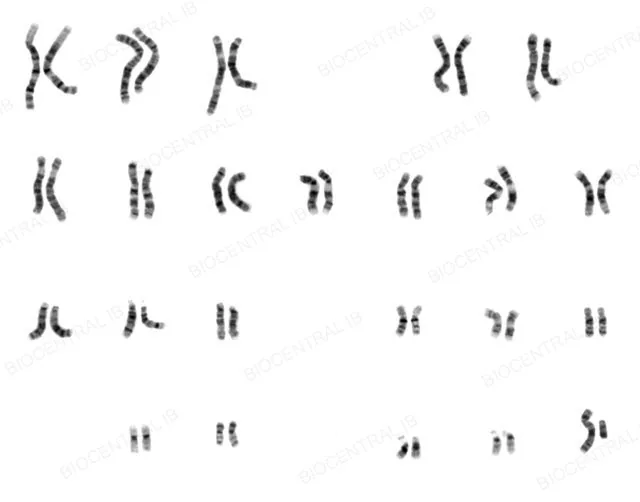
A karyotype is a cell's full chromosome complement; a karyogram is the image made by photographing, cutting out and pairing those chromosomes.
  • Chromosomes are conventionally ordered by three criteria:
    • Size (largest first)
    • Centromere position
    • Banding pattern
  • A karyogram also reveals biological sex directly: two X chromosomes for a female, one X and one Y for a male.
  • This is also how the chromosome 2 fusion hypothesis gets tested: a fused chromosome should show both original banding patterns joined end to end, with a leftover fusion site and often a second, non-functional centromere — exactly what human chromosome 2 shows.
Nature of scienceThis makes the fusion hypothesis genuinely testable — it predicts an exact banding and centromere pattern that karyogram evidence can confirm or refute.
Photograph of an unsorted human male metaphase chromosome spread
Real chromosome spread
Courtesy: NHGRI
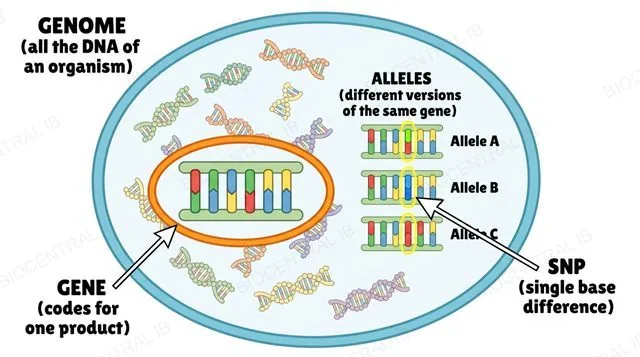
Diagram of a cell nucleus showing genome, gene, allele and SNP nested at increasing levels of detail
A3.1.8

Gene, allele, genome

Members of the same species share, overwhelmingly, the same genes — individual diversity comes from different alleles of those genes.
  • Worth keeping distinct:
    • Gene — a length of DNA that codes for a specific product
    • Allele — one particular version of a gene
    • Genome — an organism's entire DNA complement
  • Most of the genetic difference between two individuals of the same species is single-nucleotide polymorphisms (SNPs) — single-base differences scattered through the genome — rather than differences in which genes are present at all.
A3.1.9

The C-value paradox

Eukaryote genomes vary along two separate axes: overall size (total DNA) and base sequence (nucleotide order).
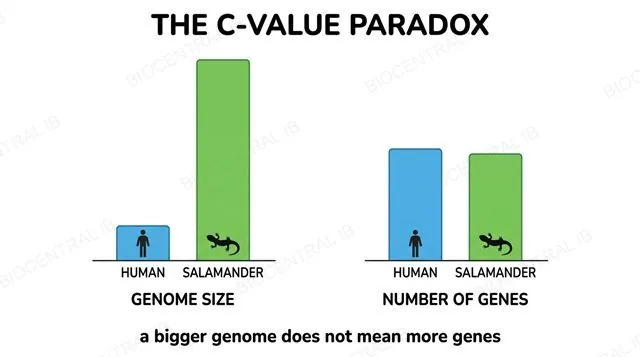
  • Genome size and gene number are only loosely related.
  • Some salamanders have genomes many times larger than the human genome without carrying proportionally more genes; the explanation is that much of a large genome is non-coding DNA — introns, repeats and regulatory regions that don't code for protein.
  • Sequence variation between species is also far larger than variation within a species, where members are typically distinguished only by SNPs.
Bar chart comparing genome size and number of genes between a human and a salamander: the salamander genome is much larger, but gene number is similar
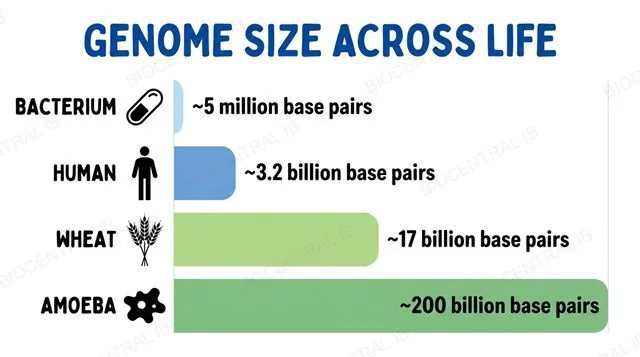
Bar chart comparing genome sizes in base pairs across bacterium, human, wheat and amoeba
A3.1.10

Comparing genome sizes

Genome size is compared as a number of base pairs, usually quoted in millions (Mb) or billions (Gb).
  • The human genome is about 3.2 billion base pairs — roughly 3200 Mb.
  • Genome sizes vary enormously across eukaryotes: some plant and amphibian genomes are many times larger, for the same non-coding-DNA reasons behind the C-value paradox.
~3.2 Gbhuman   ~17 Gbwheat   ~200 Gbamoeba
A3.1.11

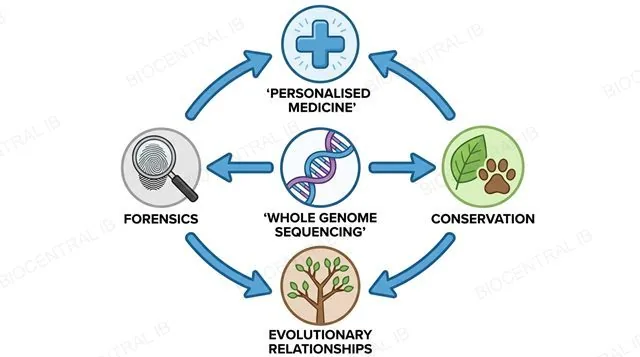
Uses of whole genome sequencing

Whole genome sequencing determines an organism's complete DNA base sequence, letting genomes be compared directly across species or individuals.
  • The more similar two genomes' sequences are, the more recently those organisms are inferred to share a common ancestor — a powerful tool for estimating evolutionary relatedness.
ApplicationsPersonalised medicine (spotting disease-linked variants), conservation (measuring genetic diversity in an endangered population), agriculture and forensic identification.
Diagram showing whole genome sequencing used for personalised medicine, whole genome sequencing, conservation and evolutionary relationships, arranged around a central icon

Key vocabulary — species and genomes

Worth being able to define in a single sentence each

Species
Under the biological species concept, a group able to interbreed and produce fertile offspring.
Binomial name
A two-part scientific name (genus + species epithet) unique to one species.
Karyotype / karyogram
A cell's chromosome complement / the ordered image of its chromosomes.
Gene / allele / genome
A DNA sequence coding for a product / one version of a gene / an organism's entire DNA.
SNP
Single-nucleotide polymorphism — a one-base difference in DNA sequence between individuals.
Non-coding DNA
DNA that doesn't code for protein, including introns and repeated sequences.
Part three · HL only

Species boundaries and modern tools

A3.1.12 – A3.1.15
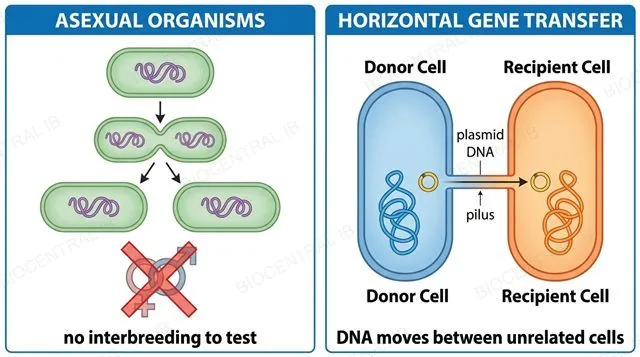
Two-panel diagram: asexual organisms have no interbreeding to test, and horizontal gene transfer moves DNA between unrelated bacterial cells
A3.1.12 · HL

When the BSC breaks down

  • The BSC is built entirely around interbreeding — which breaks down immediately for organisms that don't reproduce sexually at all.
  • Asexually reproducing organisms (many bacteria, some plants and invertebrates) produce offspring without mating, so there's no interbreeding test to apply.
  • Species boundaries in these groups have to be drawn on other grounds instead, such as morphological or genetic similarity.
A3.1.12 · HL

Bacteria break the rule twice over

Bacteria present a further complication on top of asexual reproduction: genes don't only pass from parent to offspring.
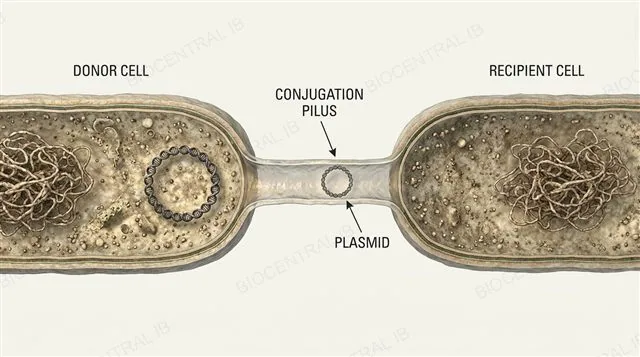
  • Horizontal gene transfer moves DNA directly between bacterial cells that aren't parent and offspring — even between quite distantly related bacteria.
  • This blurs the clean genetic lineages that species boundaries usually rely on, since a bacterium's genome can be a patchwork acquired from multiple sources rather than inherited along one line of descent.
Why it mattersBetween no interbreeding test and genes moving sideways across lineages, bacterial "species" end up defined by convention — shared traits and genome similarity — rather than by the BSC.
Diagram of horizontal gene transfer: a plasmid moving through a conjugation pilus from a donor bacterial cell to a recipient bacterial cell
A3.1.13 · HL

Chromosome number as a species trait

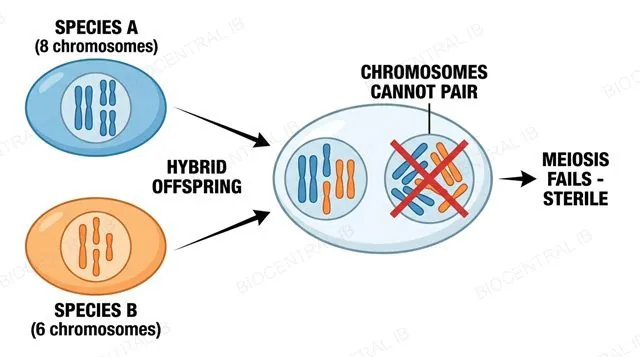
  • Diploid chromosome number is normally constant across a species, and this connects directly to the BSC's fertile-offspring test: cross-breeding between closely related species is unlikely to produce fertile offspring if their chromosome numbers differ.
  • During meiosis, homologous chromosomes must pair up — if a hybrid inherits mismatched chromosome sets, pairing fails, meiosis can't produce viable gametes, and the hybrid is sterile, the same underlying reason the horse × donkey mule can't reproduce.
  • This makes a consistent chromosome-number difference a useful extra trait: two similar-looking organisms that consistently differ in diploid number are very likely separate species.
Diagram showing species A with 8 chromosomes and species B with 6 chromosomes producing hybrid offspring whose chromosomes cannot pair, so meiosis fails and the hybrid is sterile
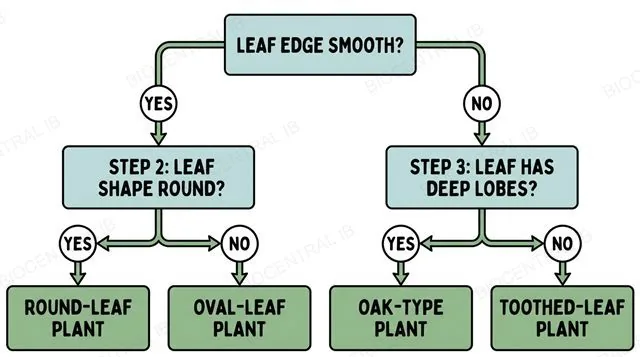
Dichotomous key flowchart for identifying leaves using three two-choice decision steps
A3.1.14 · HL

Building a dichotomous key

  • A dichotomous key identifies an unknown organism through a series of steps, each offering exactly two contrasting choices ("di-chotomous") based on an observable feature.
  • Each choice leads either to another pair of choices or to a named organism, progressively narrowing the possibilities until one identification remains.
  • Building a real one means choosing features that are easy to observe reliably and that actually split the group roughly in two at each step — a key where nineteen species go one way and one goes the other is technically dichotomous but not very useful.
A3.1.15 · HL

Species detection from environmental DNA

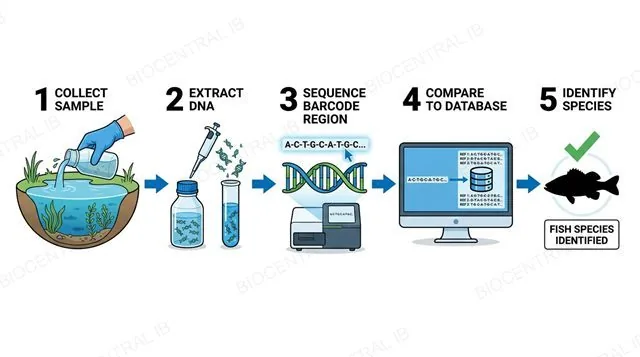
Environmental DNA (eDNA) is genetic material shed by organisms into their surroundings, recoverable directly from soil, water or air without ever seeing the organism itself.
  • DNA barcoding compares a short, standardised region of that recovered DNA against a reference database of known sequences to identify which species are present in a sample.
Why it mattersMakes it possible to detect rare, elusive or cryptic species — and survey whole communities at once — far more easily than direct observation, a fast-growing tool in ecological monitoring.
Five-step diagram of environmental DNA barcoding: collect sample, extract DNA, sequence barcode region, compare to database, identify species

Key vocabulary — HL

Worth being able to define in a single sentence each

Horizontal gene transfer
Movement of DNA directly between cells that aren't parent and offspring, common in bacteria.
Dichotomous key
An identification tool built from a series of two-choice steps based on observable features.
Environmental DNA (eDNA)
Genetic material shed into the environment and recoverable without capturing the organism.
DNA barcoding
Comparing a short standardised DNA region against a reference database to identify species.
Quick check · HL

Two bacterial species swap genes directly through horizontal gene transfer rather than through reproduction. Why does this make the biological species concept hard to apply to bacteria?

Bacteria don't have DNA
It blurs the clean genetic lineages species boundaries rely on, and bacteria don't interbreed to test anyway
Bacteria can only reproduce sexually
The BSC only applies to plants
Correct answer: it blurs lineages and removes the interbreeding test. The BSC is built around interbreeding to produce fertile offspring — asexual bacteria never do this, and horizontal gene transfer moves DNA between unrelated cells, so species boundaries have to be drawn on other grounds.

Where this shows up again

A3.2 · Classification and cladistics
How are individual species grouped into larger categories such as genus, family and higher taxa?
A4.1 / D1.3 · Evolution and speciation / Mutation and gene editing
How does variation within a species provide the raw material for natural selection and the formation of new species?
D1.3 / A1.2 · Mutation and gene editing / Nucleic acids
What is the molecular origin of the mutations that create variation between and within species?
A1.2 / A3.2 · Nucleic acids / Classification and cladistics
How does comparing DNA base sequences help resolve cases where the biological species concept is hard to apply?

A3.1 Diversity of Organisms — one-page recap

Screenshot this slide to revise from

Species concepts
  • Morphological: grouped by appearance — look-alikes can still differ genetically.
  • Biological (BSC): interbreed to produce fertile offspring — horse × donkey mule is sterile.
Fuzzy boundaries
  • Ring species: every neighbour interbreeds except where the ring closes.
  • Chronospecies: fossil lineage split into species is unavoidably arbitrary.
Chromosomes
  • Number varies by species: human 46, chimp 48, always even.
  • Human chr 2 = ancestral ape chromosomes 12 + 13, fused.
Genomes
  • Gene / allele / genome / SNP — one product, one version, all DNA, one-base difference.
  • C-value paradox: genome size and gene number are only loosely related.
HL · Species boundaries
  • Asexual organisms: no interbreeding, so no BSC test.
  • Bacteria: horizontal gene transfer blurs lineages further.
HL · Modern tools
  • Chromosome number as extra evidence for a species split.
  • Dichotomous keys and eDNA barcoding identify species by feature or by trace DNA.

A species isn't a fixed box — it's wherever fertile gene flow actually stops.

Next: how do we group species themselves into genus, family, and the rest of the tree of life?
A3.1 Diversity of Organisms · BioCentral IB
Use ↓ ↑ or click to navigate
01 / 20