BioCentral IBBioCentral IB
IB Biology · Theme A · A3.2 · HL only

Classification and cladistics

Grouping life by its evolutionary history
Guiding questions

What tools are used to classify organisms into taxonomic groups?

How do cladistic methods differ from traditional taxonomic methods?

Part one

Why and how we classify

A3.2.1 – A3.2.3
A3.2.1

Why we need to classify

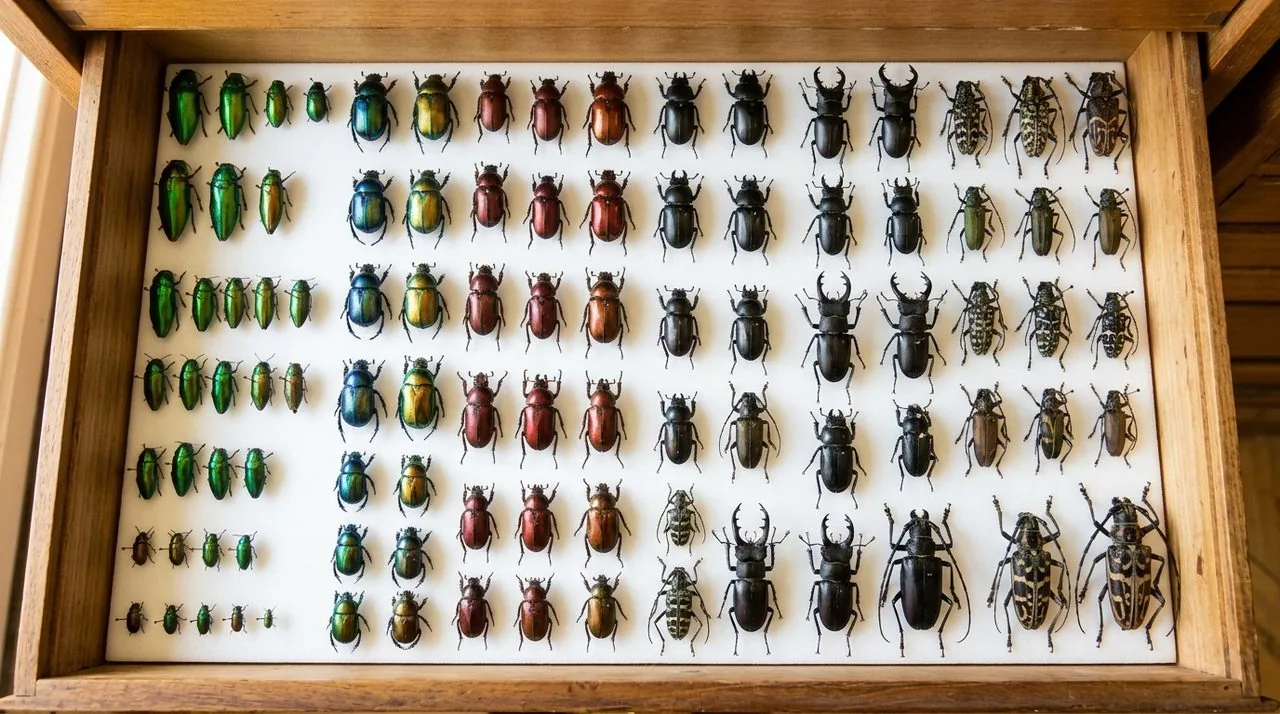
Classification is needed because of the immense diversity of species.
  • About 2.2 million species have been described, and there may be around 8.7 million species of eukaryotes alone.
  • Classification gives every group a place and a name, so organisms can be identified and compared.
  • Once organisms are classified, a broad range of further study is easier: ecology, conservation, medicine and evolution.
Why it mattersWithout an agreed system, what is known about one organism could not be found or compared with what is known about others.
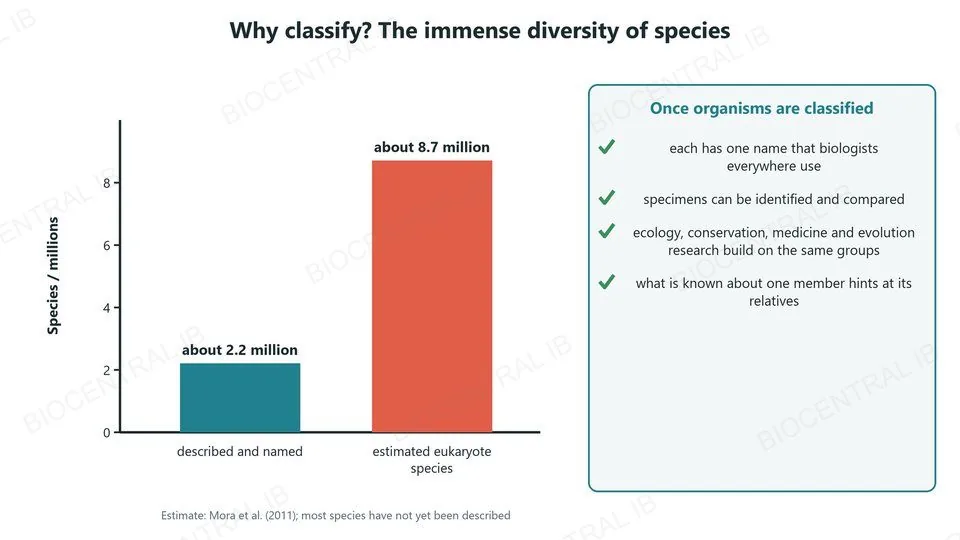
A bar chart: about 2.2 million species have been described and named, but there may be about 8.7 million species of eukaryotes. A panel lists what classification makes possible: one name used everywhere, identification and comparison, research built on the same groups, and predictions about relatives
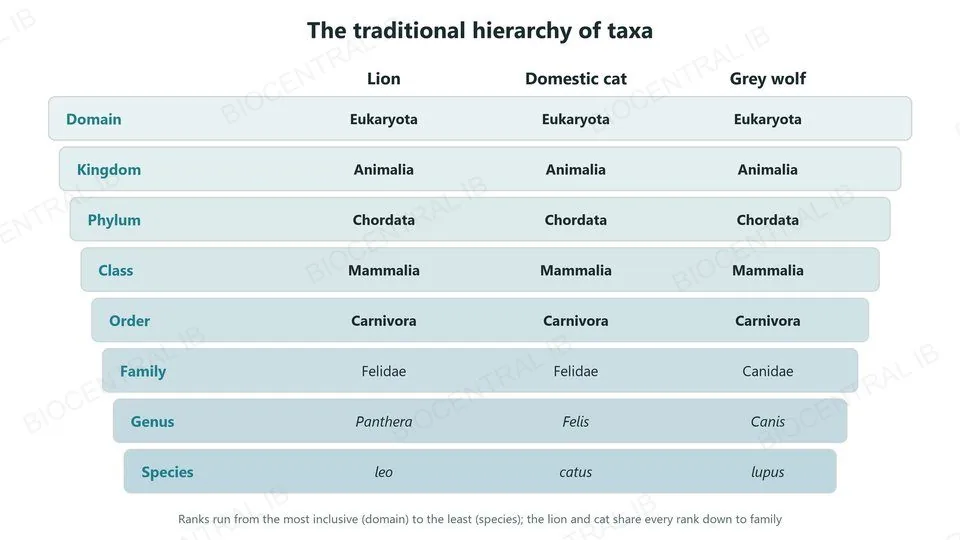
A table of the traditional hierarchy for the lion, domestic cat and grey wolf: domain Eukaryota, kingdom Animalia, phylum Chordata, class Mammalia and order Carnivora for all three; family Felidae for the lion and cat but Canidae for the wolf; genera Panthera, Felis and Canis; species leo, catus and lupus
A3.2.2

The traditional hierarchy

Traditionally, organisms are placed in a hierarchy of taxa: kingdom, phylum, class, order, family, genus and species, with domain now added above kingdom.
  • Each taxon is nested inside the one above: a genus contains related species, a family related genera, and so on.
  • The lion and the domestic cat share every rank down to family; the wolf differs from them at family level.
Why it mattersThe more ranks two species share, the more closely related they were thought to be.
A3.2.2

Where the hierarchy breaks down

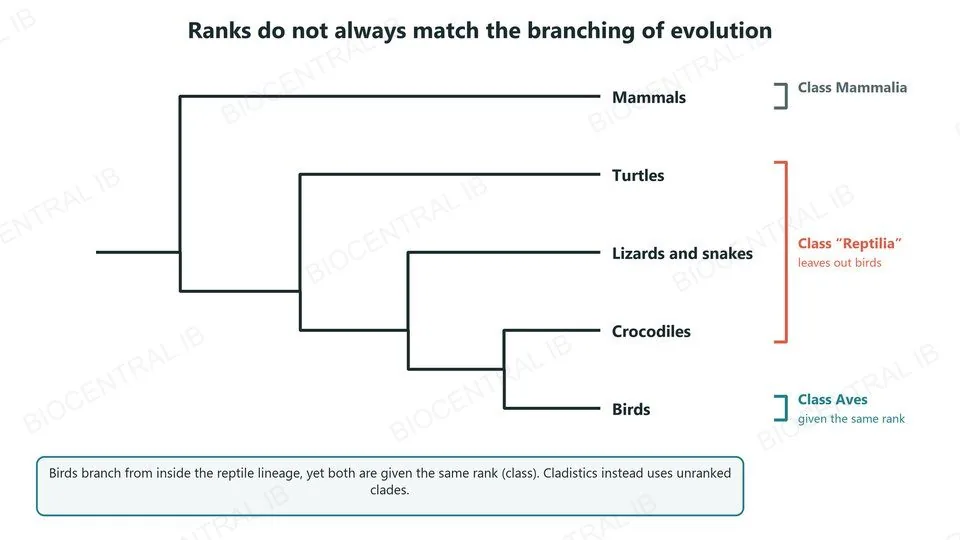
The traditional hierarchy does not always correspond to the patterns of divergence produced by evolution.
  • Birds evolved from within the reptile lineage, yet birds (Aves) and reptiles (Reptilia) are both given the rank of class.
  • Nothing defines how different two groups must be to count as separate orders or classes, so ranks are partly arbitrary.
  • Cladistics offers an alternative: classification using unranked clades.
Nature of scienceA fixed ranking of taxa does not reflect the gradation of variation. Moving to unranked clades is an example of a paradigm shift.
A cladogram of mammals, turtles, lizards and snakes, crocodiles and birds. Birds branch from within the reptile lineage, next to crocodiles, yet traditional classification calls the reptiles one class and gives the birds a class of their own, the same rank
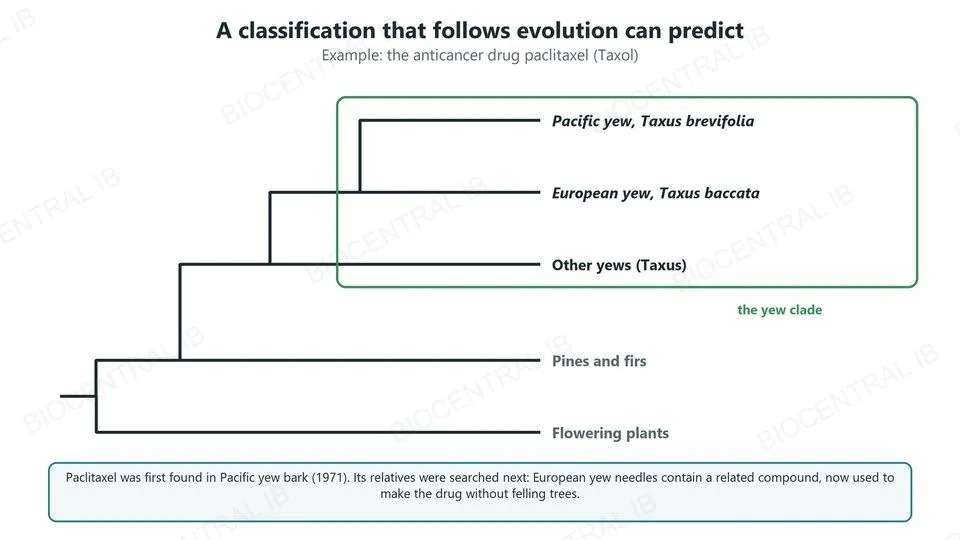
A cladogram with the yew clade boxed: Pacific yew Taxus brevifolia, European yew Taxus baccata and other yews, beside pines and firs and flowering plants. Paclitaxel was found first in Pacific yew bark; European yew needles contain a related compound now used to make the drug
A3.2.3

Classifying by evolution

The ideal classification follows evolutionary relationships, so all the members of a group have evolved from a common ancestor.
  • The characteristics of organisms in such a group can be predicted, because they are shared within the clade.
  • After the anticancer drug paclitaxel was found in Pacific yew bark, related yews were searched: European yew needles contain a related compound, now used to make the drug.
Why it mattersPredictions like this make a classification based on evolution far more useful than one based on appearance or use.
Quick check

Bats, birds and butterflies can all fly. Why would “flying animals” be a poor group in a classification?

It would contain too few species to be useful
Flight evolved separately, so the group has no single common ancestor
Flying animals cannot be given binomial names
It would need DNA evidence, which is not available
Correct answer: flight evolved separately. Bats, birds and insects gained flight independently (convergent evolution), so “flying animals” is not a clade and predicts little else about its members.
Part two

Clades and cladograms

A3.2.4 – A3.2.7
A3.2.4

Clades: shared ancestry

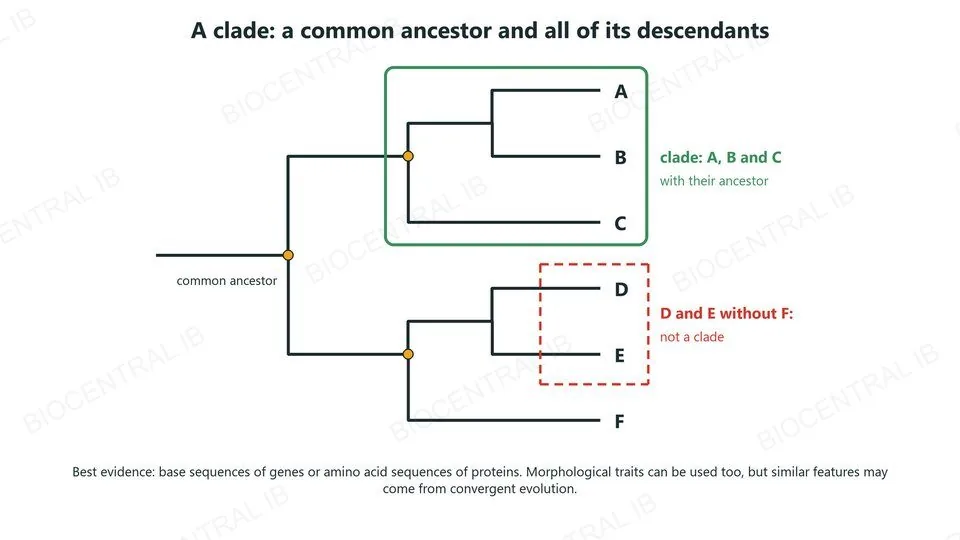
A clade is a group of organisms with a common ancestor and all of its descendants, sharing characteristics inherited from that ancestor.
  • The most objective evidence for placing organisms in the same clade comes from base sequences of genes or amino acid sequences of proteins.
  • Morphological traits can also be used, such as the pentadactyl limb shared by tetrapods.
  • But similar structures can evolve separately by convergent evolution, like the wings of birds and insects, so only traits inherited from a common ancestor count.
Why it mattersSequences can compare organisms that share few visible features, and are less easily misled by convergence.
A cladogram of six species, A to F. A green box encloses A, B and C with their common ancestor: a clade. A dashed red box around D and E but not F is not a clade. A note says the best evidence comes from base or amino acid sequences; morphological traits can be used but similar features may come from convergent evolution
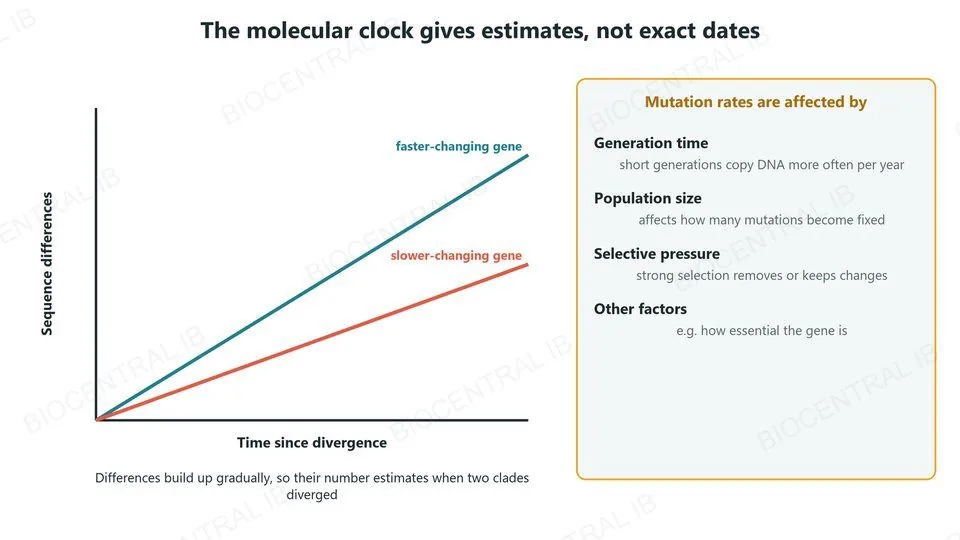
A graph of sequence differences against time since divergence: a faster-changing gene gives a steeper straight line than a slower-changing gene. A panel lists what affects mutation rates: generation time, population size, selective pressure and other factors such as how essential the gene is
A3.2.5

The molecular clock

Sequence differences accumulate gradually, so their number can be used to estimate when two clades diverged from a common ancestor.
  • The rate is calibrated using a split dated by fossils, then differences are converted into time.
  • A protein gaining 3 differences per million years, with 30 differences between two species, suggests a split about 10 million years ago.
  • It only gives estimates: mutation rates are affected by generation time, population size, the intensity of selective pressure and other factors.
LimitationDifferent genes, and different lineages, change at different rates.
A3.2.6

Building cladograms from sequences

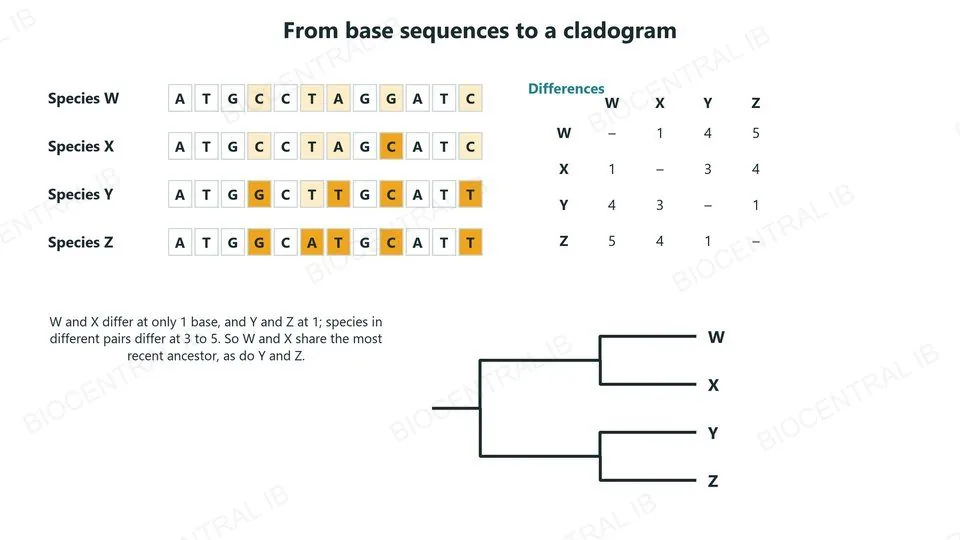
Base sequences of genes or amino acid sequences of proteins are compared to construct cladograms.
  • Line up the same gene from each species and count the differences between every pair.
  • The species with the fewest differences are joined first: they share the most recent common ancestor.
  • Simple sample data like this shows the idea; real studies compare many genes using computer programs.
Why it mattersSequences provide many characters that can be counted objectively.
The same 12-base sequence in species W, X, Y and Z with differing bases highlighted; a table of differences: W and X differ at 1 base, Y and Z at 1, and species in different pairs at 3 to 5; and the resulting cladogram joining W with X and Y with Z
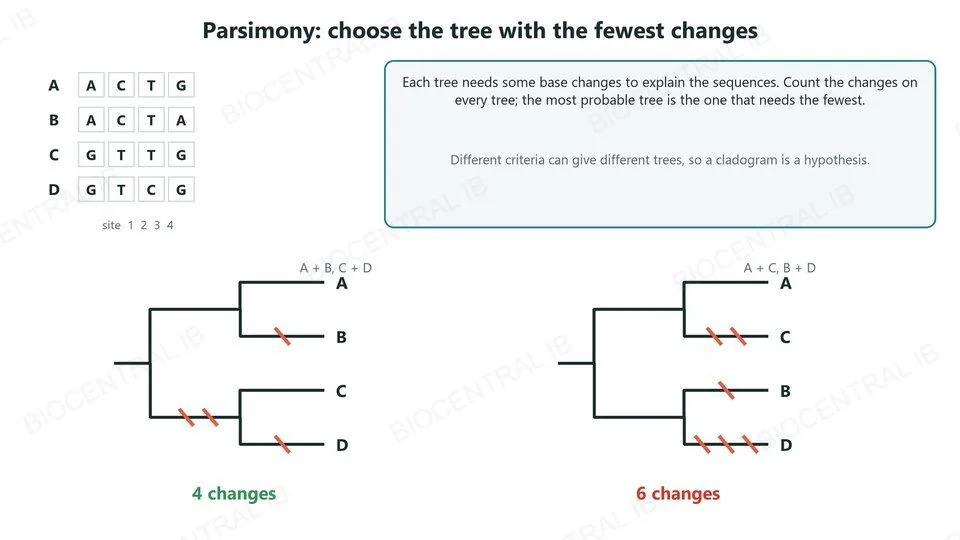
Four species, A to D, with four sites. Two possible trees: grouping A with B and C with D needs 4 base changes, marked on the branches; grouping A with C and B with D needs 6. The tree needing fewer changes is preferred
A3.2.6

Choosing a tree: parsimony

Parsimony analysis selects the most probable cladogram: the one that explains the observed sequence variation with the smallest number of sequence changes.
  • For four species there are three possible trees; count the changes each one needs.
  • Here, grouping A with B and C with D needs 4 changes, while the alternatives need 6, so the first tree is chosen.
Nature of scienceDifferent criteria for judgement can lead to different hypotheses: other methods can favour a different tree.
A3.2.7

Analysing cladograms

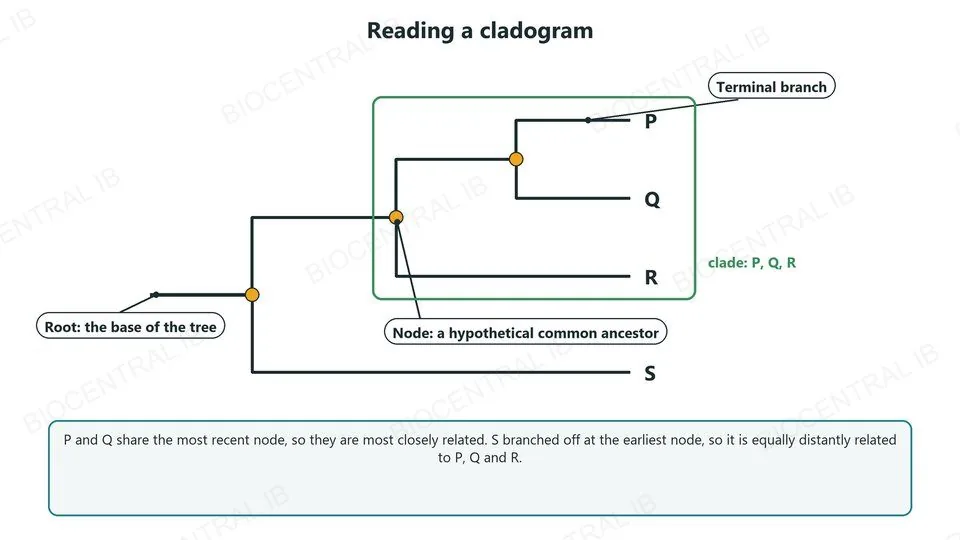
A cladogram is a branching diagram showing the probable sequence of divergence of a group of organisms.
  • The root is the base of the tree; each node, where a lineage splits, represents a hypothetical common ancestor.
  • A terminal branch leads to one group at a tip.
  • Groups sharing a more recent node are more closely related. A node with everything that descends from it is a clade.
Read it rightRelatedness comes from where branches join, not from how close the tips are drawn.
A cladogram of P, Q, R and S labelled with the root at its base, nodes as hypothetical common ancestors and a terminal branch leading to P. A box shows the clade P, Q and R. P and Q share the most recent node; S branched off at the earliest node
Quick check

In a cladogram, P and Q join at the most recent node, R joins them at an earlier node, and S branches off first. Which statement is correct?

S is the species most closely related to P
P and Q share a more recent ancestor than P and R do
R and S together form a clade
P evolved from Q
Correct answer: P and Q share the more recent ancestor. Relatedness is read from where lineages join. R and S do not form a clade without P and Q, and no species at a tip is the ancestor of another.
Part three

Testing and changing classifications

A3.2.8 · A3.2.9
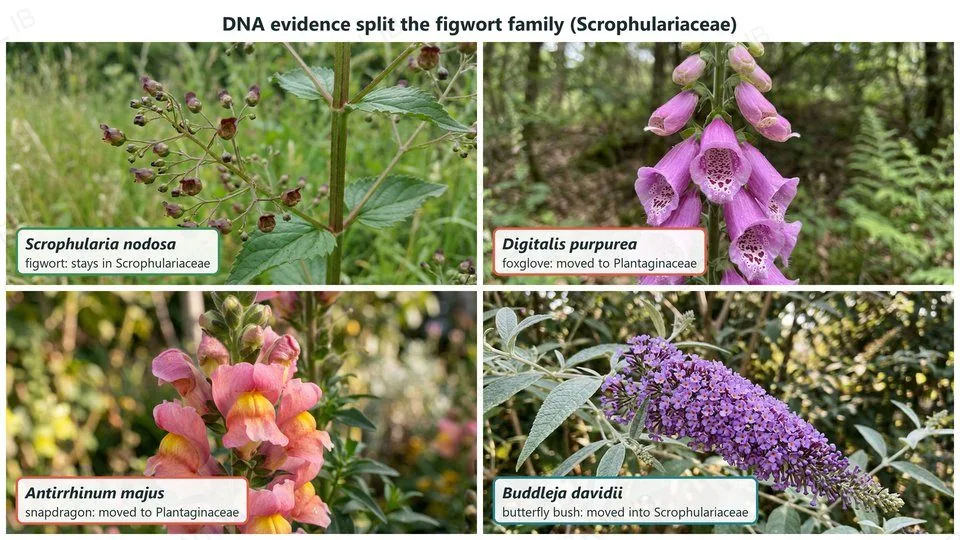
Four photographs: common figwort, Scrophularia nodosa, which stays in the figwort family; foxglove, Digitalis purpurea, and snapdragon, Antirrhinum majus, both moved to the plantain family, Plantaginaceae; and butterfly bush, Buddleja davidii, moved into the figwort family
A3.2.8

Reclassifying the figwort family

Cladistics can test whether a traditional group corresponds to a clade.
  • The figwort family, Scrophulariaceae, was defined by its flower structure.
  • DNA sequences showed it was not a single clade: similar flowers had arisen by convergent evolution, not common ancestry.
  • Foxgloves, snapdragons and speedwells moved to the plantain family; other genera went to other families; butterfly bushes moved in.
Nature of scienceKnowledge claims may eventually be falsified: a classification based on morphology was shown by cladistics to be false.
A3.2.9

Three domains

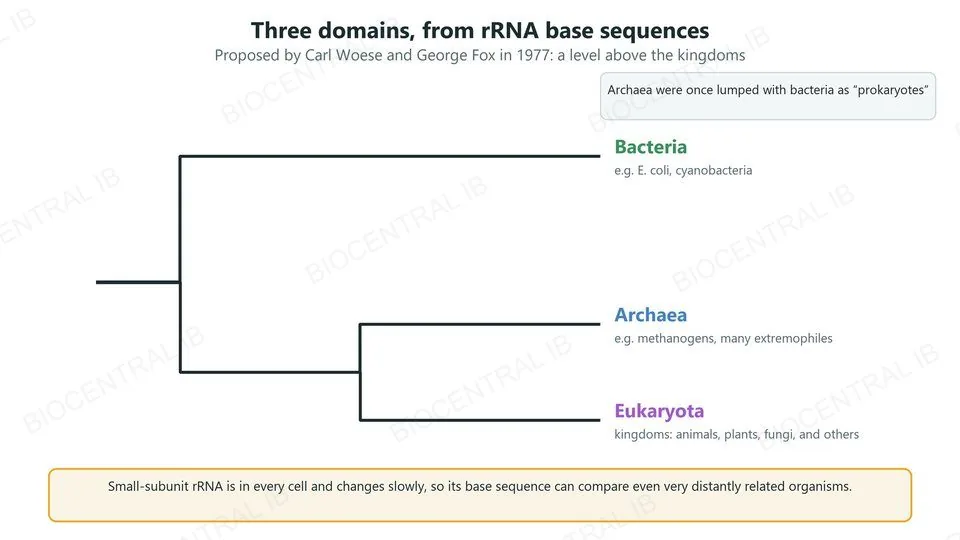
All organisms are classified into three domains, Bacteria, Archaea and Eukaryota, using evidence from rRNA base sequences.
  • In 1977 Carl Woese and George Fox compared ribosomal RNA from many organisms.
  • The “prokaryotes” fell into two groups, as different from each other as each is from eukaryotes.
  • This revolutionary reclassification added a new level above the kingdoms.
Why rRNA?Every cell has ribosomes, and rRNA changes slowly, so it can compare even very distantly related organisms.
A tree of the three domains from rRNA base sequences: Bacteria on one branch, and a branch that splits into Archaea and Eukaryota. Archaea were once grouped with bacteria as prokaryotes. Proposed by Woese and Fox in 1977 as a level above the kingdoms

Key vocabulary

Worth being able to define in a single sentence each

Taxon
a group in a classification, such as a family or genus.
Clade
a common ancestor and all of its descendants.
Cladogram
a branching diagram of the probable sequence of divergence.
Node
a branch point: a hypothetical common ancestor.
Molecular clock
estimating divergence times from accumulated sequence differences.
Parsimony
choosing the tree that needs the fewest sequence changes.
Convergent evolution
similar features evolving separately in unrelated groups.
Domain
the highest level: Bacteria, Archaea or Eukaryota.

Where this shows up again

A1.2 / D1.3 · Nucleic acids / Mutation
How do differences in DNA base sequences, used to build cladograms, arise in the first place?
A4.1 · Evolution and speciation
How does classification based on cladistics provide evidence for evolution by natural selection?
A3.1 · Diversity of organisms
How does the biological definition of a species relate to placing organisms into a genus and higher taxa?
A2.2 / A4.1 · Cell structure / Evolution
How does the shared structure of ribosomes and rRNA across all cells support the three-domain classification?

A3.2 Classification and cladistics — one-page recap

Screenshot this slide to revise from

Why classify
  • Immense diversity of species.
  • Classification makes further study possible.
The hierarchy
  • Kingdom → phylum → class → order → family → genus → species.
  • Ranks are arbitrary and do not always match evolution.
Clades
  • Ancestor plus all descendants; traits predictable.
  • Best evidence: base or amino acid sequences.
Molecular clock
  • Differences build up gradually → divergence times.
  • Estimates only: rates vary with generation time, population size, selection.
Cladograms
  • Root, node (hypothetical ancestor), terminal branch.
  • Parsimony: the tree with fewest changes.
Reclassification
  • Figwort family split: convergent flowers, not one clade.
  • Three domains from rRNA (Woese and Fox, 1977).
Next step

Now test yourself on A3.2

Reading the slides is half the job. The other half is answering questions the way the exam asks them.

28 quiz questions9 data questions4 exam questionsmarkschemes included

Unlock every lesson with Pro — quizzes, data questions and exam papers. Two lessons are completely free to try: A1.1 Water and B1.1 Carbohydrates and lipids.

One-page summary, key terms and sample questions for A3.2 →

Group by ancestry, not by appearance.

Next: how the evidence for evolution, and the process of speciation, fit together.
A3.2 Classification and cladistics · BioCentral IB
Use ↓ ↑ or click to navigate
01 / 20