BioCentral IBBioCentral IB
IB Biology · Theme A · A4.1 · SL and HL

Evolution and speciation

The evidence for evolution, and how one species becomes two
Guiding questions

What is the evidence for evolution?

How do analogous and homologous structures exemplify commonality and diversity?

Part one

The evidence for evolution

A4.1.1 – A4.1.5
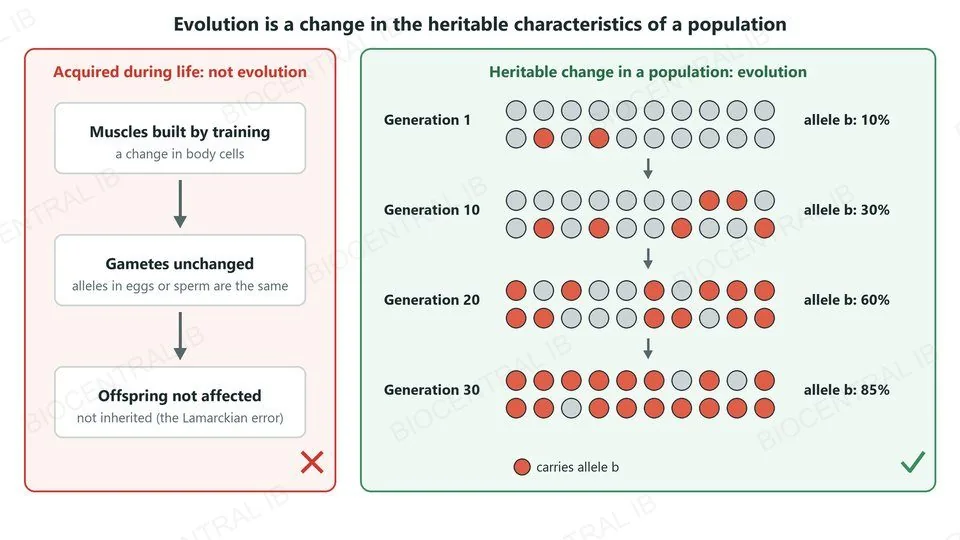
Two panels. Left, not evolution: muscles built by training change body cells, the gametes are unchanged, so offspring are not affected (the Lamarckian error). Right, evolution: a population of twenty individuals in generations 1, 10, 20 and 30, with the frequency of allele b rising from 10% to 30%, 60% and 85%
A4.1.1

Change in heritable characteristics

Evolution is the change in the heritable characteristics of a population over successive generations.
  • It is the population that evolves: the frequencies of alleles in its gene pool shift from one generation to the next.
  • Changes acquired during an individual’s life, such as muscles built by training, are not genetic in origin, so they are not inherited and are not evolution.
  • This definition separates Darwinian evolution from Lamarckism, the idea that acquired characteristics are passed on.
Nature of scienceThe theory of evolution by natural selection predicts and explains a broad range of observations and is unlikely ever to be falsified. No theory can be formally proved true, so it is still called a theory.
A4.1.2

Evidence from sequences

Base sequences in DNA or RNA and amino acid sequences in proteins give powerful evidence of common ancestry.
  • After two species split, mutations build up separately in each lineage, so the longer ago they shared an ancestor, the more their sequences differ.
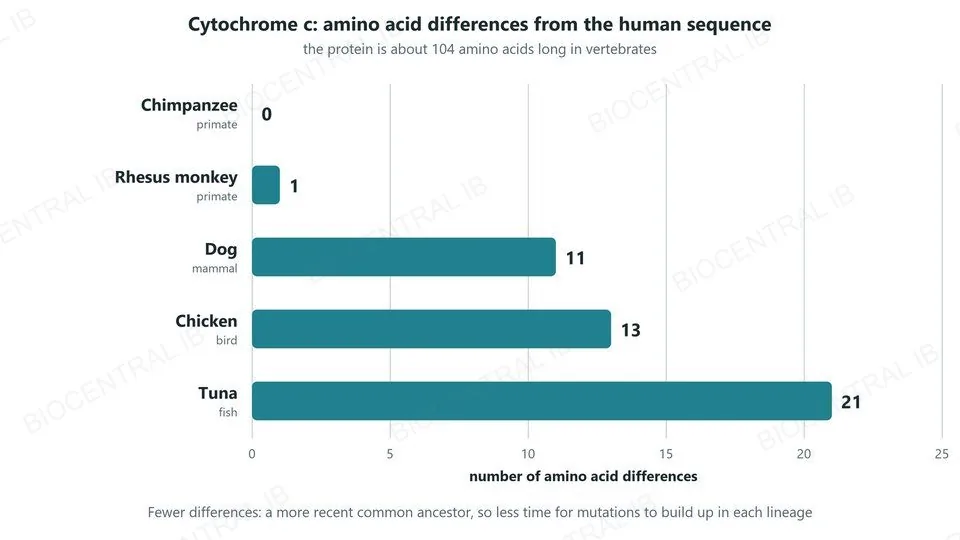
  • Cytochrome c, a respiratory protein found in nearly all organisms, is identical in humans and chimpanzees, differs by 1 amino acid from the rhesus monkey and by about 21 from tuna.
  • Trees built from sequence data match, and sometimes correct, those built from anatomy.
Why it worksAll organisms use the same genetic code, so the sequences of any two species can be compared directly.
A bar chart of amino acid differences in cytochrome c compared with humans: chimpanzee 0, rhesus monkey 1, dog 11, chicken 13, tuna 21. Fewer differences mean a more recent common ancestor
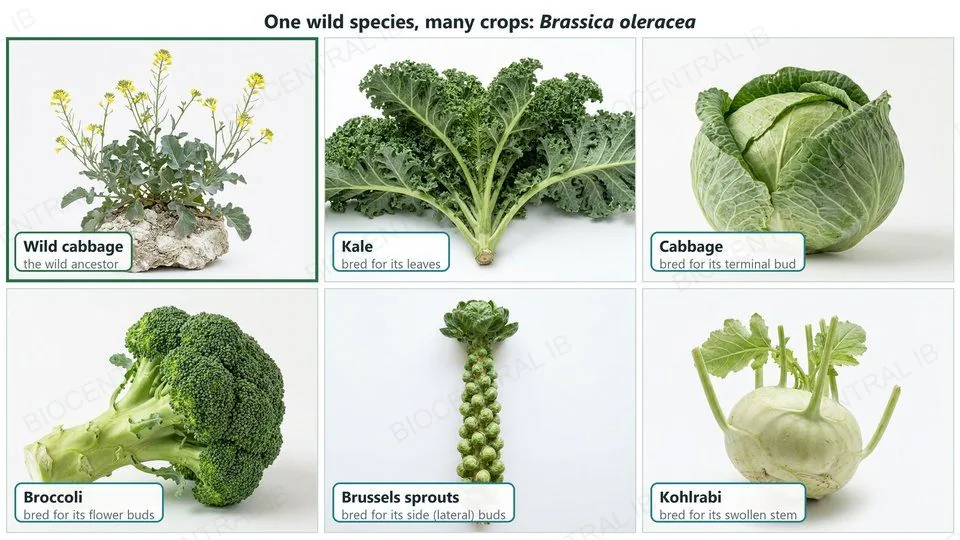
Six photographs: wild cabbage, Brassica oleracea, the wild ancestor; kale, bred for its leaves; cabbage, bred for its terminal bud; broccoli, bred for its flower buds; Brussels sprouts, bred for its side buds; kohlrabi, bred for its swollen stem
A4.1.3

Selective breeding: crops

In selective breeding (artificial selection), humans choose which individuals with desired traits breed, generation after generation.
  • Wild cabbage, Brassica oleracea, has been bred into kale (leaves), cabbage (terminal bud), broccoli (flower buds), Brussels sprouts (side buds) and kohlrabi (stem).
  • Each variety exaggerates a different part of the same plant, and all of them still belong to one species.
  • Maize was bred from a wild grass, teosinte, in the same way over roughly 9000 years.
EvidenceThe varieties differ hugely from each other and from the wild species, showing how much heritable variation a population holds and how far selection can shift it.
A4.1.3

Selective breeding: animals

Domesticated animal breeds show how rapidly evolutionary change can occur.
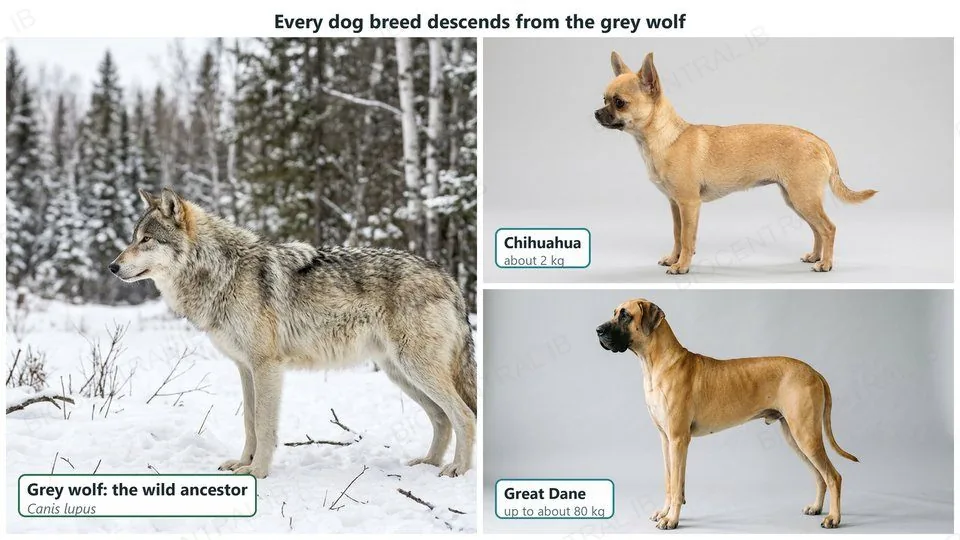
  • Every dog breed, from a 2 kg Chihuahua to an 80 kg Great Dane, descends from grey wolves domesticated at least 15 000 years ago.
  • Most of today’s breeds were developed only in the last 200 years or so.
  • Breeders select for size, coat, temperament or work, so the population’s heritable characteristics shift each generation. Dog breeds can still interbreed: they are one species.
Why it mattersNatural selection works on heritable variation in the same way, but the environment does the selecting instead of a breeder.
Photographs of a grey wolf, Canis lupus, the wild ancestor of dogs, beside a Chihuahua of about 2 kg and a Great Dane of up to about 80 kg
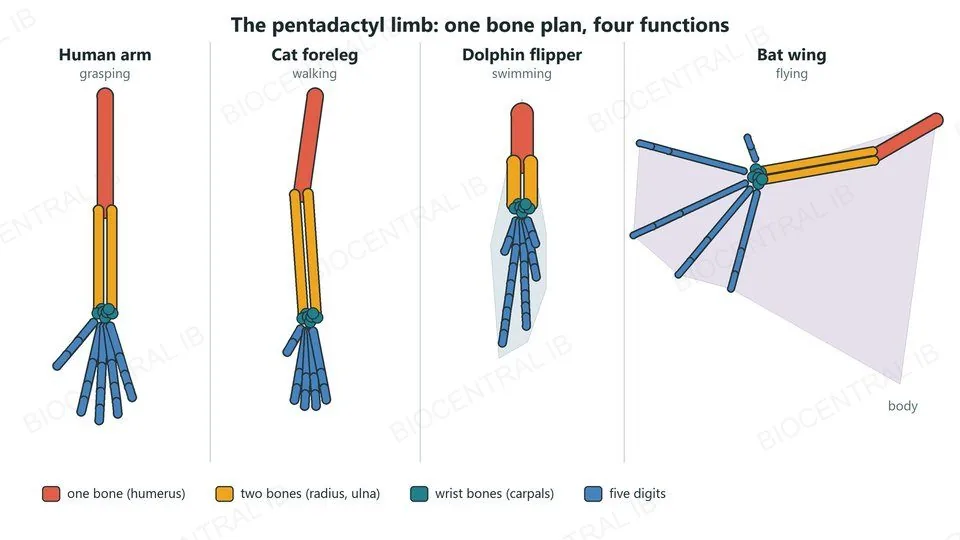
Four forelimbs drawn with the same colour code: a human arm for grasping, a cat foreleg for walking, a dolphin flipper for swimming and a bat wing for flying. Each has one upper bone (humerus), two lower bones (radius and ulna), wrist bones (carpals) and five digits
A4.1.4

Homologous structures: the pentadactyl limb

Homologous structures are shared by different species because they were inherited from a common ancestor.
  • The pentadactyl limb has one upper bone (humerus), two lower bones (radius and ulna), wrist bones and five digits.
  • Humans use it to grasp, cats to walk, dolphins to swim and bats to fly: the shape and function differ, but the bone plan is the same.
  • Descent from a common ancestor, followed by modification by natural selection, explains why such different limbs share one plan.
Watch outHomology is about shared structure and origin, not shared function.
A4.1.5

Analogous structures: convergent evolution

Analogous structures have the same function but different evolutionary origins.
  • They arise by convergent evolution: unrelated lineages facing the same selection pressures evolve similar solutions.
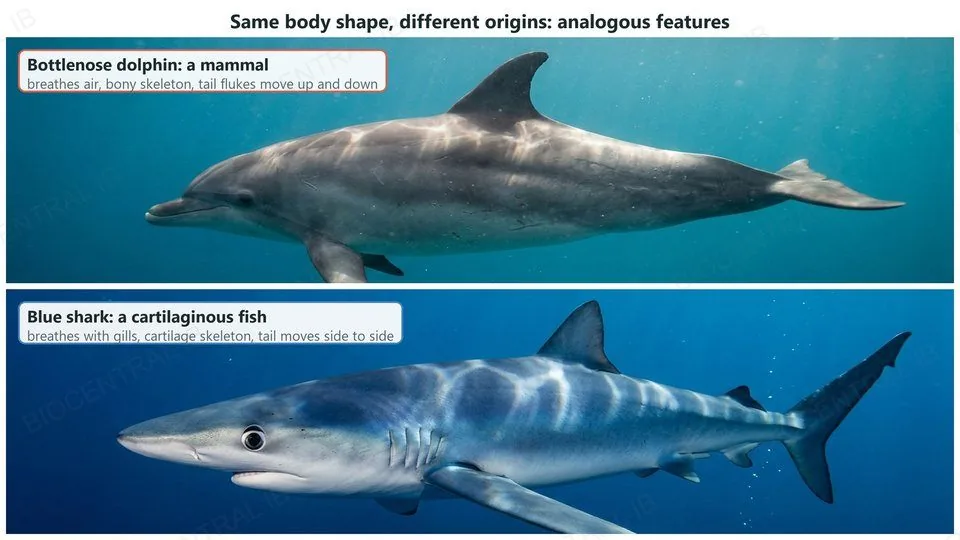
  • A dolphin (a mammal) and a shark (a cartilaginous fish) share a streamlined body and fins for fast swimming, but their common ancestor had neither.
  • Bird wings and insect wings both give flight: a bird’s wing is a modified limb with bones, an insect’s is an outgrowth of the exoskeleton.
Why it mattersAnalogous features mislead if taken as evidence of relatedness, so cladistics leaves them out (A3.2).
A bottlenose dolphin, a mammal that breathes air and has a bony skeleton and tail flukes that move up and down, above a blue shark, a cartilaginous fish with gills and a tail that moves side to side. Both have a streamlined body and fins
Quick check

A bat’s wing and a whale’s flipper have the same arrangement of bones but very different functions. What does this show?

They are analogous structures from convergent evolution
Bats and whales inherited the limb plan from a common ancestor
The limbs were shaped by one and the same selection pressure
Changes acquired by the limbs were passed on to offspring
Correct answer: a common ancestor. A shared bone plan with different functions is a homologous structure. Analogous structures are the reverse: the same function but different origins.
Part two

How new species form

A4.1.6 · A4.1.7
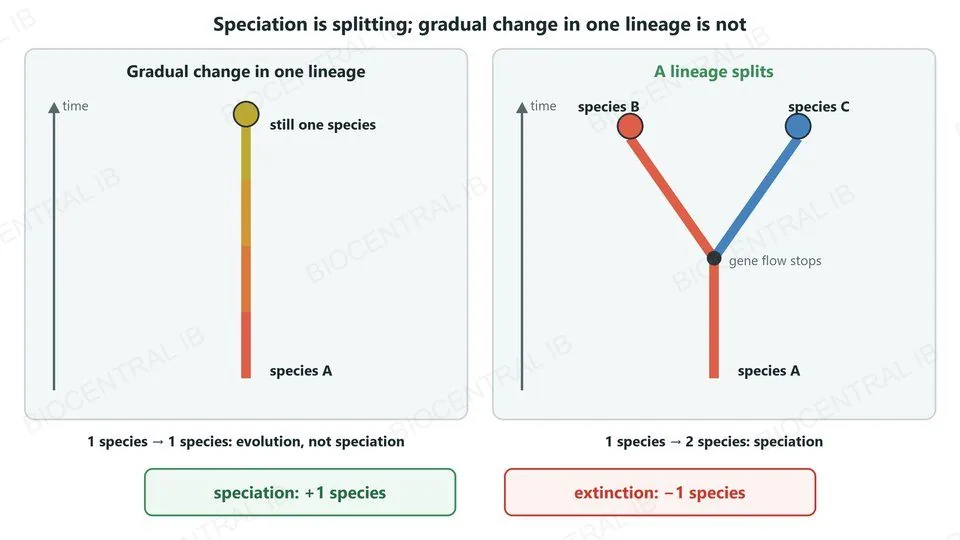
Two panels. Left: one lineage changes gradually over time but remains one species, so 1 species gives 1 species, which is evolution but not speciation. Right: a lineage splits where gene flow stops, so species A gives species B and C: speciation. Below: speciation adds one species, extinction removes one
A4.1.6

Speciation is splitting

Speciation is the splitting of a pre-existing species into two or more species that cannot interbreed.
  • It is the only way in which new species have appeared.
  • Gradual evolutionary change within one lineage is not speciation: the species changes, but there is still only one.
  • Speciation increases the total number of species on Earth; extinction decreases it.
  • The balance between the two sets how many species exist at any one time.
Watch outSpeciation is branching, not one kind of organism turning into another.
A4.1.7

Isolation and differential selection

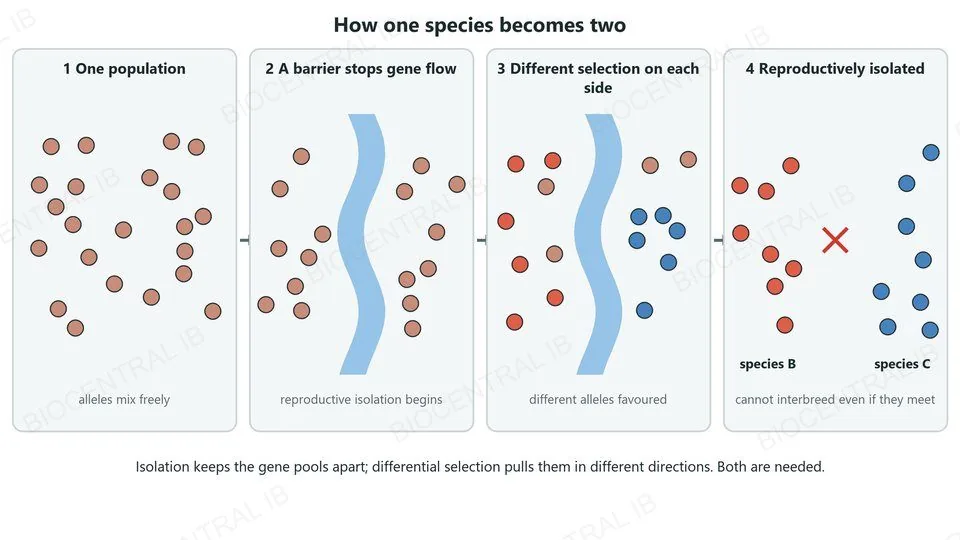
Speciation needs reproductive isolation and differential selection.
  • Reproductive isolation stops gene flow between two populations, so their gene pools can change independently. Geographical isolation, by a river, mountain range or sea, is one way this happens.
  • Differential selection: each population faces different selection pressures, such as climate, food or predators, so different alleles are favoured.
  • Over many generations the gene pools diverge until the populations can no longer interbreed, even if they meet.
Both are neededIsolation without different selection may leave two similar populations; selection without isolation is undone by gene flow.
Four stages: one population with alleles mixing freely; a river barrier stops gene flow; different selection on each side favours different alleles; the two populations become reproductively isolated species B and C that cannot interbreed even if they meet
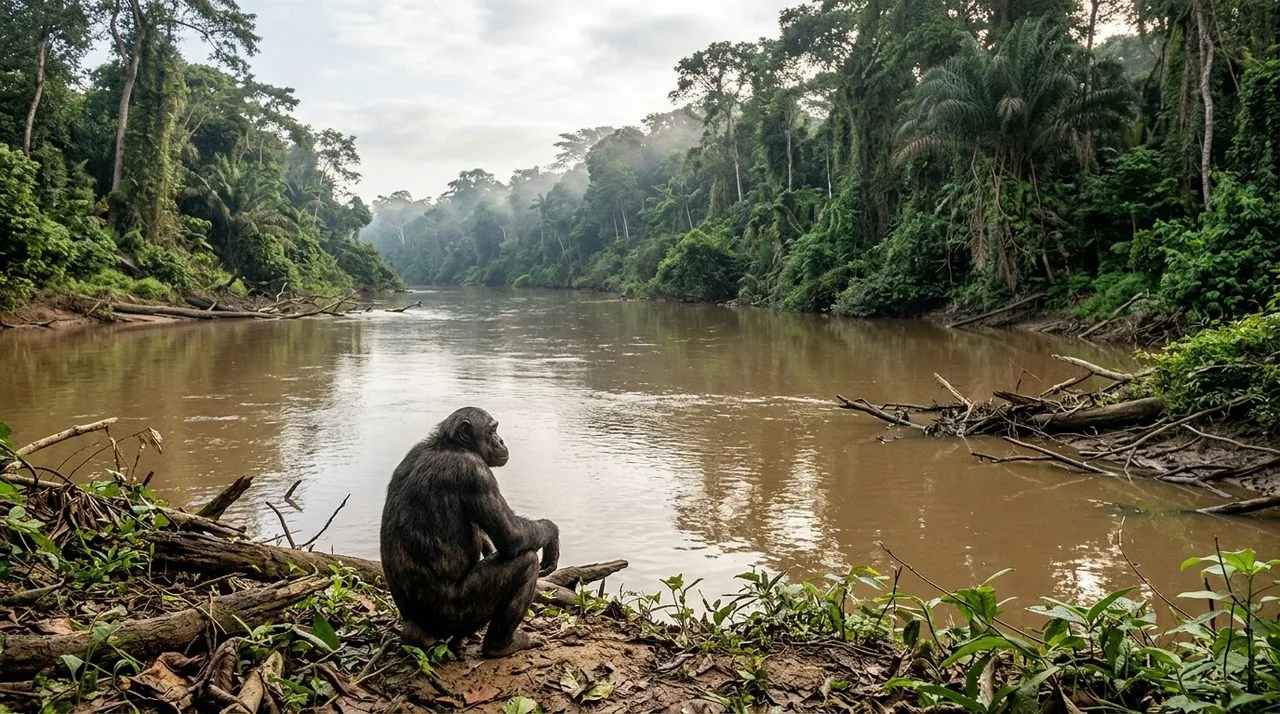
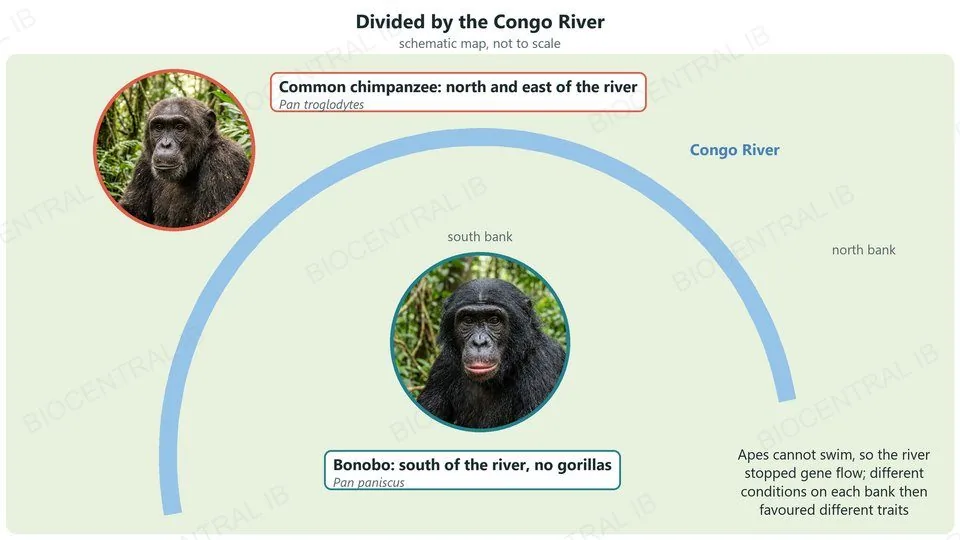
A schematic map of the Congo River arching across central Africa. The common chimpanzee, Pan troglodytes, lives north and east of the river; the bonobo, Pan paniscus, lives south of it, where there are no gorillas. Apes cannot swim, so the river stopped gene flow
A4.1.7

Chimpanzees and bonobos

Common chimpanzees and bonobos diverged after an ancestral population was split by the Congo River.
  • Apes cannot swim, so the river acted as a geographical barrier that stopped gene flow between the two banks.
  • Bonobos, Pan paniscus, live south of the river, where no gorillas compete with them for food; common chimpanzees, Pan troglodytes, live to the north and east, alongside gorillas.
  • Many biologists think these different conditions favoured different traits, so the two populations diverged in social behaviour and body form.
ExampleThe guide uses this as its example of divergence due to differential selection.
Part three · HL

Keeping species apart, and speciation in one step

A4.1.8 – A4.1.11
A4.1.8 · HL

Allopatric and sympatric

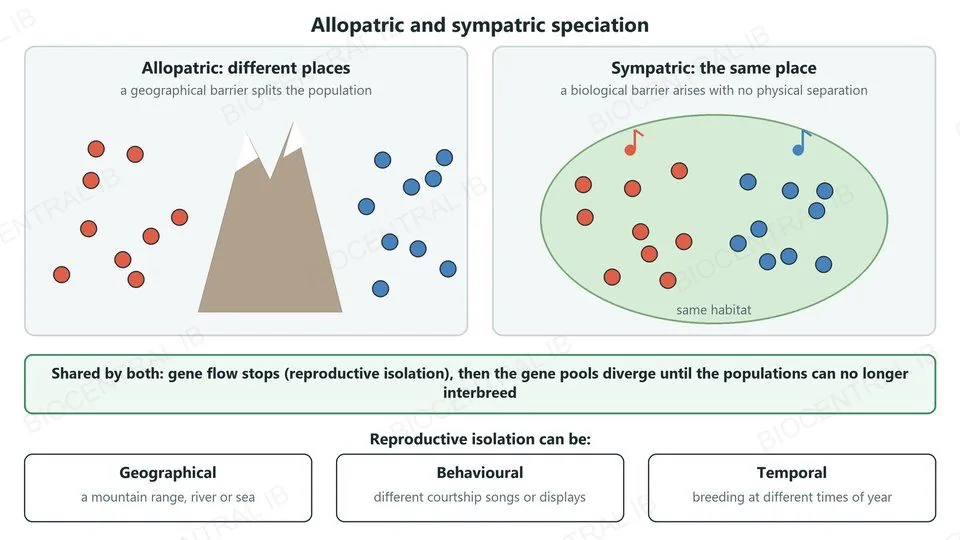
Allopatric speciation happens in different places; sympatric speciation happens in the same place.
  • Allopatric: a geographical barrier, such as a mountain range, river or sea, splits a population.
  • Sympatric: there is no physical barrier. Reproductive isolation arises within one area, for example by different courtship (behavioural), breeding at different times (temporal) or polyploidy.
  • In both, gene flow stops and the gene pools then diverge under differential selection.
RememberReproductive isolation can be geographic, behavioural or temporal.
Allopatric speciation: a mountain range separates two populations. Sympatric speciation: two groups in the same habitat with different songs. Both share the stopping of gene flow followed by divergence. Reproductive isolation can be geographical, behavioural or temporal
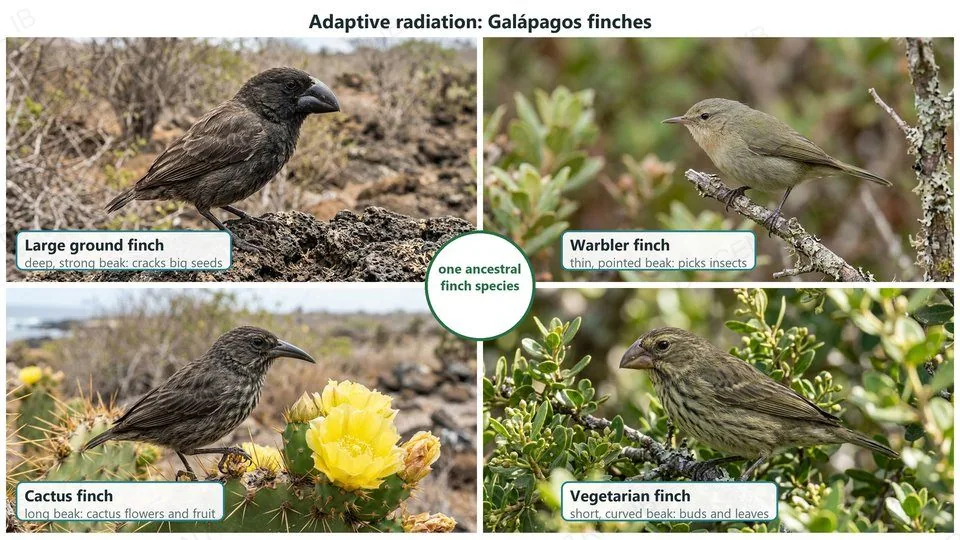
Four Galápagos finches around a badge saying one ancestral finch species: the large ground finch with a deep beak for big seeds, the warbler finch with a thin beak for insects, the cactus finch with a long beak for cactus flowers and fruit, and the vegetarian finch with a short curved beak for buds and leaves
A4.1.9 · HL

Adaptive radiation

Adaptive radiation is the rapid diversification of one ancestral species into many species, each adapted to a different niche.
  • It happens where many niches are vacant, such as newly formed islands with few competitors.
  • On the Galápagos, one ancestral finch gave rise to more than a dozen species, with beaks suited to seeds, insects, cactus flowers or buds.
  • Because each species uses different resources, closely related species can coexist without competing.
Why it mattersAdaptive radiation increases biodiversity in ecosystems where there are vacant niches.
A4.1.10 · HL

Barriers to hybridization

Barriers to hybridization stop alleles mixing between species.
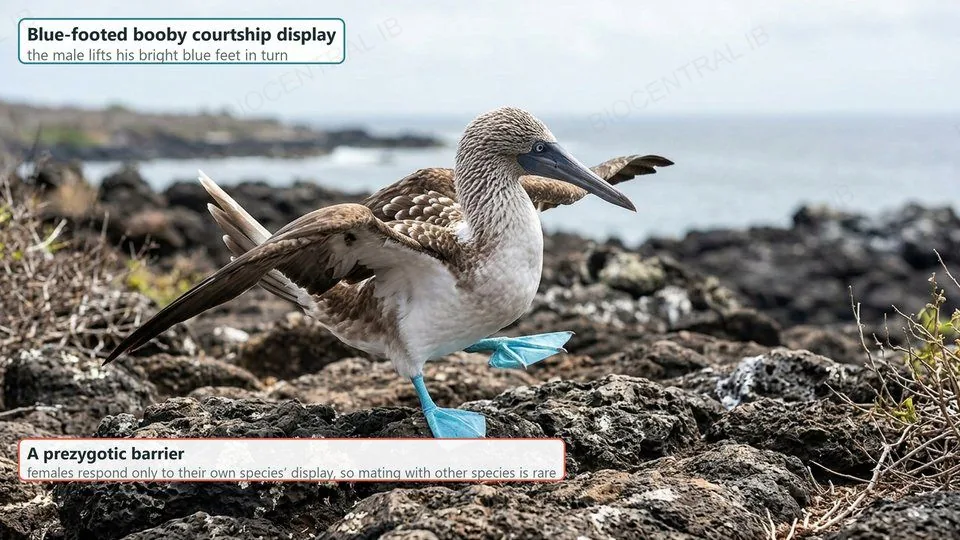
  • Prezygotic barriers act before fertilisation. In animals, courtship behaviour often prevents hybridization: a female responds only to the display, song or scent of her own species.
  • The blue-footed booby’s foot-raising display is one such species-specific courtship signal.
  • Other prezygotic barriers include breeding at different times of year (temporal) or in different habitats.
ResultMatings between species are rare, so their gene pools stay separate.
A blue-footed booby on lava rocks lifting one bright blue foot in its courtship display. Labels: a prezygotic barrier, females respond only to their own species’ display
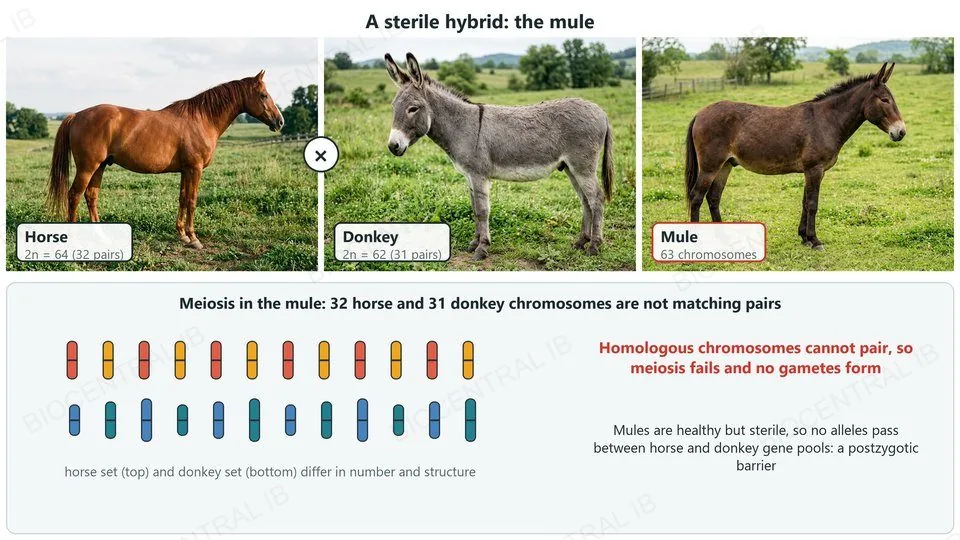
Photographs of a horse (2n = 64), a donkey (2n = 62) and their hybrid, the mule (63 chromosomes). Below, the horse and donkey chromosome sets differ in number and structure, so they cannot pair in meiosis and the mule is sterile
A4.1.10 · HL

Sterile hybrids

Postzygotic barriers act after fertilisation: the hybrid may die early or be sterile.
  • A horse (2n = 64) and a donkey (2n = 62) can mate and produce a mule with 63 chromosomes.
  • The 32 horse and 31 donkey chromosomes are not matching pairs, so they cannot pair up in meiosis and the mule makes no viable gametes.
  • The mule is healthy but sterile, so no horse or donkey alleles pass through it into the other species’ gene pool.
Watch outA hybrid being born does not make two species one: what matters is whether the hybrid is fertile.
A4.1.11 · HL

Abrupt speciation by polyploidy

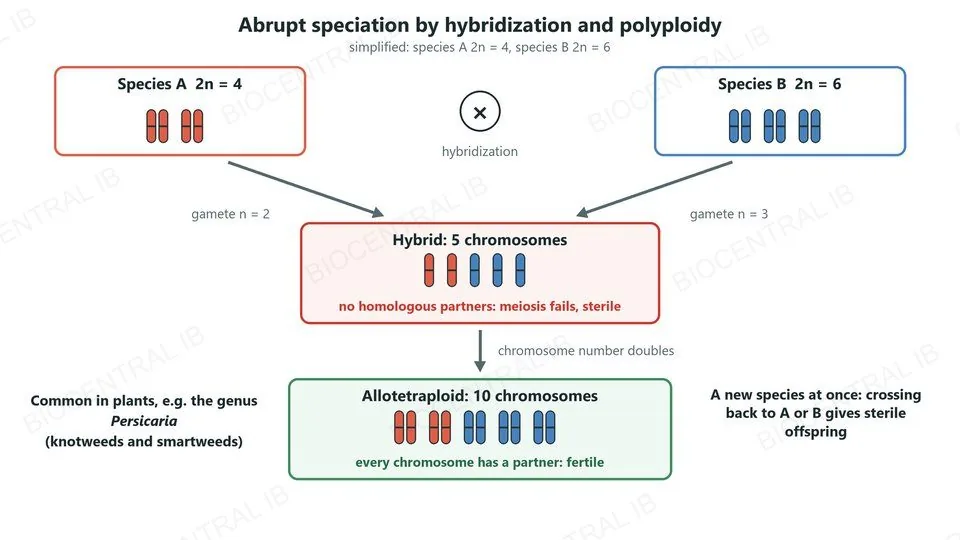
In plants, hybridization followed by polyploidy can form a new species in a single generation.
  • A hybrid between two plant species gets one set of chromosomes from each parent. With no homologous partners, its chromosomes cannot pair in meiosis, so it is sterile.
  • If its chromosome number doubles, every chromosome gains a partner: the polyploid can make gametes and is fertile.
  • Crosses with either parent species give sterile offspring, so the polyploid is reproductively isolated at once: a new species.
Why plants?Many plants tolerate extra chromosome sets and can self-fertilise, so a single polyploid plant can found a population.
Species A (2n = 4) and species B (2n = 6) hybridize. The hybrid has 5 chromosomes with no homologous partners, so meiosis fails and it is sterile. After the chromosome number doubles, the allotetraploid has 10 chromosomes, every one with a partner, so it is fertile and a new species
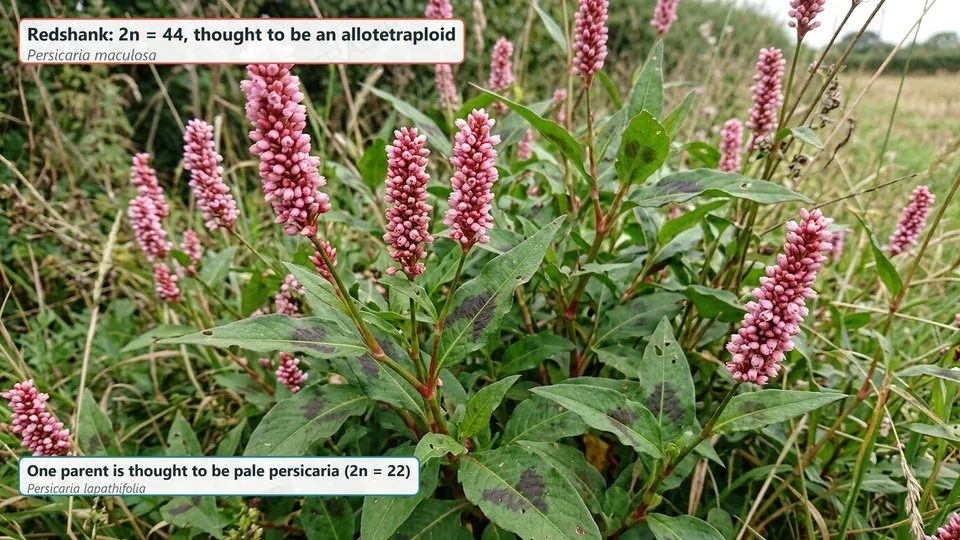
A clump of redshank, Persicaria maculosa, with pink flower spikes and dark-blotched leaves. Labels: 2n = 44, thought to be an allotetraploid; one parent is thought to be pale persicaria, Persicaria lapathifolia, 2n = 22
A4.1.11 · HL

Knotweeds and smartweeds: Persicaria

The genus Persicaria contains many species that formed by hybridization and polyploidy.
  • Closely related Persicaria species with different chromosome numbers have hybridized repeatedly, and chromosome doubling has turned some hybrids into new, fertile species.
  • Redshank, Persicaria maculosa (2n = 44), is thought to be an allotetraploid, with pale persicaria, P. lapathifolia (2n = 22), as one parent.
  • These species arise alongside their parents, so this is sympatric speciation.
Exam tipEither the common name or the scientific name is acceptable when referring to organisms in an exam.
Quick check · HL

A hybrid of two plant species, 2n = 10 and 2n = 14, is sterile. After its chromosome number doubles it is fertile. How many chromosomes does it have now, and why is it fertile?

12, because it now matches the average of its two parents
24, because every chromosome now has a partner in meiosis
24, because doubling lets it breed with both parent species
48, because both parents’ full sets have been doubled again
Correct answer: 24, every chromosome has a partner. The hybrid has 5 + 7 = 12 unpaired chromosomes. Doubling gives two copies of each set, so meiosis works. It cannot breed successfully with either parent, so it is a new species.

Key vocabulary

Worth being able to define in a single sentence each

Evolution
change in the heritable characteristics of a population over generations.
Selective breeding
humans choosing which individuals with desired traits reproduce.
Homologous structure
shared because it was inherited from a common ancestor.
Analogous structure
same function, different evolutionary origin.
Convergent evolution
unrelated lineages evolving similar features under similar pressures.
Speciation
the splitting of a pre-existing species into two or more.
Reproductive isolation
any barrier that stops gene flow between populations.
Differential selection
different selection pressures favouring different alleles in each population.

Key vocabulary · HL

Additional higher level terms

Allopatric speciation
speciation after a geographical barrier separates populations.
Sympatric speciation
speciation in the same area, with no physical barrier.
Adaptive radiation
rapid diversification of one ancestor into species filling different niches.
Niche
the role of a species in its ecosystem: its habitat, food and interactions.
Prezygotic barrier
stops fertilisation between species, e.g. courtship behaviour.
Postzygotic barrier
acts after fertilisation, e.g. a sterile hybrid such as the mule.
Hybridization
interbreeding between two different species.
Polyploidy
having more than two complete sets of chromosomes.

Where this shows up again

D4.1 · Natural selection
How does natural selection change the frequency of alleles in a population over generations?
D1.3 · Mutation and gene editing
How do mutations generate the heritable variation on which evolution and speciation depend?
A1.2 / A3.2 · Nucleic acids / Cladistics
How are similarities in DNA base sequences and protein amino acid sequences used to work out evolutionary relationships?
A3.1 / A3.2 · Diversity / Classification
How is the classification of organisms into a hierarchy of taxa used to reflect their evolutionary history?

A4.1 Evolution and speciation — one-page recap

Screenshot this slide to revise from

Evolution
  • Change in heritable characteristics of a population.
  • Acquired changes are not evolution (not Lamarckism).
Evidence
  • Sequences: fewer differences → more recent common ancestor.
  • Selective breeding: crop varieties and breeds show rapid change.
Homologous vs analogous
  • Homologous: shared ancestry (pentadactyl limb).
  • Analogous: same function, different origins (convergent evolution).
Speciation
  • Splitting of a species: the only source of new species.
  • Needs reproductive isolation + differential selection (Congo River apes).
HL · Modes and radiation
  • Allopatric (geographic) vs sympatric (behavioural, temporal).
  • Adaptive radiation: species coexist in different niches.
HL · Keeping species apart
  • Courtship barriers; sterile hybrids such as the mule.
  • Hybridization + polyploidy: new plant species at once (Persicaria).
Next step

Now test yourself on A4.1

Reading the slides is half the job. The other half is answering questions the way the exam asks them.

49 quiz questions13 data questions8 exam questionsmarkschemes included

Unlock every lesson with Pro — quizzes, data questions and exam papers. Two lessons are completely free to try: A1.1 Water and B1.1 Carbohydrates and lipids.

One-page summary, key terms and sample questions for A4.1 →

One plan, many forms.

Next: how biodiversity is measured, why it is being lost, and how it can be conserved.
A4.1 Evolution and speciation · BioCentral IB
Use ↓ ↑ or click to navigate
01 / 20