BioCentral IBBioCentral IB
IB Biology · Theme A · A4.2

Conservation of biodiversity

Why species are disappearing right now — and what conservation actually does about it. No additional HL content: SL and HL cover exactly the same material.
Guiding questions

What factors are causing the sixth mass extinction of species?

How can conservationists minimize the loss of biodiversity?

Part one

What biodiversity is, and how fast it's changing

A4.2.1 – A4.2.2
A4.2.1

Biodiversity has three levels, not one

Biodiversity is the total variety of life at every level of organization — not just how many species exist in a place.
  • Ecosystem diversity is the variety of habitats in a region — a rainforest, a coral reef and a grassland each support a different community.
  • Species diversity has two parts: richness (species present) and evenness (how evenly individuals are spread among them).
  • Genetic diversity is the range of alleles in a species' own gene pool: cheetahs are famously low in genetic diversity, leaving fewer variants against a new disease than a genetically diverse wolf population.
Why it mattersLosing any one level weakens the others — a species can vanish while its habitat still stands, and an ecosystem can degrade while its species are still present.
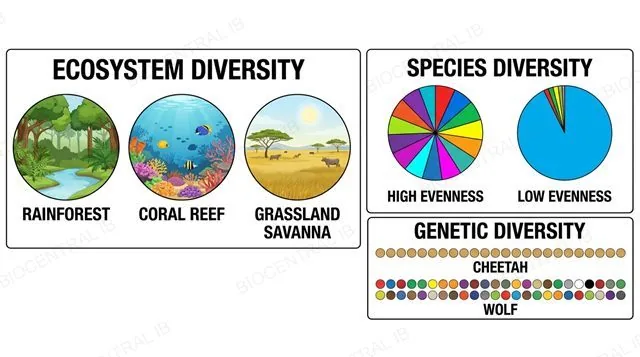
Three levels of biodiversity: ecosystem diversity (rainforest, coral reef, grassland), species diversity (high vs low evenness pie charts), and genetic diversity (cheetah vs wolf allele diagrams)
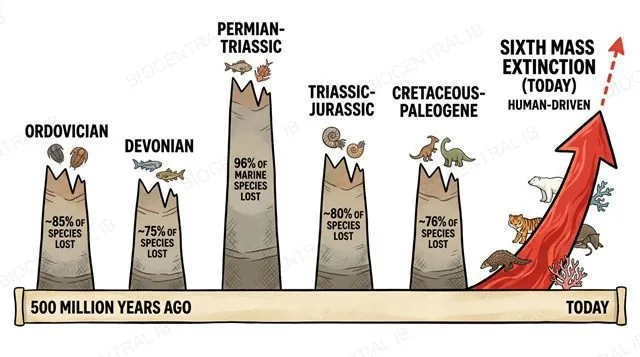
Timeline of Earth's five past mass extinctions (Ordovician, Devonian, Permian-Triassic, Triassic-Jurassic, Cretaceous-Paleogene) and the ongoing human-driven sixth mass extinction
A4.2.2

More species alive today than ever recorded

About 1.8 million species have been formally described, but the true total is estimated at roughly 8.7 million — most of life on Earth remains completely undocumented.
  • The fossil record shows five mass extinctions — periods when a large fraction of species vanished in a geologically short time.
  • The worst, Permian-Triassic (~252 Mya), wiped out ~96% of marine species.
  • Many biologists now argue Earth is entering a sixth — driven not by an asteroid or a volcano but by one species, Homo sapiens — at hundreds to thousands of times the natural background rate.
Why it mattersA high species count today doesn't mean biodiversity is safe — it's the rate of loss, not the current total, that signals a crisis.
Part two

Why biodiversity is being lost

A4.2.3 – A4.2.6
A4.2.3

Five ways humans drive extinction

Anthropogenic extinction means a species is driven extinct by human activity — not a natural event like an asteroid impact or a volcanic eruption.
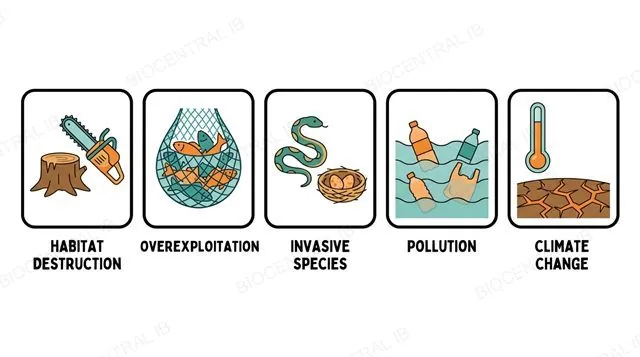
  • Habitat destruction — forests cleared, wetlands drained, rivers dammed — leaves a species with nowhere to live.
  • Overexploitation is hunting or harvesting faster than a population can replace itself: the passenger pigeon, once billions strong, was hunted to extinction by 1914.
  • Invasive species carried by humans can devastate native life with no evolved defence — the brown tree snake, introduced to Guam, eliminated 10 of its 12 native forest bird species.
  • Pollution and climate change shift habitats faster than many species can adapt.
Why it mattersThese five causes rarely act alone — they compound, stacking extra pressure onto a single struggling population.
Five direct causes of anthropogenic species extinction: habitat destruction, overexploitation, invasive species, pollution, and climate change
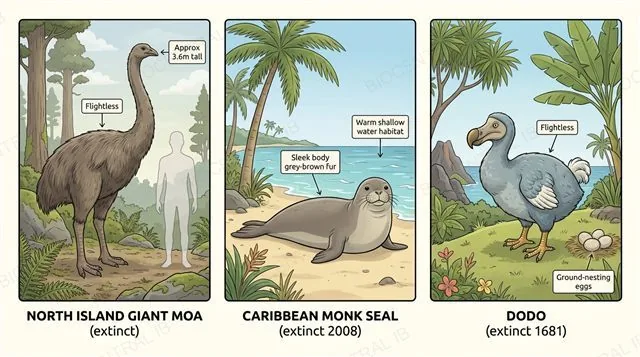
North Island giant moa, an extinct flightless bird from New Zealand, and the Caribbean monk seal, extinct since 2008, illustrated with labeled facts
A4.2.3

Terrestrial megafauna: the moa, gone in 150 years

The North Island giant moa (Dinornis novaezealandiae) is the guide's required example of the loss of terrestrial megafauna — a huge, land-based animal driven extinct by direct human hunting.

Standing up to 3.6 m tall and weighing as much as 250 kg, the flightless giant moa had evolved for millions of years with no mammalian predators, so it had no defence against humans. Polynesian (Māori) settlers arrived in New Zealand around 1300 CE and hunted moa for meat, eggs and bone tools. With a slow reproductive rate — a single egg incubated for months — moa populations could not recover fast enough. All nine moa species, including the North Island giant moa, were extinct within roughly 150 years of human arrival, one of the fastest megafaunal extinctions on record.

Why it mattersThe moa shows that overexploitation alone — with no habitat loss or climate shift involved — can erase a species that had survived for millions of years.
A4.2.3

A marine loss: the Caribbean monk seal

The Caribbean monk seal (Neomonachus tropicalis) is the guide's required example of the loss of a marine species — hunted to extinction across its entire range.

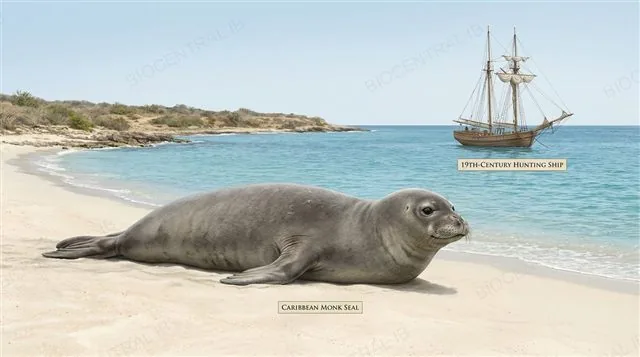
Once common on beaches and reefs across the Caribbean Sea, Gulf of Mexico and western Atlantic, the Caribbean monk seal was hunted commercially from the 1500s onward for its blubber (rendered into oil), meat and skin. Colonies were easy targets: the seals hauled out on land in large groups and had little fear of humans, having evolved with no natural land predators. Numbers collapsed through the 19th and early 20th centuries. The last confirmed sighting was in 1952, and the species was formally declared extinct by the IUCN in 2008 — the first seal species known to have gone extinct due to human activity.

Why it mattersIt is the only seal species ever driven extinct by humans — a marine parallel to the moa's story on land, showing ocean species are just as vulnerable to direct exploitation.
Caribbean monk seal, an extinct marine mammal, illustrated resting on a Caribbean beach, with a 19th-century hunting ship visible offshore
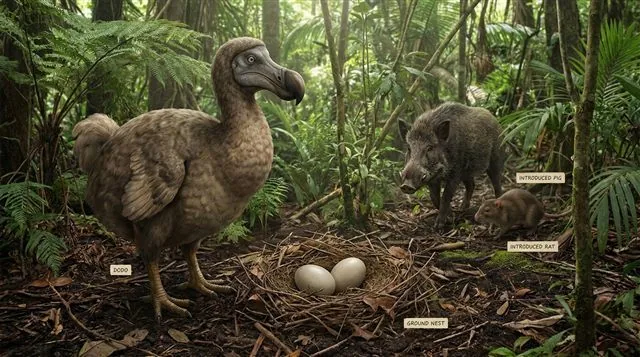
Dodo, an extinct flightless bird from Mauritius, illustrated on a forest floor beside its ground nest, threatened by an introduced pig and rat in the background
A4.2.3

A third case: the dodo of Mauritius

The dodo (Raphus cucullatus) — the guide's third case study, drawn from an extinction familiar to most students — shows how introduced species can finish what hunting starts.

Found only on the island of Mauritius, the flightless dodo had evolved with no land predators and nested on the ground. When Dutch sailors arrived in the late 1500s, direct hunting removed some birds, but the larger threat came from what the sailors brought with them: pigs, rats and crab-eating macaques that ate the dodo's eggs and chicks faster than adults could replace them. Combined with habitat clearance for settlements, the dodo was extinct by 1681 — within less than a century of first contact.

Why it mattersThe dodo shows extinction is rarely caused by a single mechanism — hunting, introduced predators and habitat loss compounded together, which is typical of real anthropogenic extinctions.
A4.2.4

An ecosystem can vanish intact

An ecosystem can be lost even if none of its species goes globally extinct — what's actually lost is the system of interactions between them.

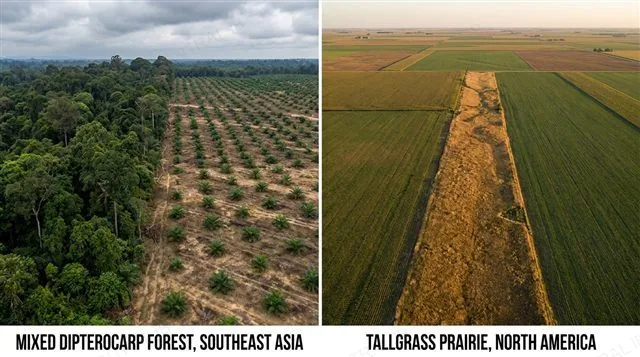
Land-use change converts forests and grasslands to farmland or cities, and it is the leading cause of ecosystem loss worldwide. Mixed dipterocarp forest — named for its dominant dipterocarp tree family — once covered vast areas of Southeast Asia, particularly Borneo and Sumatra. Since the mid-20th century it has been cleared at a rapid pace for commercial timber and, increasingly, for oil-palm plantations, which require the land to be cleared completely rather than selectively logged. Entire regions have lost the majority of their original forest cover within a single human lifetime.

Why it mattersProtecting a single species is pointless if the ecosystem sustaining it is gone.
Aerial photograph of Southeast Asian rainforest being cleared for oil palm plantation, showing the boundary between mixed dipterocarp forest and cleared land
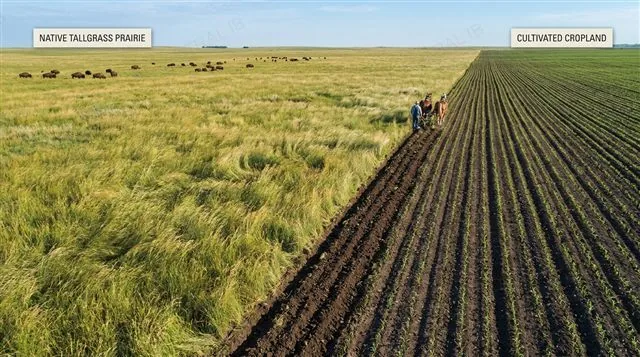
Historic tallgrass prairie landscape in the central United States being ploughed and converted into farmland, showing the boundary between native prairie grassland and cultivated cropland
A4.2.4

A second case, closer to home: the tallgrass prairie

The guide asks for a second case study of ecosystem loss from an area familiar to students — North America's tallgrass prairie is one of the most complete losses of any biome on Earth.

Tallgrass prairie once covered around 68 million hectares across the central United States and Canada, dominated by deep-rooted grasses adapted to fire and grazing bison. Beginning in the 1800s, the deep, fertile prairie soil was ploughed for wheat and corn farming — today over 96% of the original tallgrass prairie has been converted to agriculture, making it more extensively lost than most tropical rainforest. Ecosystem loss also takes less direct forms: fragmentation splits continuous habitat into small isolated patches with damaging edge effects, freshwater systems are drained and dammed (up to half the world's wetlands lost since 1900), and marine ecosystems degrade through bleaching, acidification and bottom-trawling.

Why it mattersBecause prairie loss happened gradually across two centuries rather than in one dramatic event, it attracts far less public attention than rainforest loss — despite being proportionally more complete.
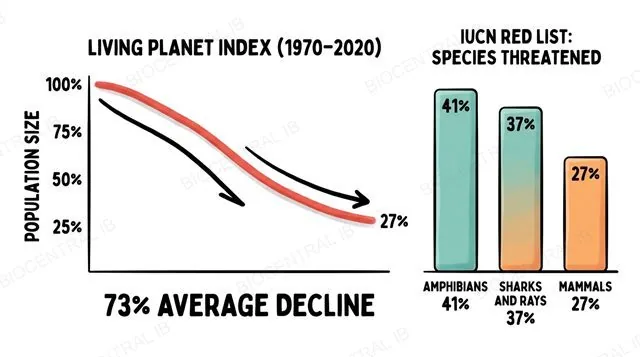
Living Planet Index chart showing a 73% average decline in monitored vertebrate populations since 1970, alongside an IUCN Red List bar chart of species threatened
A4.2.5

The evidence isn't one number

The case for a biodiversity crisis rests on multiple independent, repeated sources of data — not a single striking statistic.
  • The IUCN Red List classifies over 44,000 species as threatened, including 41% of amphibians, 37% of sharks and rays, and ~27% of mammals.
  • The Living Planet Index (WWF / ZSL) reports a 73% average decline in monitored vertebrate population sizes since 1970 — shrinking populations, not a tally of extinctions.
  • Satellite data, repeated reef-bleaching, and field range-contraction records add further weight.
  • A survey only counts as real evidence if it's repeated and checkable — citizen science adds coverage but brings its own consistency concerns.
Why it mattersWithout repeated, checkable data, a real decline can't be told apart from a one-off fluctuation.
Quick check

The Living Planet Index reports a "73% average decline" since 1970. What does this actually measure?

The number of species that have gone extinct since 1970
The average decline in monitored vertebrate population sizes, not a count of extinctions
The percentage of new species discovered since 1970
The area of forest lost worldwide since 1970
Correct answer: a population-size index, not an extinction count. The Living Planet Index tracks population sizes across thousands of monitored vertebrate species — a species can show a steep decline on this index while still being far from actual extinction.
A4.2.6

One overarching cause

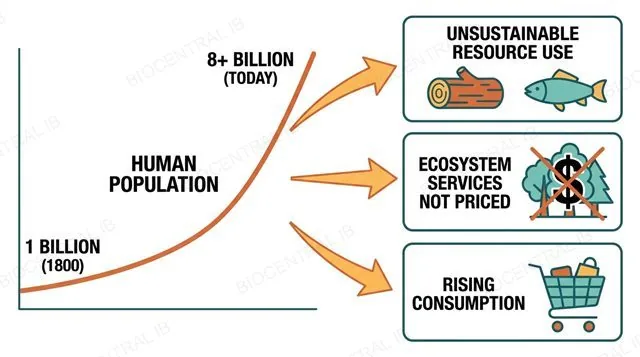
The biodiversity crisis isn't the result of any single factor — it's the combined product of a growing human population and rising per-capita consumption.
  • Human population has grown from about 1 billion in 1800 to over 8 billion today, driving demand for food, water, land and energy.
  • Unsustainable resource use means timber, fish, water and fossil fuels are consumed faster than they can be replenished.
  • Economic systems rarely price ecosystem services — a standing forest's clean water and carbon storage usually count for less than its timber value in the short term.
  • These underlying drivers are what actually produce the direct causes covered earlier.
Why it mattersFencing off a reserve cannot succeed on its own while the underlying demand for land keeps growing around it.
Diagram showing human population growth from 1 billion in 1800 to over 8 billion today driving unsustainable resource use, unpriced ecosystem services, and rising consumption
Part three

Responding: conservation in practice

A4.2.7 – A4.2.8
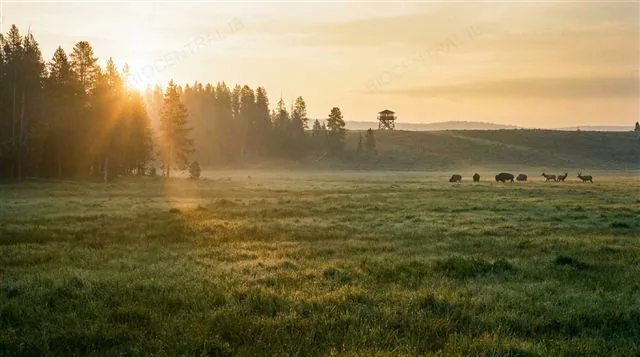
A protected national park nature reserve at sunrise, an example of in situ conservation
A4.2.7

Protect it where it lives

In situ conservation protects a species inside its own natural habitat — national parks, nature reserves and managed protected areas.
  • Because the whole community of interacting species is protected together, in situ conservation usually offers the most complete protection — not just individual organisms, but the ecosystem's interactions and evolutionary processes too.
  • The catch: the habitat itself must be actively defended, since logging, poaching and encroaching agriculture can still occur inside a park's boundary.
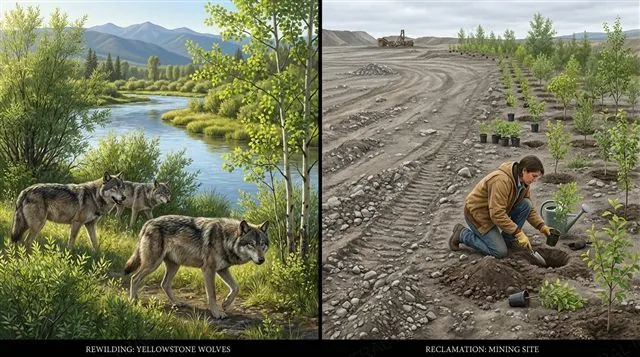
  • Related tools extend the same idea — habitat corridors restore gene flow between isolated reserves, rewilding reintroduces keystone species, and reclamation restores already-degraded land.
Why it mattersIn situ conservation only works for as long as the habitat is genuinely defended — protection on paper isn't protection in practice.
A4.2.7

Putting nature back: rewilding & reclamation

Rewilding reintroduces species — often keystone species — to restore an ecosystem's natural processes, while reclamation actively restores land that has already been degraded, both named separately from simply protecting intact habitat.

Rewilding works by putting back a missing piece of the ecosystem rather than just fencing off what remains — the best-known example is the reintroduction of grey wolves to Yellowstone National Park in 1995, which changed elk grazing behaviour enough to allow willow and aspen to recover along riverbanks, in turn changing river channel shape. Reclamation goes further, actively rebuilding degraded land — replanting native vegetation on old mining sites, restoring drained wetlands, or re-establishing soil on abandoned farmland — so it can support a functioning ecosystem again rather than staying permanently degraded.

Why it mattersBoth approaches accept that simply stopping further damage isn't enough — a degraded or incomplete ecosystem needs active intervention to recover its original processes.
Grey wolves being reintroduced to Yellowstone National Park, illustrated alongside a degraded mining site being replanted with native vegetation as an example of ecological reclamation
A4.2.7

When the habitat is already gone

Ex situ conservation protects a species outside its natural habitat — zoos, botanic gardens, seed banks and captive-breeding programmes — usually as a last resort.
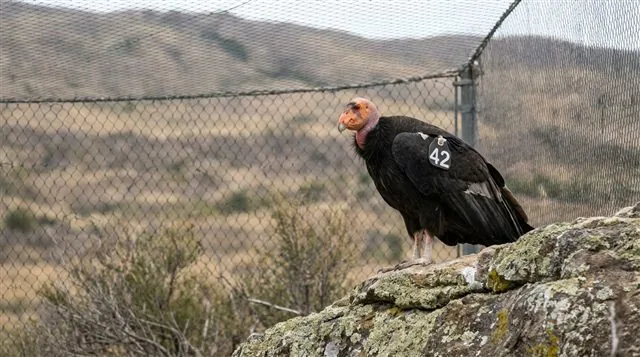
  • The California condor is the standard example: the wild population collapsed to just 27 birds, but captive breeding rebuilt it to over 500, with many now reintroduced to the wild.
  • Seed and tissue banks apply the same logic more cheaply, storing genetic material for possible future restoration.
  • The real limitation is scope — ex situ conservation saves genes and individuals, not the ecosystem they came from, and reintroduction can still fail if the original threat hasn't actually been dealt with.
Why it mattersEx situ conservation is a genuine safety net — never a substitute for protecting the wild habitat itself.
A California condor with a wing tag in a captive-breeding aviary, an example of ex situ conservation
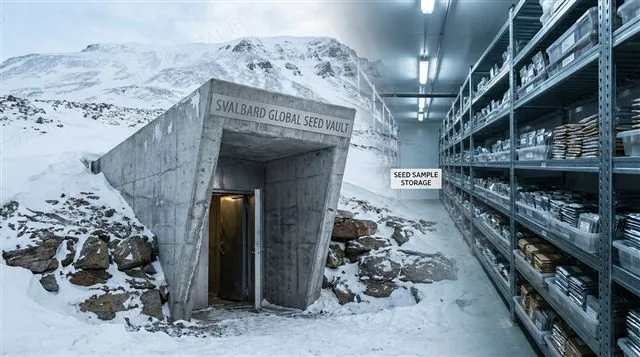
Svalbard Global Seed Vault entrance built into an Arctic mountainside, with rows of stored seed sample boxes on cold storage shelving visible inside
A4.2.7

The last resort: seed & tissue banks

Storing germ plasm — seeds, spores, tissue samples or genetic material — in a seed or tissue bank preserves a species' genetic diversity without keeping any living organism at all.

The Svalbard Global Seed Vault, built into a mountainside in the Arctic, stores duplicate seed samples from crop varieties and wild relatives worldwide at −18°C, safeguarded against war, disaster or the simple loss of a national collection. Because seeds can remain viable for decades or centuries when stored correctly, seed banks are far cheaper than maintaining living captive populations — no ongoing feeding, veterinary care or enclosure space is needed. The limitation is scope: seed and tissue banks preserve genetic material, not a living, evolving population, and germinating stored seed decades later is not guaranteed to succeed.

Why it mattersSeed and tissue banks are a genetic insurance policy — a last line of defence if a species is lost everywhere else, not a substitute for a living wild or captive population.
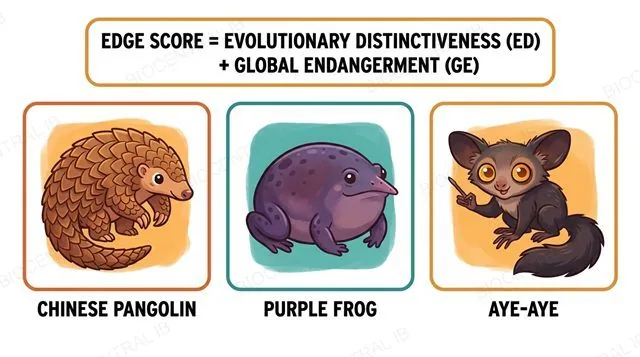
EDGE score formula combining Evolutionary Distinctiveness and Global Endangerment, illustrated with three top-ranked EDGE species: Chinese pangolin, purple frog, and aye-aye
A4.2.8

Not every endangered species is equal

Conservation funding is always limited, so the EDGE of Existence programme (Zoological Society of London) gives a scientific basis for deciding which species to prioritise.
  • A species' EDGE score combines two numbers: Evolutionary Distinctiveness (ED) — how unique its evolutionary history is, scoring highly with few close relatives and an ancient split — and Global Endangerment (GE), its IUCN Red List status, where Critically Endangered outweighs Vulnerable.
  • Split funding purely by threat level, and the most distinctive species often lose out to more "ordinary" endangered ones.
  • Real top EDGE species: the Chinese pangolin, the purple frog and the aye-aye — each the sole survivor of an ancient lineage.
DebatedWhich species to prioritise is a genuinely contested ethical, political and economic question — not a purely scientific one.
Quick check

Why might the EDGE programme prioritise the purple frog over a more common threatened species?

It is more profitable to protect
It breeds more easily in captivity
It has high Evolutionary Distinctiveness — losing it would erase an entire ancient branch of the tree of life
It is automatically the single most endangered species on the IUCN Red List
Correct answer: high Evolutionary Distinctiveness. EDGE combines evolutionary distinctiveness with endangerment status, so a species with very few close living relatives can outrank an equally-threatened but more "ordinary" species.

Key vocabulary

Worth being able to define in a single sentence each

Biodiversity
The total variety of life at every level — ecosystem, species and genetic.
Species richness
The number of different species present in a community.
Species evenness
How evenly individuals are distributed among those species.
Genetic diversity
The range of alleles within a species' own gene pool.
Anthropogenic
Caused by human activity, not a natural event.
In situ conservation
Protecting a species inside its own natural habitat.
Ex situ conservation
Protecting a species outside its natural habitat (zoos, seed banks).
IUCN Red List
The global assessment of a species' extinction risk.
EDGE score
A ranking combining evolutionary distinctiveness with endangerment.

A4.2 Conservation of biodiversity — one-page recap

Screenshot this slide to revise from

What is biodiversity
  • Three levels: ecosystem, species, genetic.
  • Richness = species count; evenness = how evenly spread.
Species & extinction scale
  • ~1.8M species described; ~8.7M estimated total.
  • Five past mass extinctions; possibly a sixth underway now.
Direct causes
  • Habitat loss, overexploitation, invasive species, pollution, climate change.
  • Case studies: North Island giant moa, Caribbean monk seal.
Ecosystem loss
  • Land-use change, fragmentation, freshwater & marine degradation.
  • Case study: mixed dipterocarp forest, Southeast Asia.
Evidence & drivers
  • IUCN Red List; Living Planet Index (73% decline since 1970).
  • Overarching cause: population growth + rising consumption.
Conservation
  • In situ (reserves, corridors, rewilding) vs ex situ (zoos, seed banks).
  • EDGE prioritises evolutionarily distinct, endangered species.

Where this shows up again

C4.1 · D4.2
How do the interactions and stability of an ecosystem depend on its biodiversity?
D4.3
How could climate change alter species distributions and add to the current biodiversity crisis?
D4.1 · A4.1
How does natural selection depend on the genetic diversity within a species?
A3.1 · A3.2
How does the classification of species help conservationists identify and prioritise biodiversity?

The sixth extinction isn't inevitable

Every level of biodiversity protected today is one less branch of the tree of life lost tomorrow.
A4.2 Conservation of biodiversity · BioCentral IB
Use ↓ ↑ or click to navigate
01 / 20