BioCentral IBBioCentral IB
IB BIOLOGY · THEME B · B4.1

Adaptation to environment

A habitat sets the rules; adaptation is how a species learns to win by them — from a grass blade rolled tight against a dune wind to a coral reef that exists only because a handful of conditions line up at once.
Guiding questions

How are the adaptations and habitats of species related?

What causes the similarities between ecosystems within a terrestrial biome?

Part one

Habitat, adaptation and tolerance

B4.1.1 – B4.1.4
B4.1.1

A habitat is a place, not a role

A habitat is the physical location — geographical and physical, including the type of ecosystem — where a community, species, population or organism lives.
  • A habitat can be as large as a biome or as small as another organism's body: the gut of a termite is the habitat of the cellulose-digesting protists living inside it.
  • Habitat is not the same claim as niche or ecosystem: habitat describes where an organism lives, niche describes how it lives — its functional role and interactions — and ecosystem describes the whole community plus its abiotic surroundings together.
Why it mattersEvery other idea in B4.1 is really asking the same follow-up question: given this habitat, what would a species need to survive here?
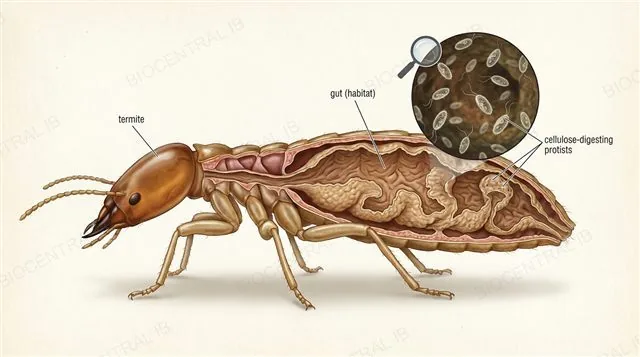
Cutaway diagram of a termite showing cellulose-digesting protists living inside its gut, illustrating that a habitat can be another organism's body, labeled
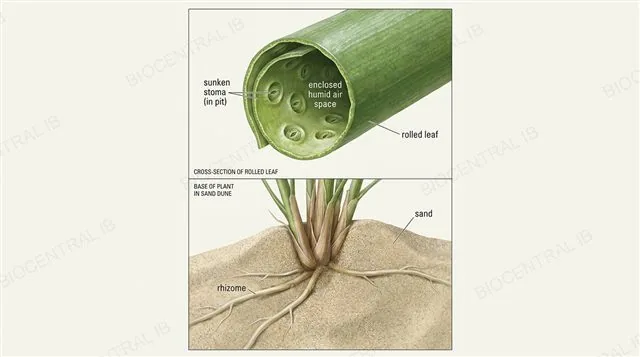
Cross-section of a rolled marram grass leaf showing sunken stomata in pits, an enclosed humid air space, and deep-growing rhizomes anchoring the plant in sand, labeled, photorealistic detail
B4.1.2

Marram grass rolls its leaves to keep water in

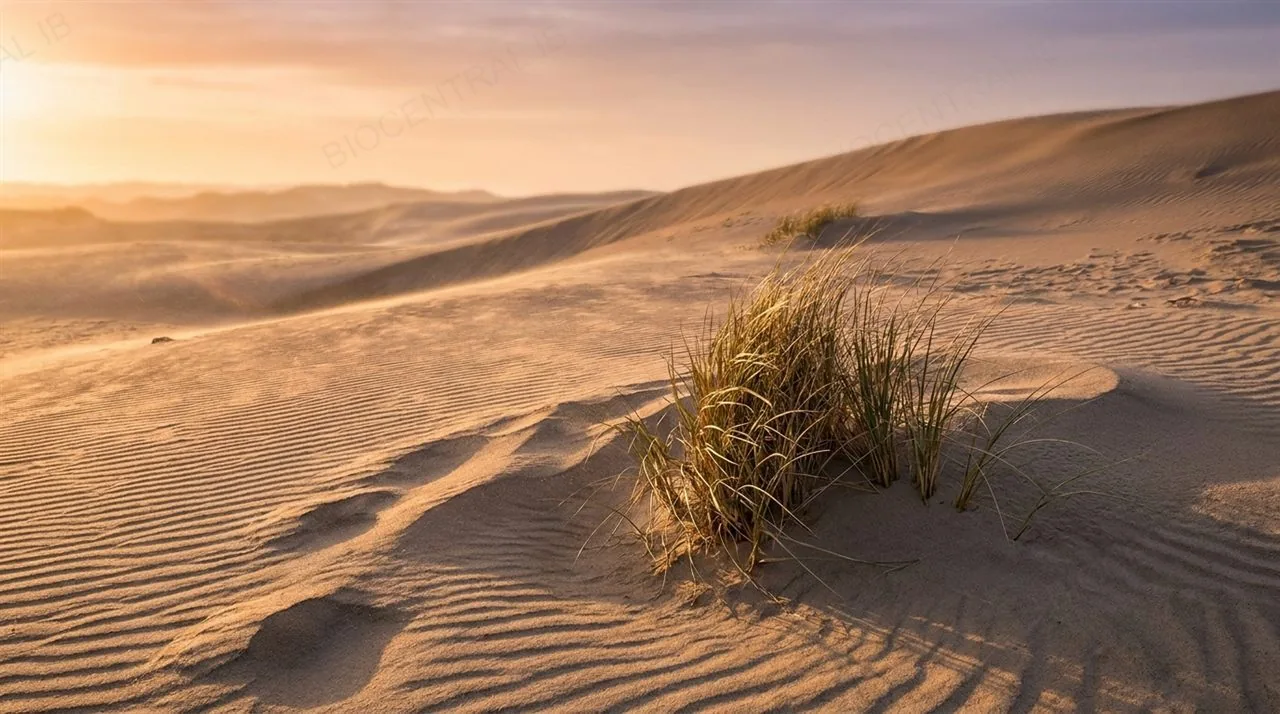
Marram grass (Ammophila arenaria) shows a set of structural adaptations to the abiotic stress of a sand dune habitat: constant wind, free-draining sand and almost no standing water.
  • Its leaves roll up, enclosing a humid pocket of air that shrinks the water-vapour concentration gradient between the leaf interior and the outside air, slowing transpiration.
  • Stomata sit sunken in pits on the leaf's inner rolled surface, trapping a still, moist boundary layer of air right where gas exchange happens; deep-growing rhizomes anchor the plant in shifting sand and help stabilise the dune itself.
Why it mattersEvery one of these features solves the same single problem — a sand dune loses water almost as fast as rain can supply it.
B4.1.2

Mangroves solve the opposite problem

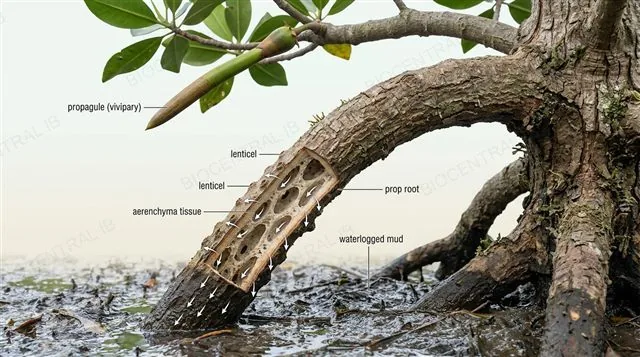
Mangrove trees are adapted to the opposite abiotic stress from a dune: waterlogged, oxygen-poor, salty intertidal mud.
  • Prop roots carry lenticels connected to spongy aerenchyma tissue, letting O₂ diffuse down into the submerged root system in soil that has almost none; red mangroves also exclude salt at the root membrane by ultrafiltration, keeping internal ion concentration low despite growing in seawater.
  • Vivipary — propagules germinating while still attached to the parent tree — gives the seedling a head start rooting fast in soft, shifting intertidal mud before it is ever released.
Why it mattersMarram grass and mangroves are both "plant adapted to a stressful habitat" — but the two habitats' stresses are nearly opposite, so the adaptations barely overlap.
Mangrove prop root cross-section showing lenticels connected to aerenchyma tissue for oxygen diffusion into waterlogged mud, with a viviparous propagule still attached to the parent tree, labeled, photorealistic detail
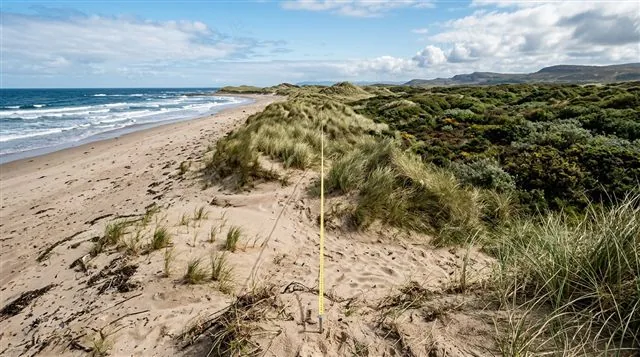
A transect line running across a natural habitat gradient such as a sand dune from shore to inland vegetation, with changing plant species abundance visible along its length, photorealistic landscape photography
B4.1.3

Where a species lives tracks the abiotic conditions it can take

A wide range of abiotic variables limit where a species is found: light intensity, temperature, water availability, soil pH, salinity and oxygen concentration among them, for both plants and animals.
  • Each species can only tolerate abiotic conditions within a certain range — its range of tolerance for that variable — and it is simply absent wherever the real-world value falls outside that range.
  • Because a species' distribution and an abiotic variable can both be measured directly in the field, the two can be correlated against each other rather than only inferred.
Why it matters"Adapted to a habitat" and "has a certain range of tolerance for its abiotic variables" are two ways of saying the same thing.
B4.1.4

One curve, three zones

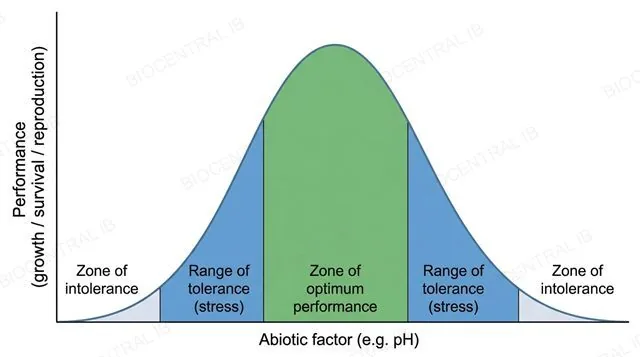
Plotting an organism's performance — growth, survival, reproduction — against a single limiting factor produces a bell-shaped curve with three named zones.
  • A central zone of optimum performance sits where the factor is closest to ideal; flanking zones of physiological stress, together making up the full range of tolerance, are where the organism survives but performs less well.
  • Beyond the range of tolerance lies the zone of intolerance, where the factor is fatal — a plant tolerant of soil pH 6.0–8.5 simply cannot survive at pH 9.0, because 9.0 falls outside its range of tolerance altogether.
Why it mattersThe limiting factor for a species isn't whatever variable is scarcest in absolute terms — it's whichever one that species' own tolerance curve is narrowest for.
A bell-shaped curve graph of organism performance against an abiotic factor, labeled with zone of intolerance, range of tolerance (stress zones) either side of a central zone of optimum performance
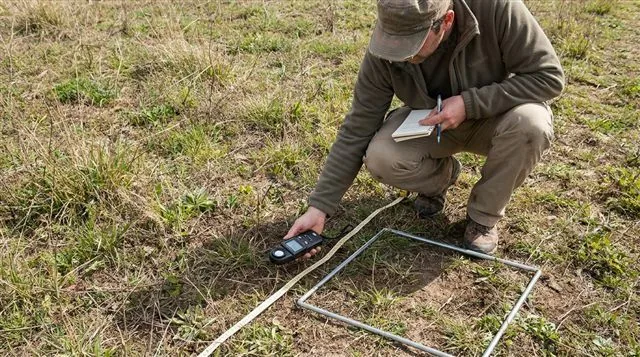
A researcher laying a transect line across a semi-natural habitat and using a light meter and quadrat to record an abiotic variable and species abundance at fixed intervals, photorealistic field photography
B4.1.4 · Application of skills

Proving the curve means going outside

A transect line, laid across a natural or semi-natural habitat where an abiotic variable changes, is how the tolerance-range relationship gets tested with real data rather than assumed.
  • A semi-natural habitat is one shaped by human influence but still dominated by wild rather than cultivated species — a real field site, not a farm.
  • Sensors measure the abiotic variable — temperature, light intensity or soil pH, for example — at fixed points along the line, while species abundance is recorded at the same points, so the two datasets can be plotted against each other directly.
Why it mattersA tolerance curve is a hypothesis until a transect's actual field measurements confirm where a species really does and doesn't turn up.
Quick check

A plant survives across a soil pH range of 6.0–8.5, with its best growth around pH 7.0. At pH 8.0 it still survives but grows slowly. What zone is pH 8.0 in?

Zone of optimum performance
Range of tolerance (a zone of physiological stress)
Zone of intolerance
Outside the plant's habitat entirely
Correct answer: range of tolerance (a zone of physiological stress). pH 8.0 is inside the plant's overall 6.0–8.5 tolerance range — the plant survives — but it's away from the pH 7.0 optimum, so growth is reduced. Only a pH outside 6.0–8.5 entirely, such as 9.0, would put the plant in the zone of intolerance.
Part two

Marine conditions and terrestrial biomes

B4.1.5 – B4.1.7
B4.1.5

A coral reef needs several conditions to line up at once

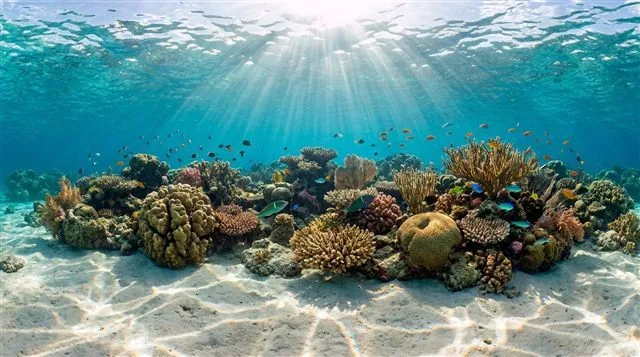
Reef-building corals only form reefs where a specific combination of abiotic marine conditions all hold together, which is why reefs are restricted to tropical and subtropical seas.
  • Water temperature must stay warm and stable, roughly 23–29°C — growth is severely limited below about 18°C and above about 32°C — and water must be shallow and clear enough for light to reach deep into it.
  • Salinity must sit at normal marine levels, pH must stay stable around 8.1–8.4, and nutrient levels must stay low, since excess nutrients favour algal overgrowth that can smother a reef.
Why it mattersLosing any one condition — not just warmth — is enough to stop a reef from forming, which is exactly why reefs are so narrowly distributed on Earth.
A clear, shallow tropical coral reef with sunlight penetrating the water column to the reef structure below, photorealistic underwater photography
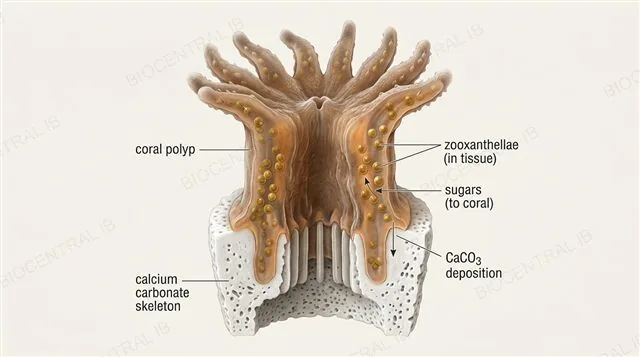
Cross-section of a coral polyp showing photosynthetic zooxanthellae living in its tissue, with arrows showing sugars passing from zooxanthellae to coral and the coral depositing a calcium carbonate skeleton, labeled
B4.1.5

The reef itself is built by a partnership

Reef-building corals host zooxanthellae — photosynthetic dinoflagellates living within their own tissue — in a mutualism that is what actually builds a reef.
  • Zooxanthellae photosynthesis supplies the coral with sugars and other compounds that fuel the coral's own respiration, directly powering the coral's growth and metabolism.
  • That same energy supply drives calcium carbonate deposition — the coral secreting the hard skeleton that accumulates, generation after generation, into a reef structure.
Why it mattersA coral reef isn't really built by corals alone — it's built by corals and their zooxanthellae together, which is why the same warm, clear, low-nutrient water both organisms need is what a reef needs too.
B4.1.6

Two numbers predict which biome forms

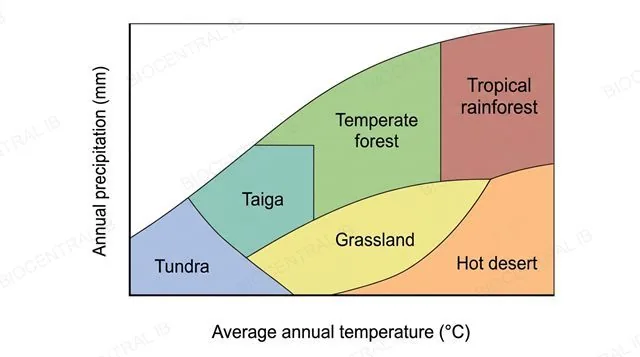
For any given combination of temperature and rainfall pattern, one natural terrestrial ecosystem type is likely to develop — the two variables together are the primary abiotic determinants of biome distribution.
  • Plotting average annual temperature on one axis and annual precipitation on the other produces a graph on which each major biome occupies its own characteristic region — a location on the graph predicts a biome, not the other way around.
  • Consistently warm temperatures with very high year-round rainfall predict tropical rainforest; a seasonal warm/cold cycle with moderate, fairly even rainfall predicts temperate forest; cold winters and moderate precipitation predict taiga; low-to-moderate rainfall between forest and desert levels predicts grassland; low rainfall with extreme temperature swings predicts hot desert; and very low temperature and precipitation predict tundra.
Why it mattersTwo climate numbers, not soil type or the species already living there, are what actually decide which biome forms in a given place.
A climate graph with average temperature on the horizontal axis and annual precipitation on the vertical axis, divided into labeled regions for tropical rainforest, temperate forest, taiga, grassland, hot desert and tundra, clean scientific diagram
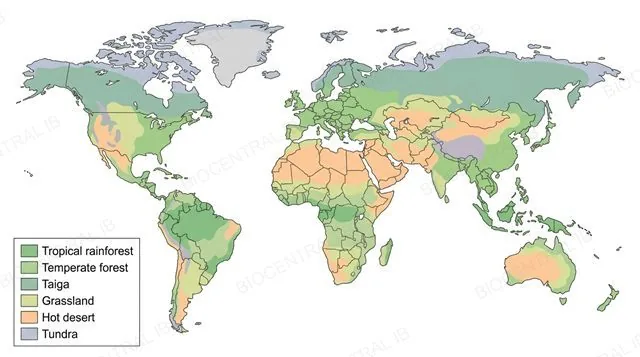
A simplified world map showing the global distribution of six terrestrial biomes: tropical rainforest, temperate forest, taiga, grassland, hot desert and tundra, each in a distinct color, labeled with a legend
B4.1.7

A biome is a climate, not a location

A biome is a group of ecosystems that share similar communities because they experience similar abiotic conditions — even when those ecosystems are on opposite sides of the planet.
  • The tundra biome, for example, is defined by permafrost, extremely cold year-round temperatures and very low precipitation (mainly snow) — conditions that recur wherever they occur, regardless of continent.
  • Because biomes are defined by shared abiotic conditions rather than shared ancestry, the same biome type can appear on multiple continents that have had no ecological contact with each other for millions of years.
Why it mattersTwo ecosystems can look almost identical without a single shared ancestor between their species — climate, not lineage, is what a biome actually tracks.
B4.1.7

Unrelated deserts, the same solution

Similar abiotic pressures within a biome drive convergent evolution — unrelated organisms independently evolving similar adaptations to the same problem.
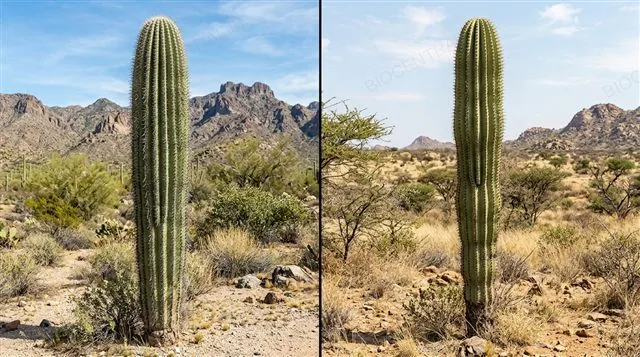
  • Cacti in the deserts of the Americas and euphorbias in the deserts of Africa are only distantly related, yet both independently evolved thick succulent stems for water storage, spines instead of broad leaves, and CAM photosynthesis.
  • Neither plant family inherited these traits from a shared desert-adapted ancestor — the resemblance exists because the same arid desert pressures acted on both lineages separately, on separate continents.
Why it mattersTwo plants can end up looking almost like twins purely because they solved the same problem separately — convergent evolution is what makes a biome's "similar communities" claim true even without shared ancestry.
A cactus from the Americas beside a euphorbia from Africa, both showing thick succulent spiny stems, side by side comparison highlighting convergent evolution, photorealistic
Quick check

Cacti (Americas) and euphorbias (Africa) both have succulent stems, spines and CAM photosynthesis, despite not being closely related. What best explains this?

They share a common desert-adapted ancestor from before the continents separated
Cacti were introduced to Africa and evolved into euphorbias
Convergent evolution — similar arid abiotic pressures independently selected for similar traits in each unrelated lineage
Random genetic drift coincidentally produced identical traits in both groups
Correct answer: convergent evolution. Cacti and euphorbias are not closely related — the shared arid desert pressures on separate continents independently selected for the same set of water-conserving, herbivore-deterring traits in each lineage, which is exactly what convergent evolution means.
Part three

Life at the extremes: desert and rainforest

B4.1.8
B4.1.8

In the desert, water comes from food, not drinking

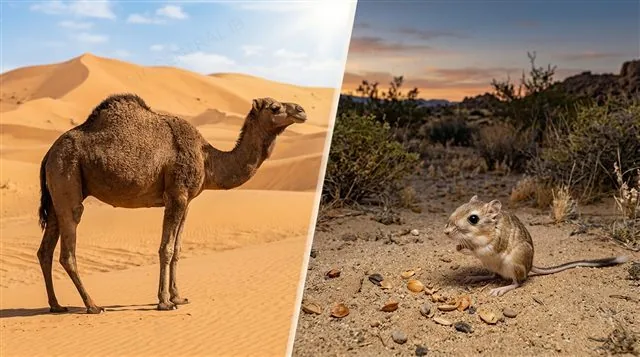
Hot desert animals share the same core problem — almost no free water to drink — but reach the same solution, metabolic water, by different routes.
  • A camel's hump stores fat rather than water; metabolising that fat generates both energy and metabolic water, reducing how often the camel needs to drink.
  • Kangaroo rats go further still: they survive without ever drinking at all, obtaining essentially all their water as metabolic water from oxidising the carbohydrates, fats and proteins in the seeds they eat.
Why it matters"Desert animal" doesn't mean "needs less water" — it means "gets its water from a different source," usually its own food.
A camel standing in a hot desert landscape beside a kangaroo rat, both shown obtaining water metabolically from food rather than drinking, photorealistic wildlife photography
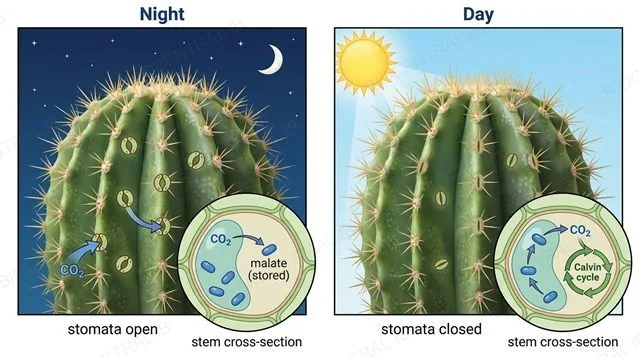
A desert cactus shown in two panels, stomata open at night taking up CO2 and fixing it into malate for storage, stomata closed during the hot day while stored malate feeds the Calvin cycle, labeled CAM photosynthesis
B4.1.8

A cactus opens its stomata when it's dark

Desert cacti use CAM (crassulacean acid metabolism) photosynthesis, a strategy that separates when CO₂ is captured from when it is actually used.
  • Stomata open only at night, when temperatures are lower and humidity is higher, minimising the water lost to transpiration during gas exchange.
  • CO₂ taken up at night is fixed into malate and stored; during the day, with stomata closed to prevent water loss, the stored malate releases CO₂ internally to feed the Calvin cycle using daylight energy.
Why it mattersCAM doesn't avoid the water-loss problem of photosynthesis — it just times the CO₂-capturing step for when that cost is cheapest to pay.
B4.1.8

A rainforest tree needs a wider base than its roots can give it

Tropical rainforest soil is often thin and nutrient-poor, which creates a structural problem for the very tall trees that grow in it.
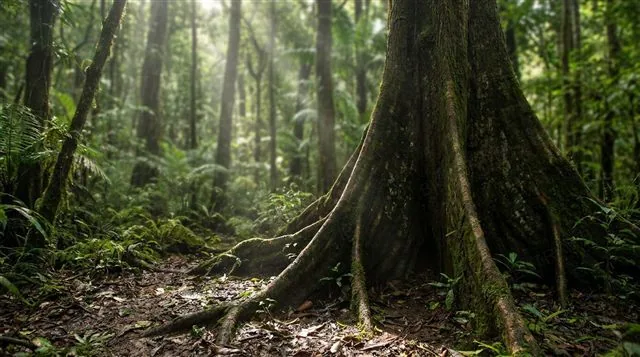
  • Buttress roots — wide, flaring extensions of the trunk that spread out above and below the soil surface — stabilise a tall tree against toppling in soil too thin to anchor deep roots alone.
  • The same flared structure also increases the root system's surface area, helping the tree take up what nutrients the thin topsoil does hold.
Why it mattersButtress roots solve a mechanical problem (staying upright) and a nutritional one (thin soil) with a single structure.
A tall tropical rainforest tree trunk with large flaring buttress roots spreading out at its base above the forest floor, photorealistic
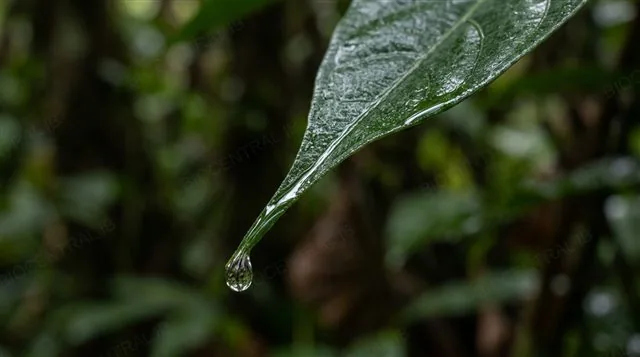
A close-up macro photograph of a tropical rainforest leaf with an elongated pointed drip tip, a water droplet running off the very end of the tip, photorealistic
B4.1.8

A pointed leaf tip sheds water fast

Rainforest leaves face near-constant rainfall, and a wet leaf surface is a standing invitation to fungi and bacteria.
  • A drip-tip leaf — an elongated, pointed extension at the leaf's end — funnels rainwater off the leaf surface faster than a rounded leaf tip would.
  • Shortening how long the leaf surface stays wet directly reduces how long fungi and epiphyllous bacteria have to colonise it, lowering disease and overgrowth risk in a habitat that is wet almost every day.
Why it mattersIn a hot desert the adaptation problem is keeping water in; in a rainforest it can just as easily be getting water off the leaf fast enough.

Key vocabulary

This entire topic is SL and HL — worth being able to define each in a single sentence

Habitat
The physical place where a community, species, population or organism lives.
Niche
The functional role an organism plays in its ecosystem, distinct from where it lives.
Adaptation
An inherited trait that improves survival and reproduction in a specific habitat.
Range of tolerance
The span of an abiotic factor's values within which an organism can survive.
Limiting factor
The abiotic variable that most restricts a species' distribution or performance.
Zooxanthellae
Photosynthetic dinoflagellates living in coral tissue, supplying sugars in exchange for shelter.
Biome
A group of ecosystems with similar communities due to similar abiotic conditions.
Convergent evolution
Unrelated organisms independently evolving similar traits under similar pressures.
CAM photosynthesis
Opening stomata at night to fix CO₂ into malate, minimising daytime water loss.
Vivipary
A propagule germinating while still attached to its parent plant.

Where this shows up again

B4.2
Habitat describes where a species lives; niche describes how it lives (B4.2). Using the termite gut example, explain why two species could share exactly the same habitat but still occupy different niches.
A4.1
Convergent evolution produced similar traits in cacti and euphorbias (B4.1.7). Explain why convergent evolution is evidence for natural selection acting on unrelated lineages, rather than evidence of shared ancestry.
C1.3
CAM photosynthesis (B4.1.8) separates CO₂ fixation from the Calvin cycle in time. Relate this to the light-dependent and light-independent reactions of photosynthesis covered in C1.3.
C4.1
A species' range of tolerance for a limiting factor (B4.1.4) constrains where its population can grow. Explain how this connects to carrying capacity and population distribution in C4.1.

B4.1 Adaptation to environment — one-page recap

Screenshot this slide to revise from — this entire topic is SL and HL

Habitat & adaptation
  • Habitat = where; niche = how.
  • Marram grass (dune) vs mangrove (mud) — opposite stresses.
Tolerance & distribution
  • Bell curve: optimum → stress → intolerance.
  • Transect correlates species with an abiotic variable.
Coral reefs
  • Warm (23–29°C), clear, low-nutrient, stable pH.
  • Zooxanthellae mutualism builds the reef.
Biomes
  • Temperature + precipitation predict biome.
  • Same biome, unrelated continents = shared climate.
Convergent evolution
  • Cactus ≈ euphorbia: no shared ancestor, shared pressure.
Desert & rainforest
  • Desert: metabolic water, CAM photosynthesis.
  • Rainforest: buttress roots, drip-tip leaves.

Every adaptation is an answer to a habitat's question

A rolled leaf, a stored fat hump, a pointed leaf tip — each one only makes sense once you know exactly what problem its habitat was asking it to solve.
B4.1 Adaptation to environment · BioCentral IB
Use ↓ ↑ or click to navigate
01 / 22