BioCentral IBBioCentral IB
IB BIOLOGY · THEME B · B4.2

Ecological niches

No two species share a job description — a niche is everything about how, when and on what a species survives, from the oxygen it needs to the food it eats to the neighbours it can't coexist with.
Guiding questions

What are the advantages of specialized modes of nutrition to living organisms?

How are the adaptations of a species related to its niche in an ecosystem?

Part one

Niche, nutrition and the tools to get food

B4.2.1 – B4.2.8
B4.2.1

A niche is a job, not an address

An ecological niche is the full role a species plays in its ecosystem — every biotic and abiotic interaction that shapes its growth, survival and reproduction, not simply where it lives.
  • Habitat is the "address" — the physical place a species occupies. Niche is the "profession": how it gets food, which abiotic conditions (temperature, pH, light) it tolerates, and how it interacts with predators, competitors and prey.
  • Because niche captures so many dimensions at once, it is effectively unique to each species — even close relatives sharing a habitat differ in some aspect of how they make a living there.
Why it mattersConfusing habitat with niche is the single most common mistake on this topic — habitat is only one input into a much larger picture.
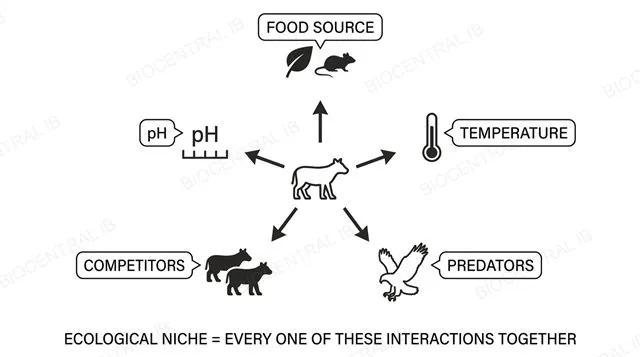
A single organism at the centre of a diagram with labeled arrows pointing to food source, temperature, predators, competitors and pH, illustrating an ecological niche as a set of interactions
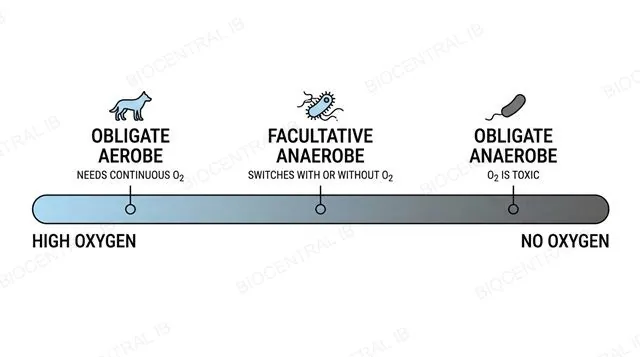
A horizontal oxygen-tolerance gradient labeled from obligate aerobe through facultative anaerobe to obligate anaerobe, with example organism icons at each point
B4.2.2

How much oxygen can an organism tolerate?

Obligate aerobes, facultative anaerobes and obligate anaerobes sit at three different points on a single abiotic gradient — tolerance to oxygen gas.
  • Obligate aerobes need a continuous oxygen supply and cannot survive without it — most animals, plants and many bacteria fall here.
  • Facultative anaerobes can switch pathway and respire with or without oxygen depending on what's available, while obligate anaerobes survive only in oxygen-free environments — for many, oxygen is directly toxic.
Why it mattersOxygen availability alone can carve out separate niches within one habitat — from a pond's surface to its oxygen-starved mud.
B4.2.3

Three groups, one autotrophic strategy

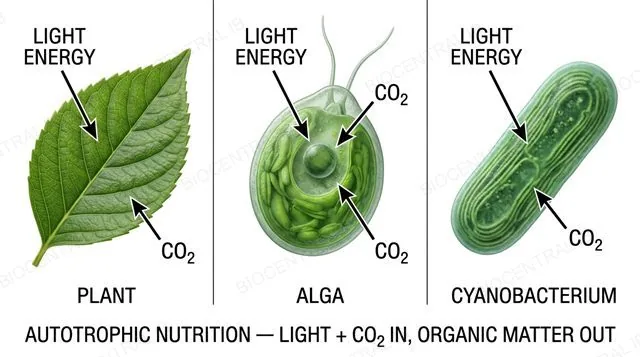
Photosynthesis is the autotrophic mode of nutrition shared by plants, algae and several groups of photosynthetic prokaryotes, using light energy to fix carbon dioxide into organic compounds.
  • All three groups convert light energy into chemical energy stored in organic molecules, without consuming other organisms for carbon or energy — the defining feature of an autotroph.
  • The biochemical details differ between groups (prokaryotic photosynthesis pathways are not required), but the outcome is the same: new organic matter built from CO₂, water and light.
Why it mattersPhotoautotrophs form the base of almost every food chain — nearly every heterotroph on the planet ultimately depends on this one nutritional mode.
A green plant leaf, a green algal cell and a cyanobacterium shown side by side, each with an arrow labeled light energy and an arrow labeled carbon dioxide entering, captioned autotrophic nutrition
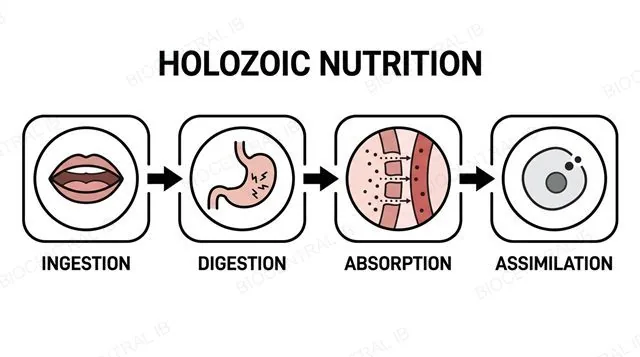
A simplified digestive tract diagram with four labeled sequential stages: ingestion, digestion, absorption and assimilation, connected by arrows
B4.2.4

Four steps from meal to tissue

Holozoic nutrition is the heterotrophic mode used by most animals — food is ingested, digested internally, absorbed and assimilated, in that order.
  • Ingestion takes food into the body through the mouth; digestion then breaks it down mechanically and chemically, using enzymes, into smaller soluble molecules.
  • Absorption moves those small molecules across a membrane into cells or the bloodstream; assimilation is the final step, incorporating them into the organism's own tissues.
Why it mattersAll animals are heterotrophic — none can photosynthesise — so holozoic nutrition is the mechanism almost every animal niche is built around.
B4.2.5

Euglena runs both modes at once

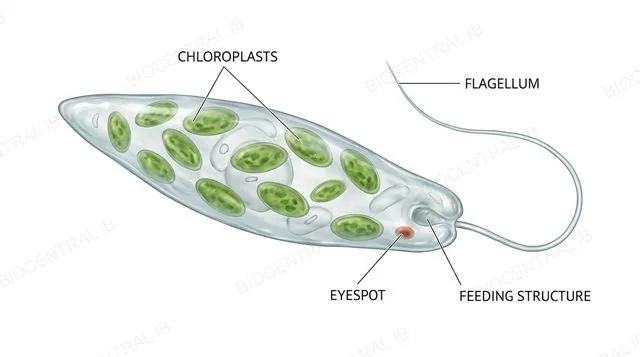
Mixotrophic nutrition combines autotrophic and heterotrophic modes within a single organism — common among protists and a large share of oceanic plankton.
  • Euglena is the classic freshwater example: it carries chloroplasts for photosynthesis and a feeding structure for ingesting particles, switching between or combining the two as conditions demand.
  • Obligate mixotrophs use both modes continuously; facultative mixotrophs switch between them, often depending on light availability.
Why it mattersMixotrophy blurs the tidy autotroph/heterotroph divide — nutrition modes are strategies, not fixed categories, wherever flexibility pays off.
A Euglena cell shown in microscopy style with its chloroplasts labeled, its flagellum labeled, its eyespot labeled and its feeding structure labeled
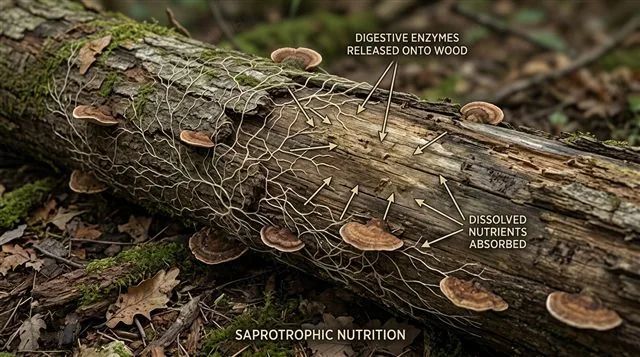
A saprotrophic fungus growing on a decaying log, with labeled arrows showing digestive enzymes released onto the wood and small dissolved nutrient molecules being absorbed back into the fungus
B4.2.6

Digesting the meal outside the body

Saprotrophic nutrition is a heterotrophic mode used by decomposer fungi and bacteria, which digest dead organic matter extracellularly before absorbing the products.
  • Saprotrophs release digestive enzymes onto dead or decaying matter, breaking complex molecules down outside their own cells rather than ingesting food whole.
  • The resulting small, soluble molecules are then absorbed directly across the cell surface — no ingestion step is needed at all.
Why it mattersSaprotrophs are the ecosystem's recyclers — without extracellular digestion, the nutrients locked in dead matter would never cycle back for other organisms to use.
B4.2.7

Archaea: one domain, many strategies

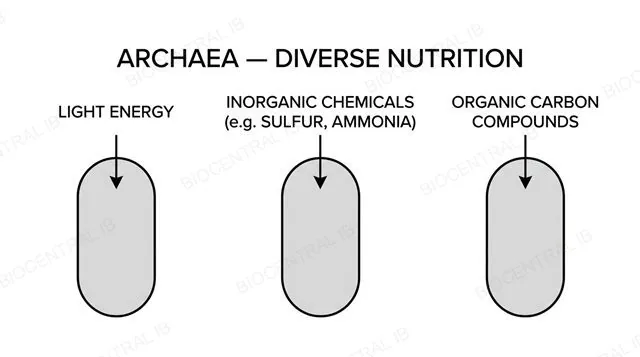
Archaea are one of the three domains of life, and they show an unusually wide diversity of ways to obtain the energy needed for ATP production.
  • Some archaea harvest light energy directly; others oxidise inorganic chemicals such as sulfur or ammonia compounds; still others oxidise organic carbon compounds, much like typical heterotrophs.
  • Naming specific archaeal species and the detailed biochemical mechanisms behind each strategy are both outside what is required here.
Why it mattersThis diversity is exactly why archaea earned their own domain — no single nutritional label captures how they collectively get energy.
Three archaeal cell icons under the heading archaea diverse nutrition, each with a labeled arrow reading light energy, inorganic chemicals, or organic carbon
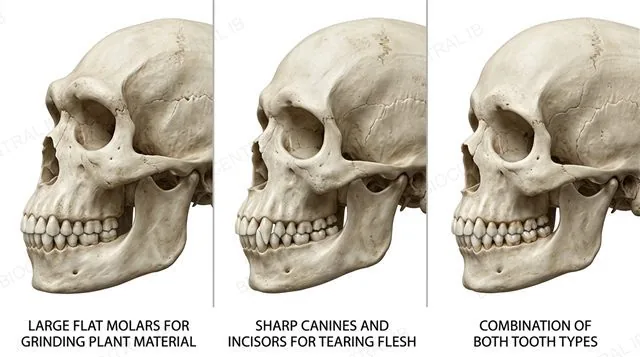
Three hominid skull and jaw close-ups compared side by side, one labeled large flat molars for grinding plant material, one labeled sharp canines and incisors for tearing flesh, one labeled a combination of both tooth types
B4.2.8

Teeth tell you what a hominid ate

Tooth structure correlates closely with diet, letting researchers infer the diet of extinct hominids such as Homo floresiensis and Paranthropus robustus from skull and dental evidence alone.
  • Herbivorous and omnivorous hominids, including modern Homo sapiens, carry large, flat molars suited to grinding tough plant material; more carnivorous diets favour sharper canines and incisors for tearing flesh.
  • Omnivorous species typically show a combination of both tooth types, reflecting a mixed diet rather than a specialised one.
Why it mattersNOS: this is a deduction, not a direct observation — dentition patterns in living mammals let scientists infer the diet of species known only from fossils.
Quick check

Euglena has both chloroplasts and a feeding structure, and switches between photosynthesising and ingesting food particles depending on light availability. What term best describes this?

Obligate mixotroph — it uses both modes at once, all the time
Facultative mixotroph — it switches between modes depending on conditions
Obligate autotroph — it can only photosynthesise
Holozoic heterotroph — it ingests, digests, absorbs and assimilates food
Correct answer: facultative mixotroph. Obligate mixotrophs use both modes continuously and simultaneously; a facultative mixotroph like this one switches between autotrophic and heterotrophic nutrition depending on conditions such as light availability.
Part two

Adaptation, competition and niche breadth

B4.2.9 – B4.2.13
B4.2.9

Mouthparts built to break in

Herbivores and the plants they feed on are locked in antagonistic coevolution, each evolving traits in response to the other — starting with how herbivores physically access plant tissue.
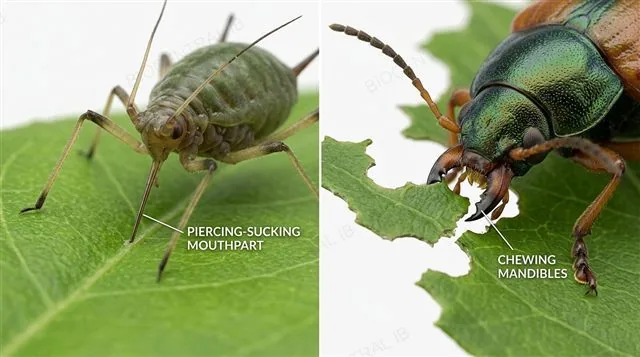
  • Chewing mandibles, seen in leaf-eating beetles, crush and macerate tough plant material so it can be digested.
  • Piercing and sucking mouthparts, such as an aphid's stylet, instead puncture plant tissue to drink sap directly, avoiding the need to break down solid plant matter at all.
Why it mattersTwo completely different mouthpart strategies solve the same underlying problem — plant tissue is hard to access — in mechanically opposite ways.
An aphid's needle-like stylet piercing into a leaf labeled piercing sucking mouthpart, next to a leaf beetle's mandibles chewing a leaf edge labeled chewing mandibles
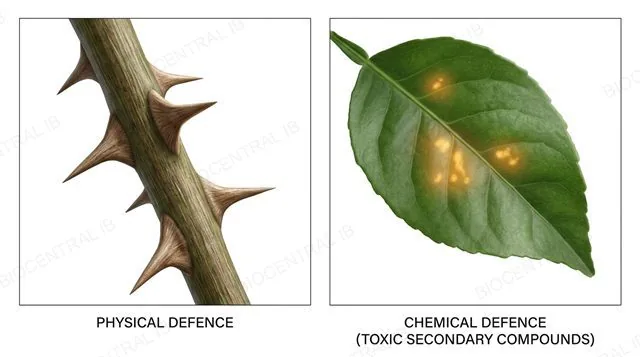
A plant stem with sharp thorns labeled physical defence, and a leaf with a glowing internal callout labeled toxic secondary compounds representing chemical defence
B4.2.9

Plants fight back, chemically and physically

Plants resist herbivory with both physical structures and chemical defences, and some herbivores have evolved metabolic countermeasures of their own.
  • Physical defences include thorns and other structures that make feeding difficult or costly for the herbivore.
  • Chemical defences are toxic secondary compounds concentrated in seeds and leaves — the plant's most valuable tissue — deterring or poisoning would-be feeders.
  • Some herbivores have evolved metabolic adaptations that detoxify these compounds, letting them feed on plants that repel most other species.
Why it mattersA herbivore's tolerance for one plant's toxins often defines its niche — it can eat what its competitors cannot.
B4.2.10

Finding, catching and killing prey

Predators carry a suite of adaptations for locating, capturing and dispatching prey — chemical, physical and behavioural, all shaped by the same pressure to hunt successfully.
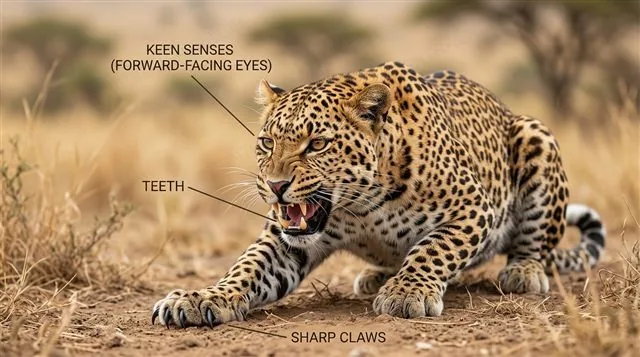
  • Physical adaptations include sharp claws and teeth for gripping and killing, alongside keen senses — vision, smell or hearing tuned to detect prey at a distance.
  • Chemical adaptations include venoms and toxins that subdue prey quickly; behavioural adaptations include stealth, ambush and coordinated pack hunting.
Why it mattersNo single adaptation defines a predator — successful hunting usually needs several of these working together at once.
A predator animal such as a big cat shown with its sharp claws labeled, its teeth labeled, and its forward-facing eyes labeled keen senses
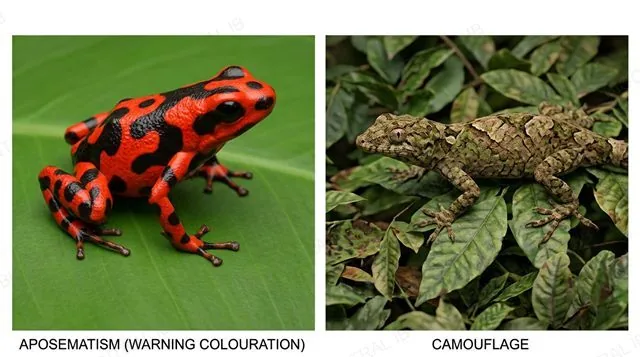
A brightly coloured poison-dart-frog-like animal labeled aposematism next to a mottled, leaf-patterned animal that blends into its background labeled camouflage
B4.2.10

Prey evolve just as many ways to survive

Prey species counter predation with their own chemical, physical and behavioural defences, keeping predator and prey locked in the same evolutionary arms race.
  • Physical defences include exoskeletons and spines; chemical defences include toxins or irritant sprays that make an animal dangerous or unpleasant to eat.
  • Camouflage hides prey from detection, while aposematism does the opposite — bright warning colouration advertising real toxicity. Harmless species sometimes mimic this colouration (Batesian mimicry) without being toxic at all.
Why it mattersAposematism only works if predators learn to associate the colour with a bad outcome — exactly what lets a harmless mimic exploit the same warning for free.
B4.2.11

Two ways to reach the canopy

In a forest, direct sunlight is a scarce resource confined to the canopy — and plants have evolved very different structural strategies to reach it.
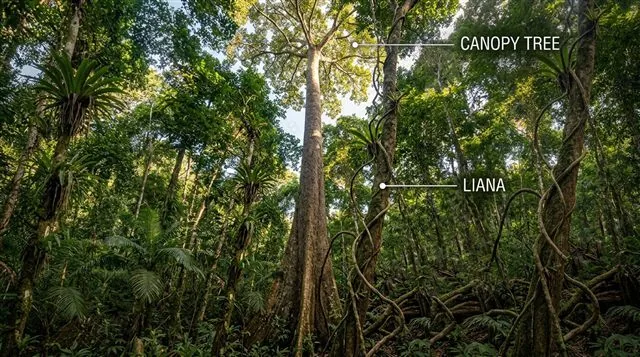
  • Canopy trees invest heavily in a tall, self-supporting trunk, growing above the general canopy layer to secure their own direct light.
  • Lianas take a cheaper route: these woody vines climb existing trees to reach the canopy without ever building a trunk capable of supporting their own height.
Why it mattersA liana reaches the same light as a canopy tree while investing a fraction of the resources in structural support — a different economic strategy for the same goal.
A forest scene with one tall canopy tree labeled canopy tree and a woody vine climbing around its trunk toward the canopy labeled liana
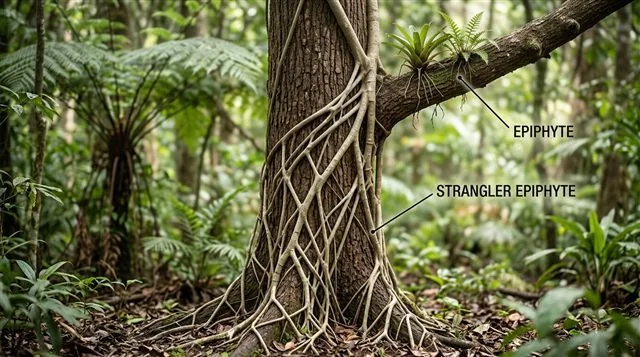
A host tree trunk with a strangler fig's aerial roots wrapped around and descending to the ground labeled strangler epiphyte, and smaller plants rooted directly on a branch higher up labeled epiphyte
B4.2.11

Living on another plant entirely

Epiphytes skip the ground altogether, growing directly on the branches of other trees to access light high in the canopy without competing for space at the forest floor.
  • True epiphytes root only on their host's branches, taking nothing from the host except physical support and a place in the light.
  • Strangler epiphytes (hemiepiphytes) start the same way but send roots down to the ground as they grow, eventually enclosing and sometimes killing the host tree they started on.
Why it mattersA strangler epiphyte's growth shows that "epiphyte" describes a starting strategy, not a permanent lifestyle — some go on to functionally replace their host.
B4.2.11

Thriving where light barely reaches

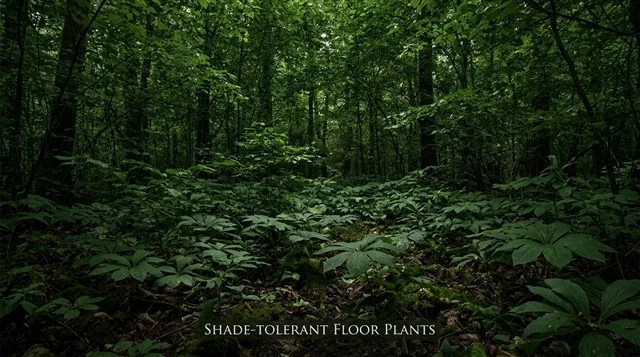
Shade-tolerant shrubs and herbs occupy the forest floor, adapted to photosynthesise efficiently even under the deep shade cast by the canopy above.
  • These plants forgo the height race entirely, investing instead in leaves and photosynthetic machinery efficient enough to make a living on a small fraction of full sunlight.
  • Their niche exists specifically because canopy trees, lianas and epiphytes have already claimed almost all the direct light overhead.
Why it mattersFive different strategies for one resource, light, are exactly what "niche" means in practice — each plant form is a distinct way of making a living in the same forest.
A dim forest floor scene beneath a dense overhead canopy, with broad-leaved shade-tolerant shrubs and herbs growing low to the ground, labeled shade-tolerant floor plants
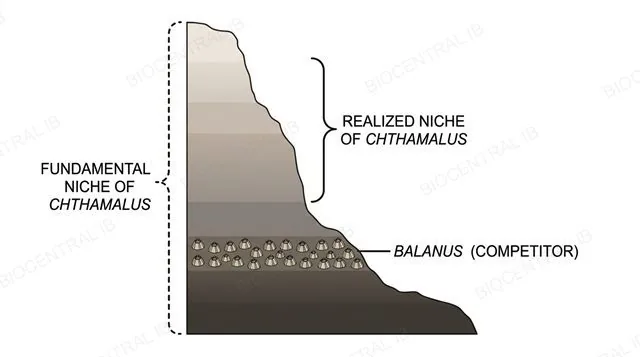
A rocky intertidal shore cross-section with a dashed outline labeled fundamental niche of Chthamalus spanning the whole shore, and a solid outline labeled realized niche of Chthamalus restricted to the upper zone where a competitor labeled Balanus occupies the lower zone
B4.2.12

What a species could do vs what it actually does

The fundamental niche is a species' full potential range, set only by its own adaptations and abiotic tolerance limits; the realized niche is the smaller range it actually occupies once competition is factored in.
  • The barnacle Chthamalus can physiologically survive across the entire intertidal zone — its fundamental niche — but competition from Balanus and Semibalanus restricts it to the upper intertidal in practice, its realized niche.
  • A realized niche is always a subset of, or at most equal to, the fundamental niche — it can never be larger.
Why it mattersThe gap between fundamental and realized niche is a direct, measurable signature of competition at work in a real ecosystem.
B4.2.13

Two identical niches can't coexist

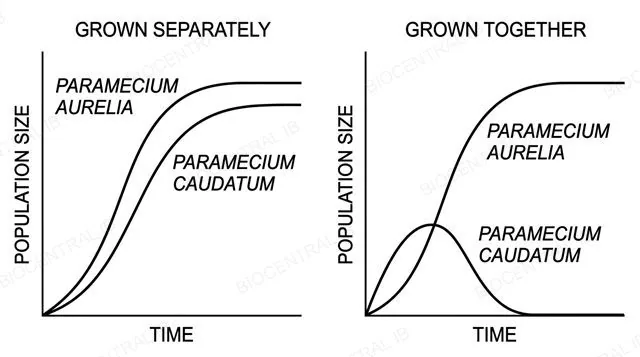
The competitive exclusion principle states that two species with fully overlapping niches cannot coexist indefinitely in the same habitat — competition for the same limited resources eventually favours one over the other.
  • G. F. Gause demonstrated this directly with two Paramecium species: grown separately, both thrived; grown together, Paramecium aurelia consistently outcompeted and eliminated Paramecium caudatum.
  • Elimination of one competitor is only one possible outcome — the other is that both species survive but are restricted to only part of their original fundamental niche.
Why it mattersIdentical resource needs cannot both be met indefinitely from a limited supply — competitive exclusion, demonstrated in a test tube.
Two population-over-time graphs side by side, the left labeled grown separately showing both Paramecium aurelia and Paramecium caudatum thriving as two rising curves, the right labeled grown together showing the Paramecium aurelia curve rising while the Paramecium caudatum curve falls to zero
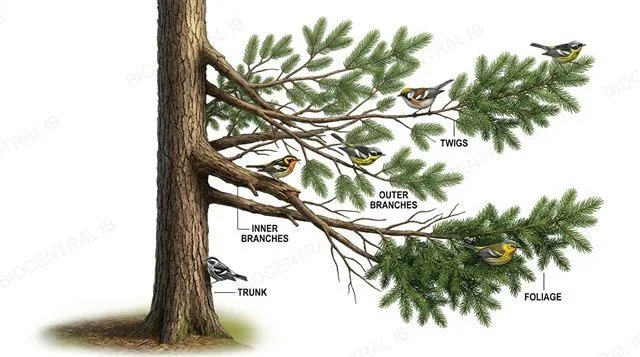
A single spruce tree cross-section with five small warbler bird icons perched at five different labeled foraging zones: trunk, inner branches, outer branches, twigs and foliage
B4.2.13

Sharing a resource without competing

Niche partitioning is the alternative to elimination — competing species divide a shared resource along some dimension, each restricted to part of their fundamental niche, and both persist.
  • Five warbler species foraging in the same spruce forest partition by feeding zone — trunk, inner branches, outer branches, twigs and foliage — rather than competing head-on for the same insects.
  • Darwin's finches partition by beak and seed size, and some predator pairs partition by time of activity, one hunting by day and the other by night.
Why it mattersBecause every realized niche is shaped by a unique set of competitors, no two species end up with truly identical realized niches — partitioning is what makes coexistence possible.
Quick check

Two species of ground finch on the same island eat seeds of very different sizes — one large and tough, one small and soft. What does this pattern best illustrate?

Competitive exclusion — one species is about to go extinct
Niche partitioning — the two species divide the shared food resource by seed size, reducing competitive overlap
Both finches share an identical fundamental niche
Both finches are saprotrophic decomposers
Correct answer: niche partitioning. Rather than competing directly for the same seeds, the two finch species divide the resource by size — each restricted to a different part of the shared fundamental niche, which is exactly what lets them coexist instead of one excluding the other.

Key vocabulary

Worth being able to define in a single sentence each

Ecological niche
The full role of a species in its ecosystem, including every biotic and abiotic interaction that shapes it.
Obligate anaerobe
An organism that survives only without oxygen, for which O₂ is often directly toxic.
Holozoic nutrition
Heterotrophic nutrition via ingestion, digestion, absorption and assimilation of food.
Mixotrophic nutrition
Nutrition combining autotrophic and heterotrophic modes within a single organism.
Saprotrophic nutrition
Extracellular digestion of dead organic matter, followed by absorption of the products.
Fundamental niche
A species' full potential niche, limited only by its own adaptations and abiotic tolerances.
Realized niche
The niche a species actually occupies once competition and other biotic interactions are factored in.
Competitive exclusion
The principle that two species with fully overlapping niches cannot coexist indefinitely.
Niche partitioning
Division of a shared resource along some dimension, allowing competing species to coexist.

Where this shows up again

B4.1
Resource partitioning reduces interspecific competition. How does this concept relate to the evolution of adaptations (B4.1) — specifically, how can competition act as a selective pressure that drives divergence in traits between species?
C4.2
Population size is influenced by energy availability in ecosystems. Explain how energy transfer through food chains (C4.2) limits the carrying capacity for top predators.
C4.2
Keystone species have disproportionate effects on their communities. Using a named example, explain how the removal of a keystone species can trigger a trophic cascade that alters the entire ecosystem structure.
D4.3
Climate change (D4.3) is shifting the geographic ranges of many species. Using the niche concept, explain why some species can track their fundamental niche by shifting their range, while others cannot and face extinction.

B4.2 Ecological niches — one-page recap

Screenshot this slide to revise from

Niche & nutrition modes
  • Niche = full role, not just habitat.
  • Photosynthetic, holozoic, mixotrophic, saprotrophic, archaeal.
Oxygen tolerance
  • Obligate aerobe / facultative anaerobe / obligate anaerobe.
  • One O₂ gradient, three tolerance strategies.
Dentition & diet
  • Flat molars = herbivore/omnivore; sharp canines = carnivore-leaning.
  • Diet deduced from fossil skulls (NOS).
Herbivory & predation
  • Herbivore mouthparts vs. plant thorns/toxins.
  • Predator claws/venom vs. prey camouflage/aposematism.
Harvesting light
  • Canopy trees, lianas, epiphytes, stranglers, shade-floor plants.
  • Five strategies, one scarce resource.
Niche breadth & competition
  • Fundamental (potential) vs. realized (actual) niche.
  • Competitive exclusion or niche partitioning.

Every species, its own way of making a living

A niche is never one trait — it's the whole overlapping set of what a species eats, tolerates and competes against.
B4.2 Ecological niches · BioCentral IB
Use ↓ ↑ or click to navigate
01 / 22