BioCentral IBBioCentral IB
IB Biology · Theme C · C1.2

Cell respiration

Every active thing a cell does is paid for in ATP — cell respiration is the stepwise system, from glycolysis to the electron transport chain, that keeps that currency in supply.
Guiding questions

What are the roles of hydrogen and oxygen in the release of energy in cells?

How is energy distributed and used inside cells?

Part one

ATP and the energetics of respiration

C1.2.1 – C1.2.6
C1.2.1

ATP is the cell's energy currency

ATP (adenosine triphosphate) is a nucleotide that distributes energy within cells, carrying it from where it's released to wherever it's needed.
  • ATP is built from the base adenine, the sugar ribose, and a chain of three phosphate groups — the same core structure as an RNA nucleotide, with two extra phosphates.
  • It is small and water-soluble, so it diffuses quickly to any part of the cell that needs energy, rather than staying fixed in one place.
  • Cells keep only a small ATP pool and continuously regenerate it from ADP (adenosine diphosphate) and phosphate, instead of stockpiling energy the way starch or fat is stored.
Why it mattersATP isn't valuable for holding unusual amounts of energy — it's valuable for being small, mobile, and constantly recycled.
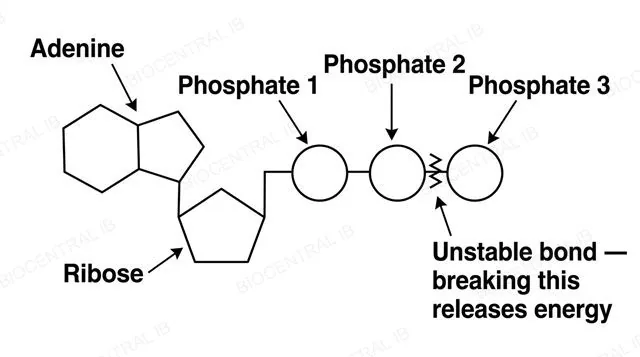
Labeled diagram of ATP's molecular structure showing adenine, ribose and three phosphate groups with the unstable terminal bond marked
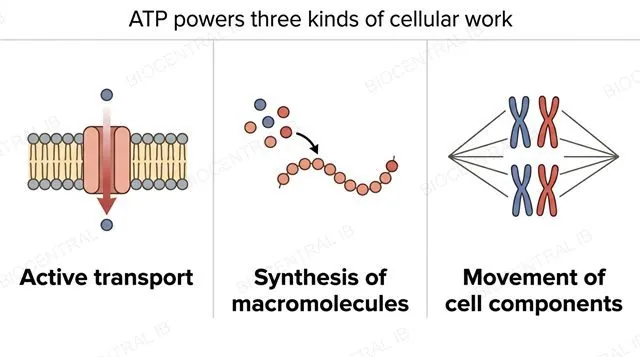
Three-panel diagram of active transport, macromolecule synthesis and movement of cell components as the three categories of work ATP powers
C1.2.2

ATP pays for three kinds of work

Cell respiration supplies ATP to a small number of energy-requiring processes in the cell, grouped into three categories.
  • Active transport moves substances across a membrane against their concentration gradient — from ion pumps to reabsorption in the kidney — and always costs ATP.
  • Synthesis of macromolecules (anabolism) uses ATP to drive condensation reactions that build polysaccharides, proteins, and nucleic acids from their smaller subunits.
  • Movement of the whole cell or of its components — chromosomes being pulled apart during mitosis, or a flagellum beating — is also powered directly by ATP hydrolysis.
Why it mattersEvery one of these three categories moves something against a gradient or against inertia — passive processes like diffusion never belong on this list.
C1.2.3

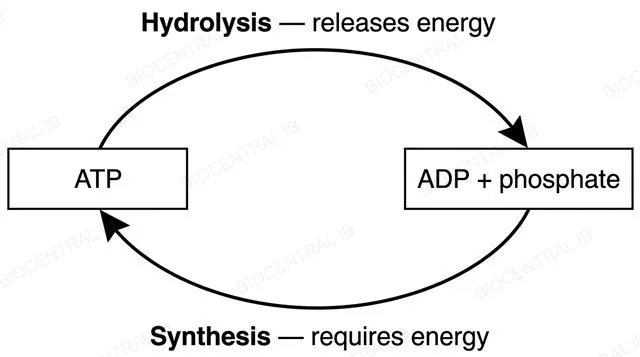
Releasing energy and storing it are opposite reactions

Hydrolysis of ATP to ADP and phosphate releases energy, while synthesising ATP from ADP and phosphate requires an input of energy.
  • Breaking the bond to the terminal phosphate group is exergonic — energy is released and made available to drive an energy-requiring process elsewhere in the cell.
  • Reforming that bond, joining ADP and phosphate back into ATP, is endergonic — the energy for this comes from cell respiration, or from photosynthesis in producers.
  • The exact quantity of energy released isn't required in kilojoules — only that it's a genuinely useful amount for the many small tasks a cell carries out continuously.
Why it mattersHydrolysis and synthesis run in parallel, not strict lockstep — a sudden burst of activity can make hydrolysis briefly outpace resynthesis until respiration catches up.
Diagram of the ATP to ADP and phosphate cycle, labeled hydrolysis releases energy and synthesis requires energy
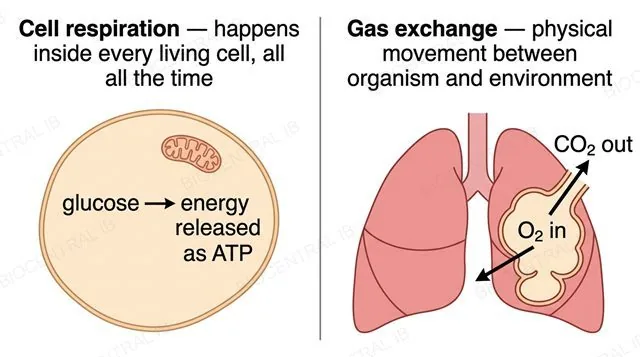
Two-panel diagram comparing cell respiration inside a cell with gas exchange at the alveolus
C1.2.4

Respiration happens in every cell, always

Cell respiration is the system inside a cell that produces ATP using energy released from carbon compounds — it is not the same process as gas exchange.
  • Glucose and fatty acids are the principal respiratory substrates, though a wide range of other carbon compounds can also be broken down for energy when needed.
  • Cell respiration runs continuously in every living cell, whether or not the organism happens to be breathing hard at that instant.
  • Gas exchange is the physical movement of O2 and CO2 between an organism and its surroundings — it supplies what aerobic respiration needs and removes what it produces, but happens at a different scale entirely.
Why it matters"Respiring" isn't a synonym for "breathing hard" — breathing moves gases; respiration is the reaction that actually releases the energy.
C1.2.5

Two respiration pathways, one starting line

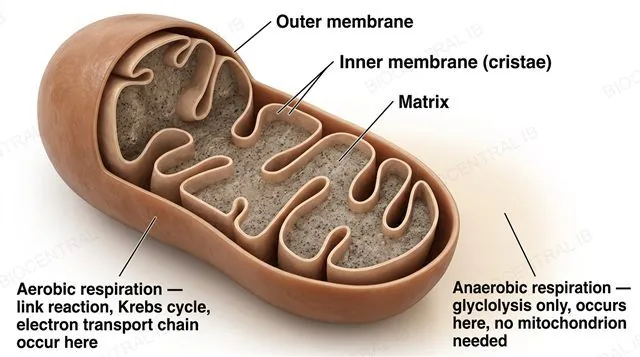
Aerobic and anaerobic cell respiration in humans both use glucose as a substrate, but differ in oxygen requirement and where in the cell they occur.
  • Aerobic respiration requires oxygen and takes place partly in the cytoplasm (glycolysis) and partly inside mitochondria, where the remaining stages occur.
  • Anaerobic respiration does not require oxygen and consists of glycolysis only, which takes place entirely in the cytoplasm — no mitochondrion is needed for this pathway.
  • Because the later, oxygen-dependent stages of aerobic respiration only run inside a mitochondrion, mitochondria are required for aerobic respiration but not for anaerobic respiration.
Why it mattersA cell with no functioning mitochondria can still make some ATP by anaerobic respiration — just far less of it, and only from glycolysis.
Labeled mitochondrion cross-section beside plain cytoplasm, showing aerobic respiration requires mitochondria while anaerobic respiration does not
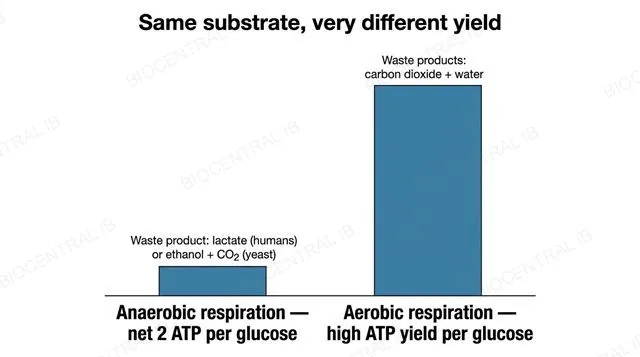
Bar-style diagram comparing the low ATP yield of anaerobic respiration with the high ATP yield of aerobic respiration, with waste products labeled
C1.2.5

Same start, very different yield

Aerobic and anaerobic respiration differ sharply in how much ATP they yield from one glucose molecule, and in what waste products they leave behind.
  • Aerobic respiration yields a high amount of ATP per glucose and produces carbon dioxide and water as waste: glucose + oxygen → carbon dioxide + water (+ ATP).
  • Anaerobic respiration in humans yields far less ATP per glucose and produces lactate as waste: glucose → lactate (+ ATP).
  • In yeast, the anaerobic pathway instead produces ethanol and carbon dioxide rather than lactate — the pathways are the same until the final step that regenerates NAD.
Why it mattersThe huge extra ATP yield of aerobic respiration comes entirely from the later, oxygen-dependent stages — not from glycolysis, which both pathways share equally.
C1.2.6

Respiration rate has real, measurable limits

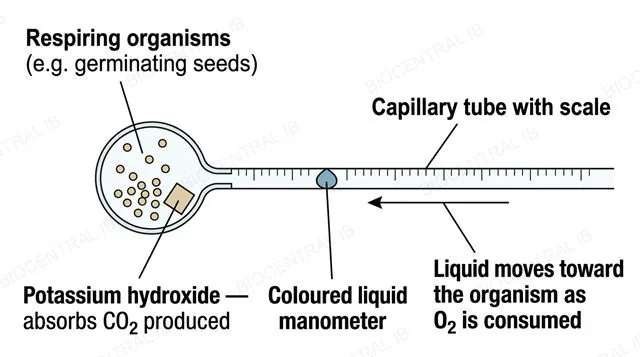
The rate of cell respiration is affected by temperature, substrate concentration, and oxygen availability, and can be measured directly using a respirometer.
  • Raising temperature increases the rate up to an optimum, beyond which the enzymes catalysing respiration begin to denature and the rate falls sharply.
  • Raising substrate concentration increases the rate only until the respiratory enzymes become saturated, after which adding more substrate has no further effect.
  • A respirometer measures the rate of oxygen consumption directly — for example, dividing the volume of O2 consumed by the time taken gives a rate such as cm³ per minute.
Why it mattersEvery one of these variables affects respiration through the same mechanism: how often substrate molecules actually meet and react with a respiratory enzyme's active site.
Labeled diagram of a simple respirometer apparatus used to measure the rate of cell respiration by oxygen consumption
Quick check

A student claims a person is only carrying out cell respiration while they are physically active and breathing hard. What is the flaw in this statement?

Cell respiration only occurs in muscle cells, so this is only true for muscle tissue
Cell respiration happens continuously in every living cell regardless of activity level; breathing simply supplies and removes gases faster during exercise
Cell respiration and breathing are two names for the same process, so the statement is technically correct
Cell respiration only begins once oxygen debt builds up during exercise
Correct answer: respiration is continuous, breathing just adjusts. Cell respiration is a constant, ongoing biochemical process producing ATP in every cell, at rest or during exercise. Breathing (gas exchange) simply moves O2 in and CO2 out faster when respiration's rate increases — it is not itself the process producing ATP.
Part two · HL

NAD, glycolysis and the Krebs cycle

C1.2.7 – C1.2.12
C1.2.7 · HL

One molecule that always travels in pairs of reactions

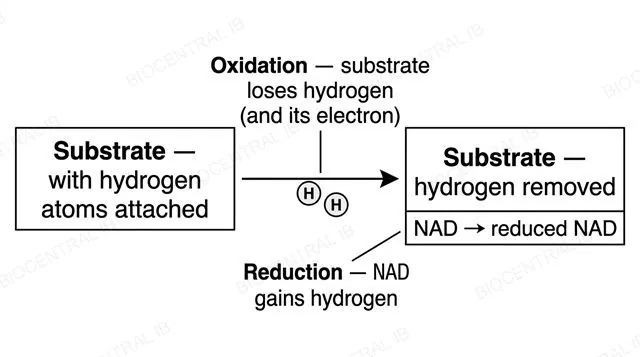
NAD (nicotinamide adenine dinucleotide) is a hydrogen carrier that becomes reduced NAD whenever it accepts hydrogen removed from a substrate during cell respiration.
  • Oxidation is a loss of electrons; when hydrogen (carrying its electron) is removed from a substrate — dehydrogenation — that substrate has been oxidised.
  • NAD accepts this hydrogen and its electron, and is itself reduced in the process, becoming reduced NAD — oxidation of the substrate and reduction of NAD always happen together, as one redox reaction.
  • Reduced NAD produced during glycolysis, the link reaction and the Krebs cycle carries this hydrogen — and its associated energy — onward to the electron transport chain.
Why it mattersDon't mix up which species does what: the substrate loses hydrogen and is oxidised; NAD gains it and is reduced.
Diagram showing a substrate being oxidised as it loses hydrogen, which NAD accepts, becoming reduced NAD
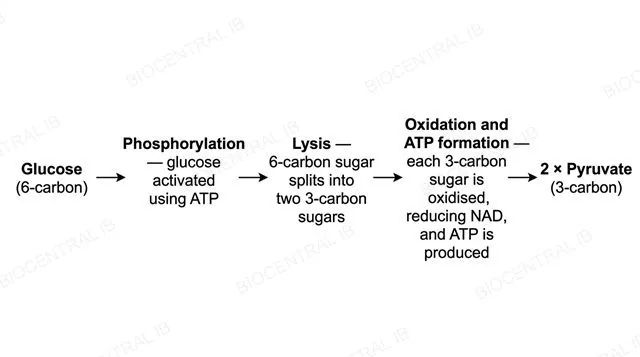
Flowchart of glycolysis showing glucose, phosphorylation, lysis, oxidation and ATP formation, ending in two pyruvate molecules
C1.2.8 · HL

Glycolysis takes glucose apart in controlled steps

Glycolysis converts glucose (6-carbon) to two molecules of pyruvate (3-carbon) through a stepwise pathway in the cytoplasm, with each step catalysed by a different enzyme.
  • Phosphorylation activates glucose and its intermediates early in the pathway, using ATP to make the molecule reactive enough for what follows.
  • Lysis splits the now-phosphorylated 6-carbon sugar into two separate 3-carbon sugar molecules, each of which continues through the rest of the pathway independently.
  • Oxidation of each 3-carbon molecule follows, reducing NAD and forming ATP directly by substrate-level phosphorylation, ending with two molecules of pyruvate.
Why it mattersThe names of the individual intermediates aren't required — what matters is the sequence: phosphorylation, lysis, oxidation, and ATP formation, in that order.
C1.2.8 · HL

Spend a little ATP to make more

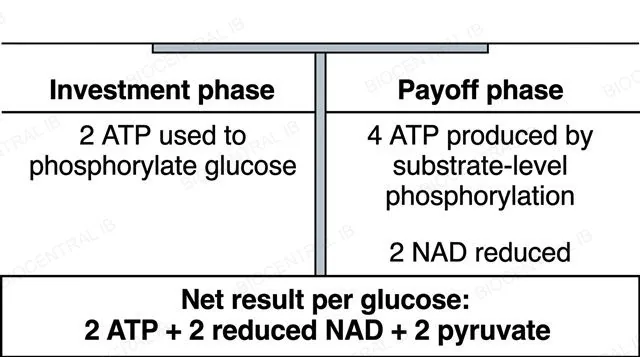
Glycolysis invests ATP early to destabilise glucose, then yields more ATP than it spent by the time pyruvate is formed.
  • The investment phase uses 2 ATP to phosphorylate glucose and its intermediates, making the sugar more reactive and trapping it inside the cell — phosphorylated sugars can't easily cross the membrane.
  • The payoff phase then produces 4 ATP by substrate-level phosphorylation, along with 2 reduced NAD, as the two 3-carbon molecules are oxidised.
  • Subtracting the 2 ATP invested from the 4 ATP produced gives a net yield of 2 ATP, plus 2 reduced NAD, per glucose molecule.
Why it mattersThat early ATP "cost" isn't wasted — it's what makes the energy-yielding second half of the pathway possible at all.
Ledger-style diagram of glycolysis showing the investment phase using 2 ATP and the payoff phase producing 4 ATP and 2 reduced NAD, net result 2 ATP
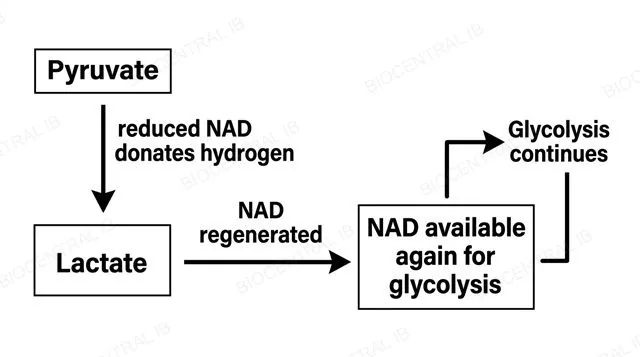
Diagram of pyruvate being converted to lactate using reduced NAD, regenerating NAD for glycolysis
C1.2.9 · HL

Lactate's real job is to keep glycolysis running

Converting pyruvate to lactate in anaerobic cell respiration produces no ATP itself — its role is to regenerate NAD so glycolysis can continue.
  • Reduced NAD produced during glycolysis donates its hydrogen to pyruvate, forming lactate and regenerating free NAD in the process.
  • Because glycolysis depends on a continual supply of free NAD to keep oxidising its substrate, this regeneration is what allows the pathway to keep running without oxygen.
  • The result is a net yield of two ATP molecules per glucose — the same net yield glycolysis always produces, now sustained anaerobically.
Why it mattersLactate isn't a waste product being disposed of for its own sake — it exists purely to free up NAD.
C1.2.10 · HL

The same pathway, one different last step

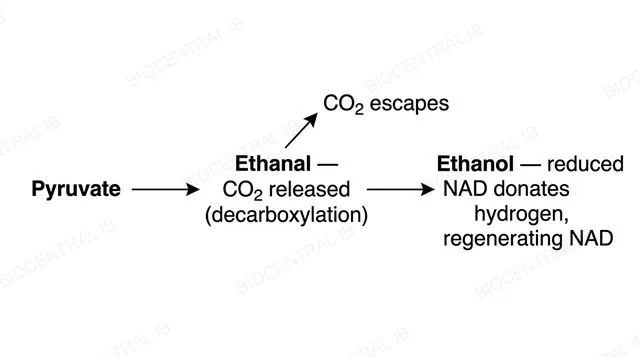
Anaerobic respiration in yeast uses the same glycolysis pathway as humans, but regenerates NAD from pyruvate differently, producing different final products.
  • Pyruvate is first decarboxylated, releasing carbon dioxide and forming ethanal, rather than being reduced directly to lactate as in human muscle.
  • Ethanal is then reduced to ethanol using reduced NAD as the hydrogen donor, which regenerates NAD so glycolysis can continue producing its net 2 ATP per glucose.
  • This is the basis of brewing, where anaerobic conditions are deliberately maintained so ethanol accumulates, and of baking, where the carbon dioxide released becomes trapped as bubbles that make dough rise.
Why it mattersSame pathway, same purpose — regenerating NAD — only the final step, and the waste product, differ between yeast and humans.
Flowchart of yeast alcoholic fermentation showing pyruvate converted to ethanal with CO2 released, then to ethanol with NAD regenerated
Diagram of the link reaction showing pyruvate converted to an acetyl group attached to coenzyme A, with CO2 released and NAD reduced
C1.2.11 · HL

Pyruvate has to be converted first

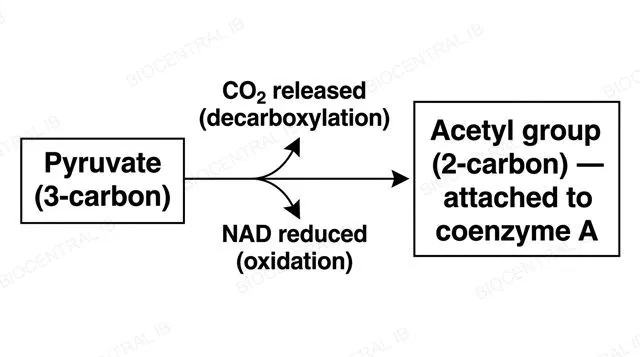
The link reaction oxidises and decarboxylates pyruvate in the mitochondrial matrix, forming the 2-carbon acetyl group that actually enters the Krebs cycle.
  • Pyruvate (3-carbon) loses one carbon as carbon dioxide — the first CO2 released in aerobic respiration — while also being oxidised, which reduces NAD.
  • The remaining 2-carbon acetyl group is then carried into the Krebs cycle attached to coenzyme A, forming acetyl-CoA.
  • This reaction happens twice per glucose molecule, once for each pyruvate produced by glycolysis, and both lipids and carbohydrates are metabolised down to this same 2-carbon acetyl form.
Why it mattersPyruvate itself never enters the Krebs cycle — only the acetyl group formed here does, a common point of confusion worth remembering exactly.
C1.2.12 · HL

One ring of reactions, run twice per glucose

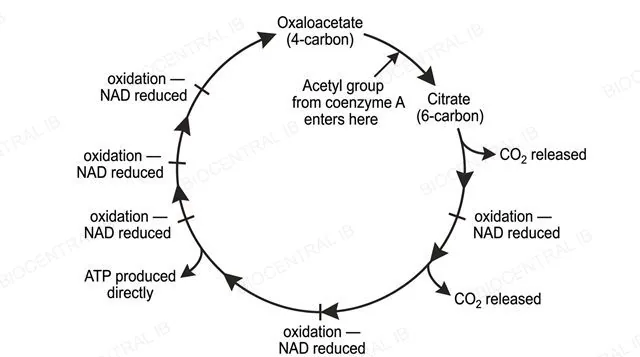
The Krebs cycle oxidises and decarboxylates the acetyl group in the mitochondrial matrix, regenerating oxaloacetate so the cycle can turn again.
  • Citrate (6-carbon) is formed when the acetyl group combines with oxaloacetate (4-carbon) — the only two intermediates the guide requires you to name.
  • Across the rest of the cycle, four oxidation (dehydrogenation) reactions reduce NAD, and two decarboxylation reactions release two molecules of carbon dioxide.
  • One ATP is generated directly by substrate-level phosphorylation per turn, and oxaloacetate is regenerated at the end — the cycle turns twice per glucose, once per pyruvate.
Why it mattersOxygen is never used directly in the Krebs cycle itself — it's needed only later, at the electron transport chain.
Ring diagram of the Krebs cycle showing oxaloacetate and citrate, with CO2 release points, oxidation points and one ATP produced directly
Quick check · HL

During intense exercise, a muscle cell's demand for ATP briefly outpaces the oxygen it's receiving. Why can't anaerobic respiration alone sustain that same ATP output for long?

Only glycolysis (net 2 ATP per glucose) can run without oxygen — the link reaction, Krebs cycle and electron transport chain that generate most of aerobic respiration's ATP all require oxygen
Anaerobic respiration produces more ATP per glucose than aerobic respiration, but only for a short burst
Lactate formation directly consumes ATP, creating a net energy loss
Without oxygen, glycolysis itself stops producing any ATP at all
Correct answer: only glycolysis works anaerobically. Without oxygen, the link reaction, Krebs cycle and electron transport chain — which together generate the vast majority of ATP in aerobic respiration — cannot run, since oxygen is the terminal electron acceptor keeping the whole chain moving. Glycolysis's net 2 ATP per glucose is all anaerobic respiration can sustain.
Part three · HL

The electron transport chain and chemiosmosis

C1.2.13 – C1.2.17
C1.2.13 · HL

Reduced NAD hands off its energy at the inner membrane

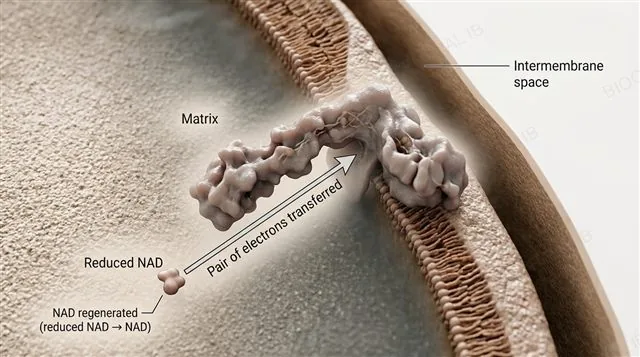
The electron transport chain (ETC) is a series of carriers embedded in the inner mitochondrial membrane that receives electrons from reduced NAD.
  • Energy is transferred when a pair of electrons is passed from reduced NAD to the first carrier in the chain, converting reduced NAD back to NAD.
  • This reduced NAD comes from three separate sources within the cell — glycolysis, the link reaction, and the Krebs cycle — all feeding into the same chain.
  • Once regenerated, NAD is free to accept more hydrogen from an earlier stage of respiration, keeping the whole system supplied with a fresh carrier.
Why it mattersThe electron transport chain is where all three earlier stages of aerobic respiration finally cash in their reduced NAD for usable energy.
Labeled inner mitochondrial membrane cross-section showing reduced NAD passing an electron pair to the first carrier of the electron transport chain
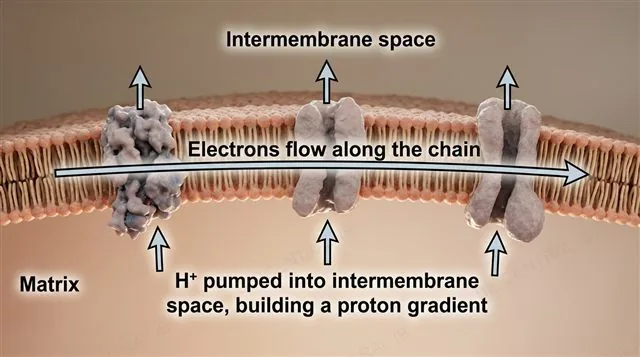
Labeled inner membrane cross-section showing electrons flowing along the electron transport chain while H+ is pumped into the intermembrane space
C1.2.14 · HL

Electron flow does real mechanical work

As electrons flow along the electron transport chain, the energy released is used to pump hydrogen ions (H+) from the matrix into the intermembrane space.
  • Each carrier in the chain passes electrons to the next in a defined sequence, releasing energy at each step — the names of the individual protein complexes aren't required.
  • That released energy actively pumps H+ against its own concentration gradient, out of the matrix and into the narrow intermembrane space.
  • Because H+ keeps being pumped one way only, a proton gradient builds up across the inner membrane — a store of potential energy, not yet ATP.
Why it mattersThis gradient is the whole point of the electron transport chain — it is what chemiosmosis will use to make ATP.
C1.2.15 · HL

The gradient gets spent on ATP synthase

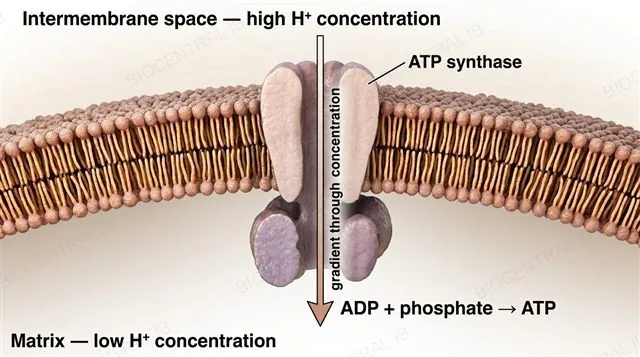
Chemiosmosis is the process by which the proton gradient across the inner mitochondrial membrane drives ATP synthesis, via a protein called ATP synthase.
  • H+ flows back down its concentration gradient, from the intermembrane space into the matrix, but only through ATP synthase — the membrane elsewhere is impermeable to H+.
  • As H+ flows through it, ATP synthase couples that flow directly to the phosphorylation of ADP, joining ADP and phosphate into ATP.
  • This is a completely different ATP-generating mechanism from the substrate-level phosphorylation seen in glycolysis and the Krebs cycle — chemiosmosis produces the majority of ATP from one glucose molecule.
Why it mattersATP synthase works like a channel for H+, not a pump — the pumping already happened, earlier, in the electron transport chain.
Labeled inner membrane cross-section showing ATP synthase with H+ flowing from the intermembrane space into the matrix, coupled to ATP synthesis
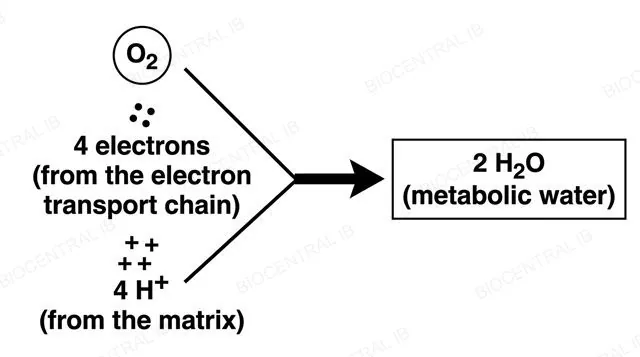
Diagram showing oxygen combining with electrons and hydrogen ions to form metabolic water at the end of the electron transport chain
C1.2.16 · HL

Without oxygen, the whole chain backs up

Oxygen is the terminal electron acceptor of the electron transport chain, accepting electrons from the chain and protons from the mitochondrial matrix.
  • At the end of the chain, oxygen combines with electrons and H+ to form metabolic water, removing them from the system.
  • This is the only role oxygen plays in aerobic respiration directly — it is not used in glycolysis or the Krebs cycle themselves.
  • By continuously accepting electrons at the very end, oxygen keeps the whole chain able to keep passing electrons forward — without it, every carrier upstream would stay reduced and stall.
Why it mattersOxygen isn't consumed "to make ATP" directly — it's consumed to keep the electron transport chain from grinding to a halt.
C1.2.17 · HL

Lipids pack in more energy, at a cost

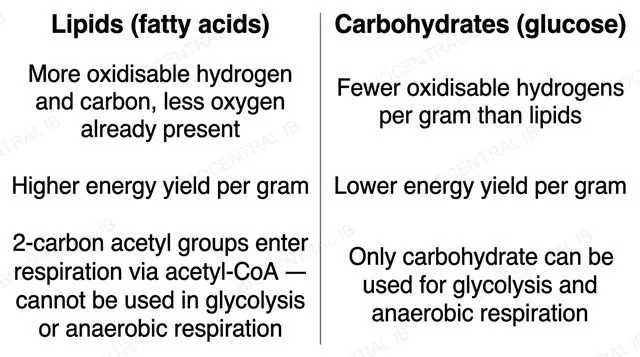
Lipids and carbohydrates differ as respiratory substrates in their energy yield per gram and in which respiration pathways they can fuel.
  • Lipids contain more oxidisable hydrogen and carbon, and less oxygen already bonded into the molecule, than carbohydrates do — giving them a higher energy yield per gram when fully oxidised.
  • Fatty acids are broken down into 2-carbon acetyl groups that enter respiration via acetyl-CoA, joining the pathway at the same point as the link reaction's product.
  • Because that entry point is downstream of glycolysis, fatty acids cannot be used in glycolysis or in anaerobic respiration — only carbohydrate can fuel those two pathways.
Why it mattersA gram of fat yields more ATP than a gram of glucose, but it only works aerobically — carbohydrate is the one substrate that works without oxygen.
Two-column comparison diagram of lipids and carbohydrates as respiratory substrates, covering energy yield per gram and which pathways each can fuel

Key vocabulary — ATP and respiration basics

Worth being able to define in a single sentence each

ATP
Adenosine triphosphate — the nucleotide that distributes energy within cells.
ADP
Adenosine diphosphate — what remains after ATP releases its terminal phosphate.
Cell respiration
The controlled, enzyme-catalysed release of energy from carbon compounds to produce ATP, in every living cell.
Respiratory substrate
A carbon compound, chiefly glucose or a fatty acid, broken down during cell respiration to release energy.
Aerobic respiration
Respiration requiring oxygen, using mitochondria, with a high ATP yield.
Anaerobic respiration
Respiration not requiring oxygen, using glycolysis only, with a low ATP yield.

Key vocabulary — the HL respiration mechanism

Every term on this slide is HL-only content

NADHL
A hydrogen carrier; becomes reduced NAD when it accepts hydrogen removed from a substrate.
GlycolysisHL
The stepwise pathway converting glucose to two pyruvate in the cytoplasm, net yield of ATP and reduced NAD.
Link reactionHL
Converts pyruvate to an acetyl group (attached to coenzyme A), releasing CO2 and reducing NAD.
Krebs cycleHL
The cyclical pathway in the mitochondrial matrix that oxidises the acetyl group, releasing CO2 and reducing NAD.
Electron transport chainHL
A series of carriers in the inner mitochondrial membrane that passes electrons from reduced NAD toward oxygen.
ChemiosmosisHL
ATP synthesis driven by H+ flowing back across the inner membrane through ATP synthase.
Proton gradientHL
A difference in H+ concentration across the inner mitochondrial membrane, built up by the electron transport chain.
Terminal electron acceptorHL
The final acceptor of electrons at the end of a chain — oxygen, in aerobic respiration.
Substrate-level phosphorylationHL
Direct transfer of a phosphate group from a substrate to ADP, without involving the electron transport chain.

Where this shows up again

B1.1
Glucose for respiration is obtained from starch (B1.1) in plants and glycogen (B1.1) in animals. Compare how these two polysaccharides are broken down to release glucose for glycolysis.
B2.1
The inner mitochondrial membrane is rich in the same phospholipids that form cell membranes (B2.1). Explain why the inner membrane's impermeability to H⁺ is essential, and how this relates to the general barrier function of membranes.
B3.1
Oxygen for aerobic respiration is obtained by gas exchange (B3.1). Explain how the ventilation and circulation systems deliver sufficient O₂ to mitochondria during exercise when respiration rate increases dramatically.
C1.3
Photosynthesis (C1.3) produces the glucose and oxygen that respiration consumes. Discuss how these two processes are interdependent in the global carbon and oxygen cycles.

C1.2 Cell respiration — one-page recap

Screenshot this slide to revise from

ATP — the energy currency
  • ATP: adenosine triphosphate, a nucleotide; hydrolysis releases energy, synthesis requires it.
  • Powers active transport, macromolecule synthesis, and movement of cell components.
Cell respiration basics
  • Substrates: mainly glucose and fatty acids; respiration ≠ gas exchange.
  • Rate rises with temperature/substrate/O2 up to enzyme saturation, then falls.
Aerobic vs anaerobic
  • Aerobic: O2 + mitochondria required, high ATP yield, CO2 + water waste.
  • Anaerobic: glycolysis only, cytoplasm, low ATP yield, lactate (humans) or ethanol + CO2 (yeast).
HL · Glycolysis and NAD
  • NAD is reduced when it accepts H removed (oxidation) from a substrate.
  • Glycolysis: glucose (6C) → 2 pyruvate (3C); net 2 ATP + 2 reduced NAD.
HL · Link reaction and Krebs cycle
  • Link reaction: pyruvate → acetyl group (+CO2, +reduced NAD) in the matrix.
  • Krebs cycle: citrate formed, oxaloacetate regenerated; 2 CO2, reduced NAD, 1 ATP per turn.
HL · Electron transport chain and chemiosmosis
  • Reduced NAD → ETC on inner membrane; H+ pumped into intermembrane space.
  • Chemiosmosis: H+ flows back through ATP synthase → ATP; O2 is the terminal electron acceptor → water.

Every ATP molecule tells the same story

From glycolysis in the cytoplasm to the last electron accepted by oxygen, cell respiration is one continuous system for keeping the cell's energy currency in supply.
C1.2 Cell respiration · BioCentral IB
Use ↓ ↑ or click to navigate
01 / 20