BioCentral IBBioCentral IB
IB Biology · Theme C · C3.1

Integration of body systems

A cheetah's chase depends on nerves, hormones and blood all acting as one. This lesson traces how the nervous and endocrine systems, and the blood that connects them, integrate separate organs into a single coordinated organism — and how feedback loops keep that organism's internal conditions steady.
Guiding questions

What are the roles of nerves and hormones in integration of body systems?

What are the roles of feedback mechanisms in regulation of body systems?

Part one

Principles of system integration

C3.1.1 – C3.1.3
C3.1.1

Coordination makes a system whole

System integration is the coordination of an organism's separate component parts — cells, tissues, organs and body systems — so that they collectively perform an overall function that none of them could achieve alone.
  • No single organ can sprint, digest a meal, or fight an infection by itself; every whole-body function depends on several systems acting together at the same time.
  • Integration in animals happens through three complementary channels: nervous signalling, hormonal (endocrine) signalling, and the physical transport of materials and energy by the blood system.
  • Without this coordination, an organism would be no more than a disorganized collection of independently-acting cells, unable to respond as one unit to a single stimulus.
Why it mattersEvery remaining statement in this lesson is really just one specific example of this same idea — nerves, hormones or blood coordinating two or more separate parts into one working whole.
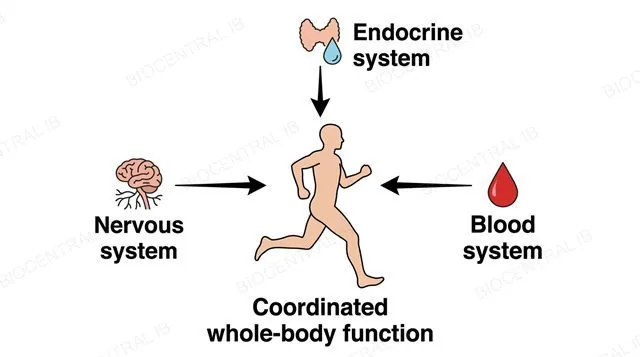
A body silhouette with nervous system, endocrine system and blood system icons pointing inward toward it with converging arrows, labeled nervous system, endocrine system, blood system and coordinated whole-body function
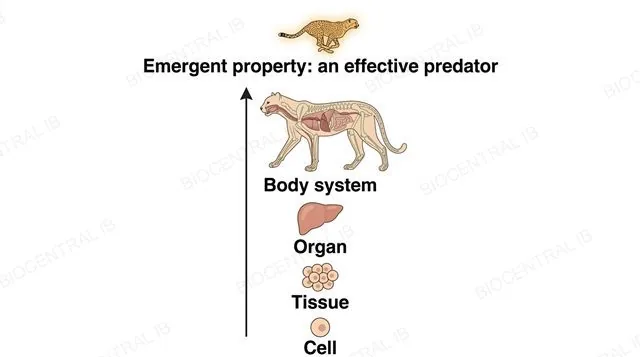
A vertical hierarchy diagram from cell to tissue to organ to body system with a single upward arrow, topped by a running cheetah silhouette, labeled cell, tissue, organ, body system and emergent property an effective predator
C3.1.2

A cheetah is more than its cells

Cells, tissues, organs and body systems form a hierarchy of subsystems, each level built from the one below it, and their integration in a multicellular organism produces emergent properties that no single level possesses alone.
  • Similar cells form a tissue; different tissues form an organ; and organs working together form a body system, each step combining smaller working parts into a larger one.
  • An emergent property belongs only to the whole, integrated system — it cannot be predicted or observed by studying any single component in isolation.
  • A cheetah's ability to sprint down prey is a genuine emergent property: it requires its muscular, skeletal, respiratory, circulatory and nervous systems working together, not any one alone.
Why it mattersSpotting an emergent property in an exam question is spotting a case where "the whole is greater than the sum of its parts" — a classic system-integration idea in its own right.
C3.1.3

Two signals, two very different speeds

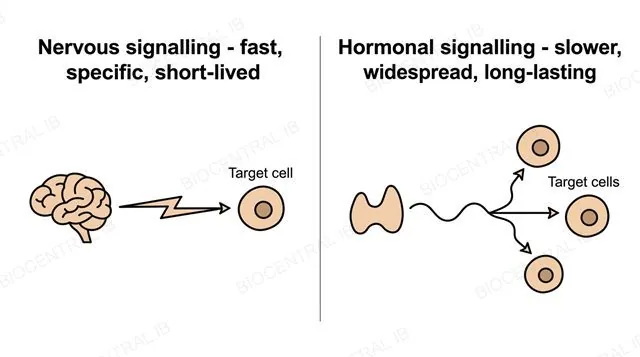
Animal organs are integrated partly through two distinct signalling systems that send messages in fundamentally different ways: the nervous system and the endocrine system.
  • Nervous signalling sends an electrical impulse along a specific nerve fibre to a precise target, producing an effect that is fast to start and typically short-lived.
  • Hormonal (endocrine) signalling releases a chemical into the blood, which carries it to any cell in the body bearing the matching receptor, producing an effect that is slower to start but typically more widespread and longer-lasting.
  • Neither system is simply a "faster" or "slower" version of the other — they differ in target specificity and duration as much as in speed.
Why it mattersExpect exam questions that hand you a described effect and ask you to identify which signalling system, nervous or hormonal, better explains it.
Two-panel comparison diagram, a fast arrow from a brain to one target cell labeled nervous signalling fast specific short-lived, and a slower branching arrow from a gland to three target cells labeled hormonal signalling slower widespread long-lasting
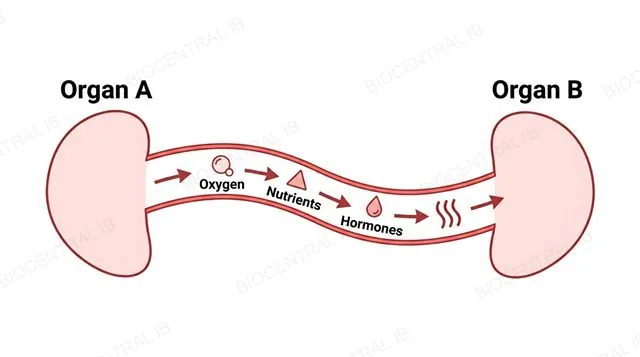
A blood vessel connecting two organs carrying oxygen, nutrient and hormone icons in one direction, labeled organ A, organ B, oxygen, nutrients and hormones
C3.1.3

The blood system is a third integrator

Alongside nervous and hormonal signalling, the blood system integrates organs by physically transporting materials and energy between them.
  • Blood carries oxygen and nutrients from the lungs and gut to every respiring tissue, and carbon dioxide and other wastes away from those same tissues.
  • Because hormones themselves travel in the blood, this transport role and hormonal signalling depend directly on each other — one cannot work without the other.
  • Heat generated by active tissues, such as contracting muscle, is also distributed around the body by the blood, helping integrate temperature across different organs.
Why it mattersThe blood system is a genuinely distinct third integrating mechanism, not simply "part of" hormonal signalling — treat nervous, hormonal and blood transport as separate, complementary answers.
Part two

The nervous system as an integrator

C3.1.4 – C3.1.10
C3.1.4

One organ, many inputs

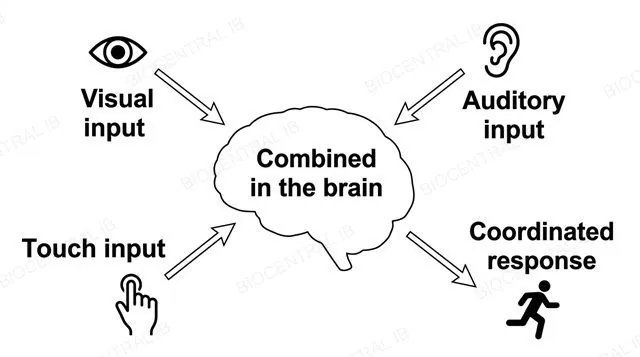
The brain acts as the body's central information-integration organ, combining information from several sensory inputs at once into a single coherent response.
  • Visual, auditory, touch and other sensory information all arrive at the brain simultaneously, and the brain processes and combines these separate inputs rather than reacting to each one in isolation.
  • Learning and memory are also centred in the brain, allowing past experience to shape how current sensory information is interpreted and acted on.
  • This course limits the brain's role to processing combined sensory input and to learning and memory — the detailed neurotransmitter chemistry of how neurons communicate is covered separately, in C2.2.
Why it mattersThe brain's integrating role, not its wiring diagram, is what's being tested here — don't confuse this statement with the synaptic mechanism detail from C2.2.
A brain outline receiving visual, auditory and touch input arrows converging inward, with one output arrow to a coordinated response icon, labeled visual input, auditory input, touch input, combined in the brain and coordinated response
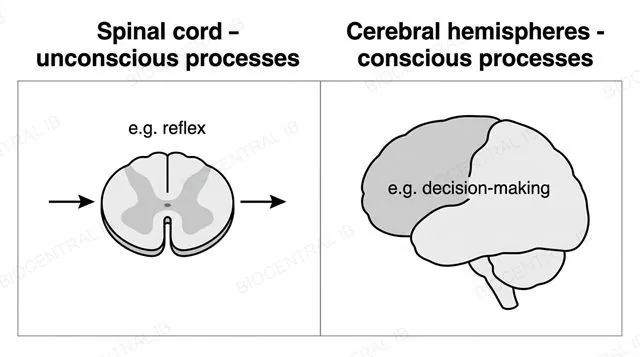
Two panels comparing a spinal cord cross-section handling unconscious processes with a brain outline handling conscious processes, labeled spinal cord unconscious processes and cerebral hemispheres conscious processes
C3.1.5

A second integrating centre, working unconsciously

The spinal cord acts as an integrating centre in its own right, but specifically for unconscious processes, while the cerebral hemispheres are associated with conscious processing.
  • A conscious process, such as deciding to pick up a cup, is processed by the cerebral hemispheres and requires awareness.
  • An unconscious process, such as a reflex, is integrated directly by the spinal cord and requires no conscious awareness or brain involvement at all.
  • The spinal cord is not simply a cable relaying signals to and from the brain — it can generate an appropriate motor response entirely on its own.
Why it mattersThis conscious/unconscious distinction sets up the pain reflex arc later in this lesson, where the spinal cord's independent integrating role becomes concrete.
C3.1.6

The nervous system's input side

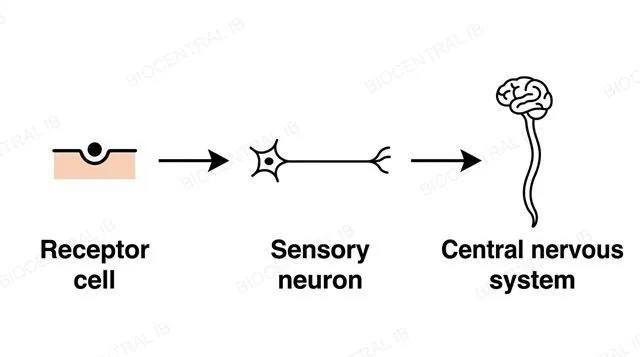
Sensory neurons convey messages from receptor cells to the central nervous system — the spinal cord and/or the cerebral hemispheres — forming the input side of the nervous system's information flow.
  • A receptor cell first detects a stimulus, such as light, pressure, heat or a specific chemical, and converts it into a nerve impulse.
  • The sensory neuron then carries that impulse from the receptor cell toward the central nervous system, where the information can be integrated.
  • The receptor cell and the sensory neuron carrying its impulse are distinct structures with distinct roles, even though they act in sequence.
Why it mattersSensory input always travels toward the CNS — fixing that direction early prevents it being reversed with motor output under exam pressure.
A single-direction chain from a receptor cell to a sensory neuron to the central nervous system, labeled receptor cell, sensory neuron and central nervous system
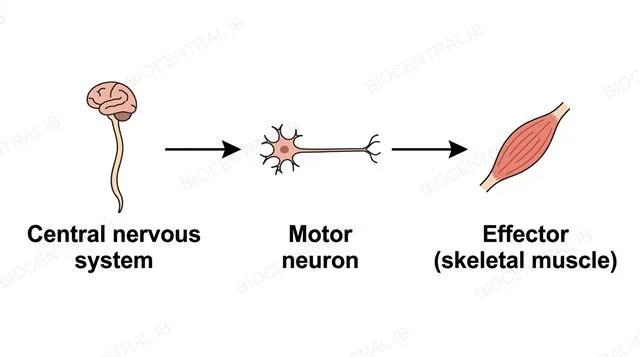
A single-direction chain from the central nervous system to a motor neuron to a skeletal muscle effector, labeled central nervous system, motor neuron and effector skeletal muscle
C3.1.7

The nervous system's output side

Motor neurons carry impulses from the central nervous system out to effectors such as skeletal muscles, forming the output side of the nervous system's information flow.
  • Once the CNS has integrated its sensory inputs and "decided" on a response, a motor neuron carries the resulting impulse away from the CNS toward a specific effector.
  • Where the effector is a skeletal muscle, arrival of the motor neuron's impulse at the neuromuscular junction stimulates that muscle fibre to contract.
  • Sensory input and motor output together let the nervous system both sense the environment and act on it — one direction alone could not do both.
Why it mattersReversing sensory and motor neuron direction is one of the most common careless errors on this topic — always check which way the arrow should point.
C3.1.8

A nerve is a bundle, not a single cell

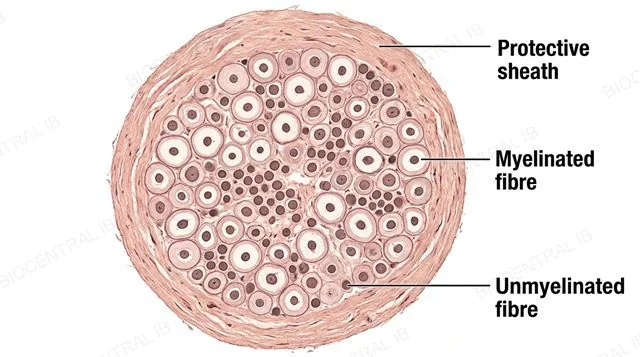
A nerve is a bundle of many individual nerve fibres — the axons of both sensory and motor neurons — wrapped together in a protective connective-tissue sheath.
  • In a transverse (cross-sectional) view, a typical nerve shows an outer protective sheath surrounding many individual fibres packed together, not one single strand.
  • Most nerves are "mixed nerves", containing the fibres of both sensory neurons and motor neurons bundled side by side within the same protective sheath.
  • Individual fibres within one nerve may be myelinated or unmyelinated, so a single transverse section can show both types at once.
Why it mattersA nerve fibre (axon) belongs to one neuron, but a whole nerve is a multi-fibre, mixed-direction structure — don't treat "nerve" and "neuron" as interchangeable terms.
A transverse section of a nerve showing an outer protective sheath surrounding a bundle of myelinated and unmyelinated fibres, labeled protective sheath, myelinated fibre and unmyelinated fibre
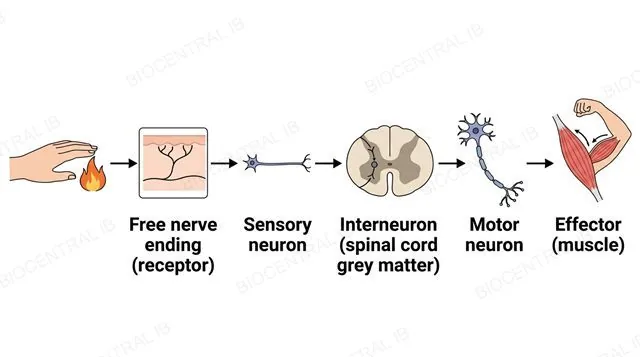
A five-stage reflex arc chain from a hand touching a flame to a free nerve ending to a sensory neuron to an interneuron in the spinal cord grey matter to a motor neuron to a muscle effector, labeled free nerve ending receptor, sensory neuron, interneuron spinal cord grey matter, motor neuron and effector muscle
C3.1.9

A reflex that never reaches the brain

A pain reflex arc is an example of an involuntary response, with skeletal muscle as the effector, that is integrated entirely within the spinal cord.
  • A free (bare) sensory nerve ending in the skin, such as in the hand, acts as the pain receptor, converting a painful stimulus directly into a nerve impulse.
  • That impulse travels along a sensory neuron into the spinal cord, where a single interneuron in the grey matter connects it directly to a motor neuron.
  • The motor neuron then carries the impulse straight to a skeletal muscle, withdrawing the limb before the sensation of pain has even reached conscious awareness in the brain.
Why it mattersThe whole point of a spinal reflex is that it bypasses the brain — routing this pathway through the brain is the single most common mistake students make here.
C3.1.10

The brain region behind smooth movement

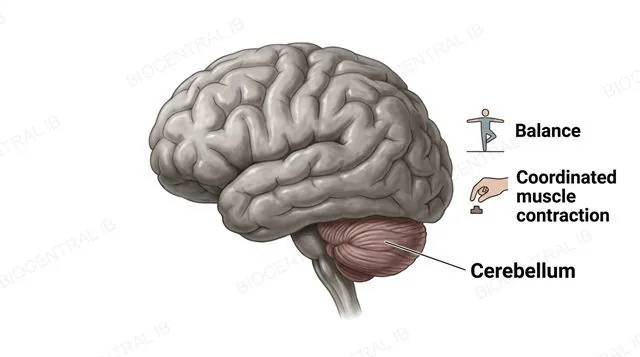
The cerebellum coordinates the contraction of skeletal muscles and plays a central role in maintaining balance, keeping this course's requirement to only a general understanding of its overall role in movement.
  • By finely timing which muscles contract, and by how much, the cerebellum turns a set of individual muscle contractions into one smooth, accurate movement rather than a jerky one.
  • The cerebellum also continuously integrates information about the body's position to help maintain balance and posture, whether standing still or moving.
  • This is a distinct role from the cerebral hemispheres' conscious decision-making — the cerebellum refines how a movement is carried out, not whether to make it.
Why it mattersKeep this to the general role described here — detailed cerebellar circuitry is explicitly outside what this course requires.
A side-profile brain with the cerebellum shaded and highlighted at the base, labeled cerebellum, balance and coordinated muscle contraction
Quick check

A person accidentally touches a hot stove and pulls their hand away before consciously feeling any pain. Which statement best explains this?

The pain reflex arc is integrated entirely within the spinal cord, so the motor response is generated before the pain sensation is separately processed by the brain
The stimulus never reaches the nervous system at all
The cerebellum generates the withdrawal response independently of the spinal cord
The hand withdraws only after the brain consciously decides to move it
Correct answer: the spinal cord integrates the reflex directly. A free nerve ending detects the stimulus, a sensory neuron carries the impulse to a single interneuron in the spinal cord's grey matter, and a motor neuron carries the response straight to the muscle — all without first involving the brain. The sensation of pain is a separate signal that reaches conscious awareness afterward.
Part three

Hormonal and rhythmic control

C3.1.11 – C3.1.13
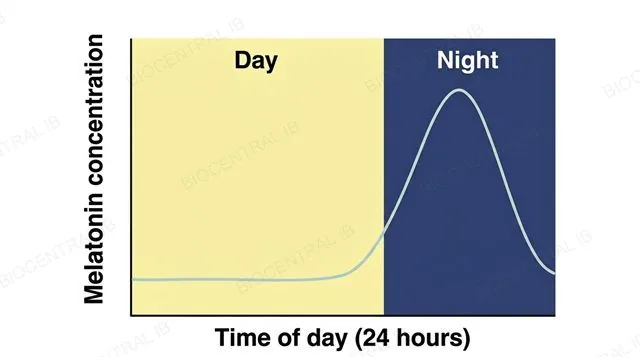
A 24-hour graph showing melatonin concentration low during the day and rising to a peak at night, labeled melatonin concentration, time of day 24 hours, day and night
C3.1.11

A hormone that tracks day and night

Melatonin, secreted by the pineal gland, follows a diurnal (daily) pattern that modulates the sleep-wake cycle as part of the body's circadian rhythm.
  • Melatonin secretion is low during daylight hours and rises during darkness, helping establish a cycle of sleeping and waking that repeats roughly every 24 hours.
  • A circadian rhythm is this kind of roughly 24-hour biological cycle; it can persist to some extent without external cues, but light — detected mainly through the eyes — is the main cue keeping it synchronized with the real day/night cycle.
  • Because melatonin is released into the blood, its rising and falling concentration can influence the brain and other tissues throughout the body at once.
Why it mattersDon't reverse the pattern: melatonin is low by day and rises at night, promoting sleep onset — not the other way around.
C3.1.12

One hormone, effects everywhere

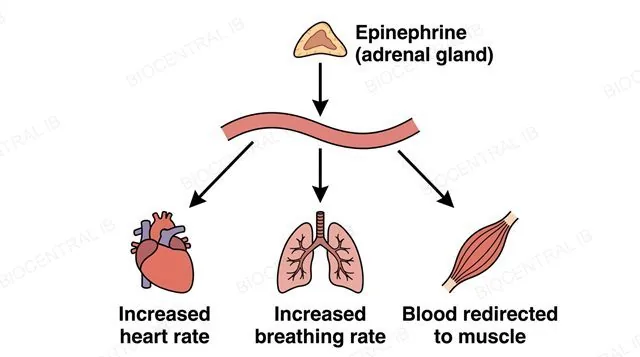
Epinephrine (adrenaline), secreted by the adrenal glands, prepares the body for vigorous activity by producing widespread effects across many organs at once.
  • Because epinephrine is released into the blood rather than delivered by a nerve impulse to one specific target, it reaches many organs with matching receptors simultaneously.
  • Its effects include an increased heart rate and stroke volume, dilated airways with an increased breathing rate, mobilized glucose reserves for extra energy, and blood flow redirected toward skeletal muscle and away from digestion.
  • All of these effects work together to facilitate the intense, sustained muscle contraction needed for vigorous activity — a coordinated, whole-body response rather than several unrelated changes.
Why it mattersBlood flow moves toward muscle and away from the gut during this response, not the reverse — a frequently reversed detail worth fixing early.
An adrenal gland releasing epinephrine into the blood which branches to a heart, lungs and skeletal muscle, labeled epinephrine adrenal gland, increased heart rate, increased breathing rate and blood redirected to muscle
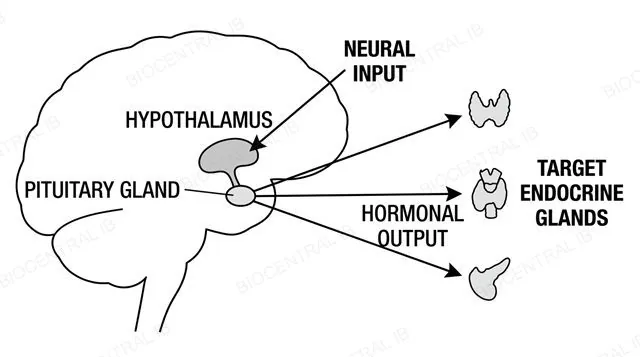
A brain outline showing the hypothalamus connected to the pituitary gland, with arrows to target endocrine glands, labeled hypothalamus, pituitary gland, target endocrine glands, neural input and hormonal output
C3.1.13

The endocrine system's master switch

The hypothalamus and pituitary gland together control the activity of the endocrine system as a whole, linking neural input to hormonal output.
  • The hypothalamus continuously monitors internal conditions and receives neural input, then signals the pituitary gland in response.
  • The pituitary gland, in turn, releases hormones that control the activity of other endocrine glands elsewhere in the body, such as the thyroid, adrenal glands and gonads.
  • This course requires only a general understanding of this control relationship — the detailed differences between the anterior and posterior pituitary's mechanisms are not required.
Why it mattersThis hypothalamus-pituitary link is the clearest single example of the nervous and endocrine systems being integrated with each other, not working as two separate systems.
Part four

Feedback control of physiological variables

C3.1.14 – C3.1.16
C3.1.14

Keeping blood pressure on target

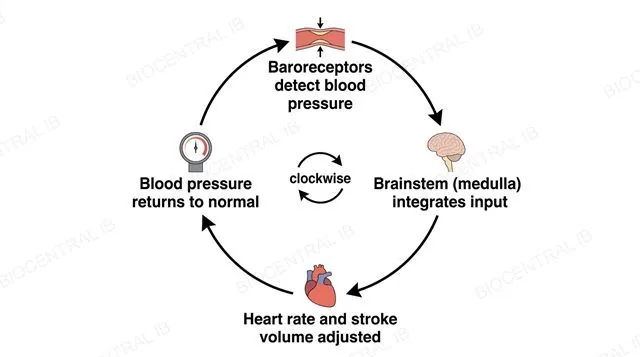
Heart rate is adjusted by negative feedback following sensory input from baroreceptors and chemoreceptors, correcting departures from a normal blood pressure.
  • Baroreceptors, in the walls of the carotid arteries and the aorta, detect blood pressure through stretch of the artery wall, while nearby chemoreceptors monitor blood pH and the concentrations of oxygen and carbon dioxide.
  • Both sets of receptors send their input to the brainstem (medulla), which integrates it and sends nerve impulses to the heart, adjusting heart rate and stroke volume.
  • A rise in blood pressure, for example, leads to a decrease in heart rate — a corrective response that brings pressure back down toward normal, the defining feature of negative feedback.
Why it mattersA very common error assumes higher blood pressure triggers a faster heart rate — it is the reverse, precisely because this is a corrective, negative feedback response.
A four-stage clockwise negative feedback loop diagram: baroreceptors detect blood pressure, brainstem medulla integrates input, heart rate and stroke volume adjusted, blood pressure returns to normal, with an explicit clockwise direction marker
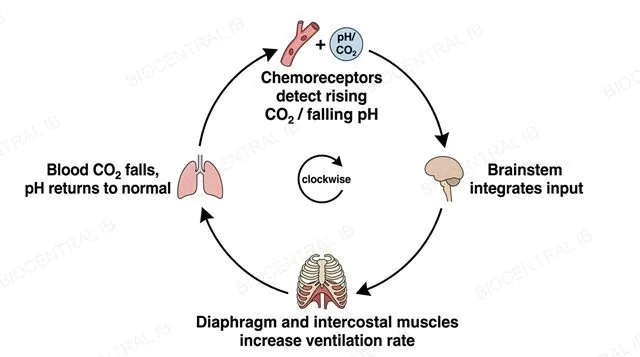
A four-stage clockwise negative feedback loop diagram: chemoreceptors detect rising CO2 falling pH, brainstem integrates input, diaphragm and intercostal muscles increase ventilation rate, blood CO2 falls pH returns to normal, with an explicit clockwise direction marker
C3.1.15

Chemistry drives every breath

Ventilation rate is adjusted by negative feedback following sensory input from chemoreceptors that detect changes in blood pH caused by shifting carbon dioxide levels.
  • Rising blood carbon dioxide reacts with water to form carbonic acid, which releases H+ ions and lowers blood pH — linking CO2 concentration and pH directly together.
  • Chemoreceptors in the brainstem detect this pH change and send signals to the diaphragm and intercostal muscles, adjusting the rate and depth of ventilation.
  • Increased ventilation removes CO2 from the blood faster, raising pH back toward normal and reducing the very stimulus that triggered the response — the hallmark of negative feedback.
Why it mattersHeart-rate control and ventilation-rate control use different effectors, the heart versus the diaphragm and intercostal muscles — don't mix up which effector answers which question.
C3.1.16

One tract, two kinds of control

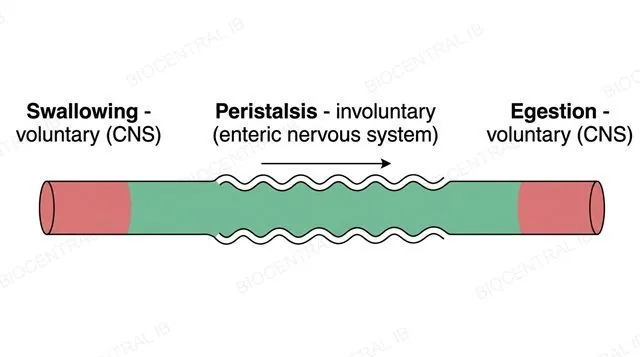
Movement through the digestive tract is controlled partly voluntarily and partly involuntarily: swallowing and egestion are under voluntary CNS control, while peristalsis between these two points is under involuntary control by the enteric nervous system.
  • The central nervous system voluntarily initiates swallowing of food at one end of the tract and egestion of faeces at the other end.
  • Between these two points, peristalsis — the wave-like, coordinated contraction of smooth muscle in the tract wall that propels its contents along — is controlled involuntarily by the enteric nervous system (ENS), a large network of neurons embedded in the tract's own wall.
  • The ENS's action ensures that the passage of material through the gut stays coordinated without requiring constant, moment-to-moment direction from the brain.
Why it mattersAvoid describing the whole digestive tract as either "all voluntary" or "all involuntary" — the real picture is genuinely split between the two ends and everything in between.
A digestive tract diagram with the two ends shaded for voluntary CNS control and the long middle section shaded differently for involuntary enteric nervous system control, one directional arrow, labeled swallowing voluntary CNS, peristalsis involuntary enteric nervous system and egestion voluntary CNS
Part five

Plant responses and phytohormones · HL

C3.1.17 – C3.1.23
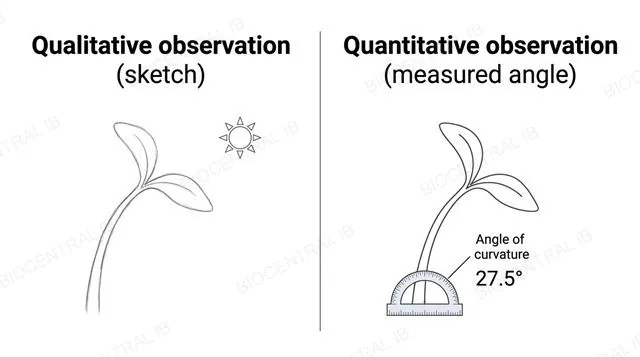
Two panels: a qualitative pencil-sketch of a seedling bent toward light, and a quantitative panel with a protractor measuring the angle of curvature, labeled qualitative observation sketch, quantitative observation measured angle and angle of curvature
C3.1.17 · HL

Turning a bent stem into data

Observing tropic responses in seedlings is an application-of-skills exercise in gathering both qualitative and quantitative data, and in recognizing the factors that limit a measurement's precision and accuracy.
  • A qualitative observation, such as a diagram sketching a seedling's bending, records a quality or characteristic without an associated numerical measurement.
  • A quantitative observation, such as measuring the angle of curvature in degrees, produces an actual numerical value that allows more precise comparison between conditions or replicates.
  • Precision describes how close repeated measurements are to each other, while accuracy describes how close a measurement is to the true value — measurements can be precise without being accurate, or vice versa.
Why it mattersExpect a question that hands you a described measurement and asks whether it's qualitative or quantitative, or whether it's evidence of precision, accuracy, or both.
C3.1.18 · HL

Bending toward the light

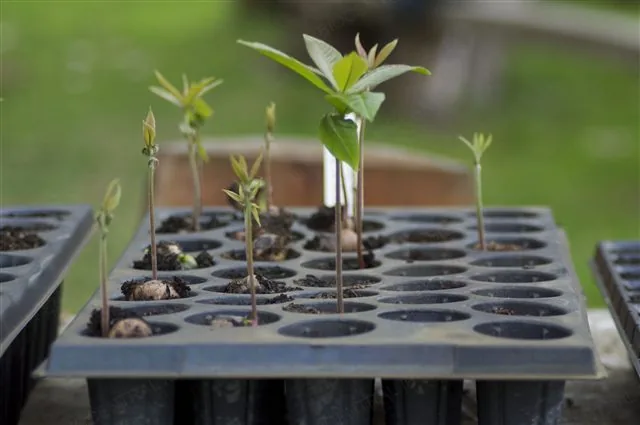
Positive phototropism is a directional growth response in which a plant shoot bends and grows toward a lateral (one-sided) light source.
  • This course requires only positive phototropism in shoots as its named example — other tropisms, such as gravitropism or hydrotropism, are not required here.
  • The word "positive" specifically means growth toward the stimulus; a response growing away from a stimulus would be described as negative.
  • This directional growth is not immediate — it develops gradually as cells on one side of the shoot elongate more than cells on the other, a mechanism explained by the next few statements.
Why it mattersPhototropism is specifically a light-directed response — keep it distinct from gravitropism, a different tropism this course doesn't name an example for.
A real photograph of oak (Quercus humboldtii) seedlings showing positive phototropism, bending their stems toward a light source
Lequerik · CC BY-SA 3.0 · Wikimedia Commons
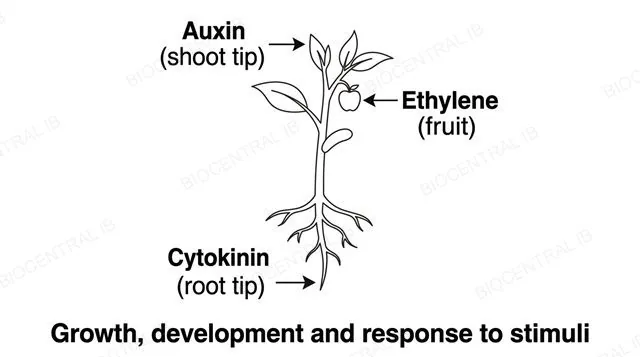
A whole seedling outline with arrows pointing to the shoot tip, root tip and a fruit, labeled auxin shoot tip, cytokinin root tip, ethylene fruit and growth development and response to stimuli
C3.1.19 · HL

A plant's substitute for nerves

Phytohormones are chemical signalling molecules that control plant growth, development and response to stimuli, taking on the coordinating role that a nervous system plays in animals.
  • A variety of different chemicals function as phytohormones in plants, rather than there being just one universal signalling molecule.
  • This lesson develops three named examples in depth across the remaining statements: auxin, cytokinin and ethylene (IUPAC name: ethene).
  • Because plants lack a nervous system, phytohormones are what let a plant integrate and coordinate activity across distant organs, such as between its roots and its shoot.
Why it mattersEvery phytohormone statement that follows is really just a specific worked example of this same general signalling role.
C3.1.20 · HL

One-way doors for a growth signal

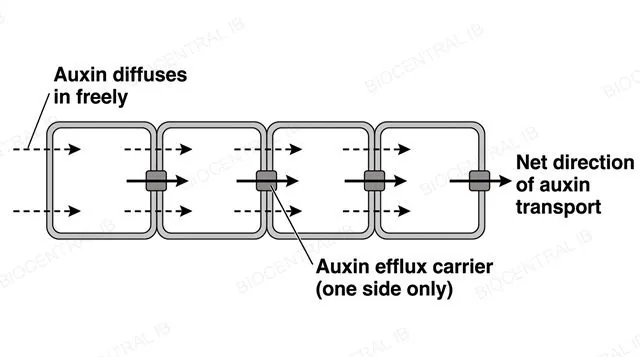
Auxin efflux carriers are membrane proteins that maintain a directional concentration gradient of auxin by controlling which side of a plant cell the hormone can leave from.
  • Auxin can diffuse freely into a plant cell from any side, but it cannot diffuse back out again without a carrier protein.
  • Auxin efflux carriers are positioned in the cell membrane on one particular side of the cell only, so auxin can only exit through that one side.
  • When every cell in a tissue coordinates to position its efflux carriers on the same side, auxin is actively transported directionally, cell to cell, and becomes concentrated in one part of the plant.
Why it mattersThis directional transport mechanism is exactly what produces the auxin concentration gradient behind phototropic bending, covered next.
A row of four plant cells with auxin diffusing in freely through both membranes but exiting only through an efflux carrier positioned on the right-hand membrane of each cell, producing a net left-to-right transport direction, labeled auxin diffuses in freely, auxin efflux carrier one side only and net direction of auxin transport
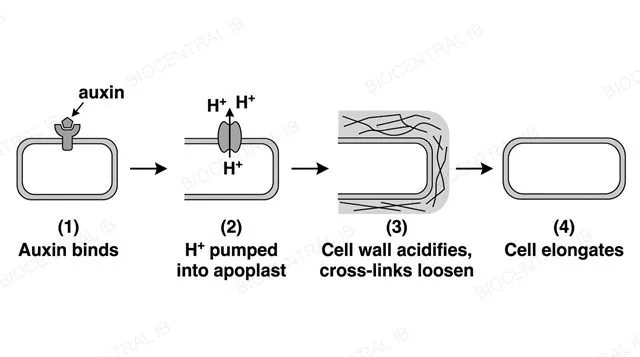
A four-stage sequence in biological order: auxin binds, H+ pumped into apoplast, cell wall acidifies and cross-links loosen, cell elongates, labeled accordingly with single-direction arrows
C3.1.21 · HL

Acid unlocks a longer cell

Auxin promotes cell growth through the acid growth mechanism, in which it triggers hydrogen ion secretion that loosens the cell wall and allows the cell to elongate.
  • Auxin promotes secretion of H+ ions into the apoplast, the cell wall space just outside the plasma membrane, acidifying that space.
  • This acidification loosens the cross-links between cellulose microfibrils in the cell wall, making the wall more flexible.
  • With a looser wall, the cell can take up more water and elongate further — and because auxin concentration gradients differ across a shoot, this produces the differential growth rates that drive phototropism.
Why it mattersThe order here matters for exam marks: auxin arrives first, hydrogen ion secretion follows, then wall loosening, then elongation — not the reverse.
C3.1.22 · HL

Root and shoot, talking in both directions

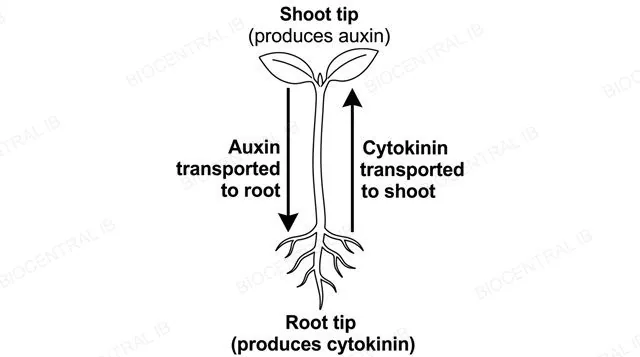
Interactions between auxin and cytokinin regulate root and shoot growth by coordinating these two organs' development with each other.
  • Shoot tips produce auxin, which is transported down toward the roots; root tips produce cytokinin, which is transported up toward the shoots.
  • Each phytohormone signals information about one organ's status to the other, letting root growth and shoot growth stay proportionate to each other rather than developing independently.
  • This two-way chemical conversation is a plant equivalent of the whole-body integration covered earlier in this lesson, just carried out by hormones alone rather than by nerves and hormones together.
Why it mattersRoot and shoot growth being integrated with each other, rather than growing independently, is the key idea an exam question is likely to be testing here.
A vertical seedling diagram with two opposite-direction arrows, auxin transported from shoot tip down to root and cytokinin transported from root tip up to shoot, labeled shoot tip produces auxin, root tip produces cytokinin, auxin transported to root and cytokinin transported to shoot
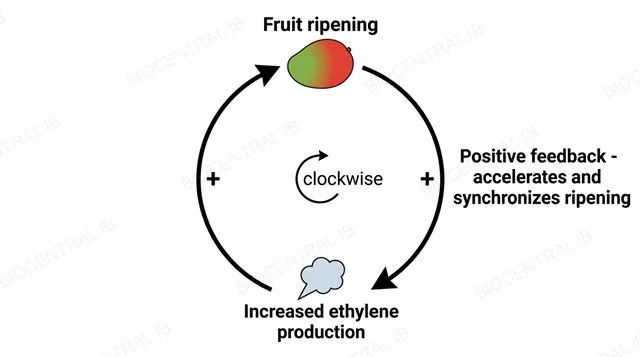
A two-stage clockwise positive feedback loop diagram, fruit ripening leading to increased ethylene production leading back to fruit ripening, visually distinguished from a negative feedback loop, with an explicit clockwise direction marker, labeled fruit ripening, increased ethylene production and positive feedback accelerates and synchronizes ripening
C3.1.23 · HL

Ripening that feeds on itself

Fruit ripening and ethylene production regulate each other through positive feedback: ethylene stimulates the changes of ripening, and ripening itself stimulates increased ethylene production.
  • Ethylene (IUPAC name: ethene) is the phytohormone responsible for triggering the physical and chemical changes that occur during fruit ripening.
  • As a fruit begins to ripen, it produces more ethylene in response, which then accelerates further ripening in a self-reinforcing cycle.
  • Unlike negative feedback, which corrects a change back toward normal, this positive feedback amplifies the original change, driving it forward rather than reversing it.
Why it mattersThis positive feedback ensures that fruit ripening proceeds rapidly and in a synchronized way, rather than slowly or unevenly across the fruit.
Quick check · HL

A researcher removes all lateral (one-sided) light and instead illuminates a seedling equally from every direction. Based on the auxin efflux carrier mechanism, what would you predict?

The seedling would grow straight up, because with no one-sided light cue there would be no reason for auxin efflux carriers to become concentrated on one particular side
The seedling would bend strongly toward whichever side has slightly more shade, regardless of the light being equal
Auxin would stop being produced entirely under equal lighting
The seedling would ripen its fruit faster under equal lighting
Correct answer: straight growth, no phototropic bending. Phototropic bending depends on auxin efflux carriers becoming polarized to one side of each cell, concentrating auxin on the shaded side and driving greater cell elongation there. With no lateral light difference, there is no basis for that polarization, no auxin concentration gradient forms, and growth proceeds evenly on all sides.

Key vocabulary

Worth being able to define in a single sentence each

System integration
Coordination of an organism's separate parts so they collectively perform an overall function.
Emergent property
A property of a whole, integrated system that cannot be predicted from its parts studied alone.
Baroreceptor
A receptor that detects blood pressure via stretch of an artery wall.
Chemoreceptor
A receptor that monitors blood pH and the concentrations of oxygen and carbon dioxide.
Enteric nervous system
The network of neurons within the gut wall that controls peristalsis involuntarily.
Circadian rhythm
A roughly 24-hour biological cycle normally synchronized to the day/night cycle.
Phototropism HL
A directional growth response of a plant to light arriving from one particular direction.
Phytohormone HL
A chemical signalling molecule that controls plant growth, development and response to stimuli.
Auxin efflux carrier HL
A membrane protein positioned on one side of a plant cell that lets auxin exit only that side.

Where this shows up again

C2.2 · Neural signalling
The cellular mechanism (action potentials, synapses) underlying the nervous signalling integrated at the whole-body level here.
B2.3 / B2.4 · Homeostatic control loops
The same negative feedback logic (sensor / integrating centre / effector) reapplied to heart rate and ventilation rate here.
C3.2 · Defence against disease
Further integration/defence content building on this topic's feedback-control concepts.

C3.1 Integration of body systems — one-page recap

Screenshot this slide to revise from

System integration
  • Coordinated via nervous, hormonal and blood transport channels.
  • Hierarchy of subsystems produces emergent properties (e.g. a cheetah's sprint).
Nervous integration
  • Brain combines sensory inputs plus learning/memory; spinal cord integrates unconscious reflexes independently.
  • Cerebellum coordinates muscle contraction and balance.
Nerves in detail
  • Sensory neurons carry input to the CNS; motor neurons carry output to effectors.
  • A nerve is a mixed bundle of both, plus a protective sheath.
Hormonal & rhythmic control
  • Melatonin (circadian sleep cycle) and epinephrine (vigorous-activity response) act via the blood.
  • Hypothalamus-pituitary links neural input to hormonal output.
Feedback control
  • Baroreceptors/chemoreceptors adjust heart rate; chemoreceptors adjust ventilation rate — both negative feedback.
  • CNS + ENS split control of peristalsis.
HL · Plant integration
  • Auxin efflux carriers create the concentration gradient driving phototropism via the acid growth mechanism.
  • Auxin-cytokinin balance root/shoot growth; ethylene drives positive-feedback fruit ripening.

One organism, working as one

From a cheetah's sprint to a seedling's bend toward the sun, every living system depends on separate parts staying in constant conversation.
C3.1 Integration of body systems · BioCentral IB
Use ↓ ↑ or click to navigate
01 / 37