BioCentral IBBioCentral IB
IB Biology · Theme D · D1.3

Mutation and gene editing

A single swapped, added, or deleted base can vanish without effect — or rewrite a protein beyond recognition. Gene mutation is the original source of all genetic variation and the cause of many inherited diseases and cancers, and, through tools like CRISPR-Cas9, something scientists can now deliberately harness to treat disease.
Guiding questions

How do gene mutations occur?

What are the consequences of gene mutation?

Part one

Types of gene mutation

D1.3.1 – D1.3.3
D1.3.1

Three ways to change a gene

A gene mutation is a permanent change to a gene's nucleotide sequence: a substitution, an insertion, or a deletion.
  • A substitution replaces one nucleotide with a different one, without changing the gene's total length.
  • An insertion adds one or more nucleotides; a deletion removes one or more — both change the gene's length, unlike a substitution.
  • All three are defined by what happens to the base sequence itself, not by whether the change ends up affecting the protein — a separate question, covered next.
Why it mattersWhich of these three changes has occurred determines almost everything about a mutation's consequences, covered over the next two slides.
D1.3.2

One base swapped — everything, or nothing

A single-nucleotide polymorphism (SNP) is a one-base difference from the usual sequence, produced by a substitution mutation.
  • Because the genetic code is degenerate, a substitution can leave the amino acid unchanged: the mRNA codon GAG becomes GAA, still glutamic acid — a silent change.
  • If the amino acid changes, the substitution is missense. In the β-globin gene, GAG to GTG in the DNA (GUG in the mRNA) replaces glutamic acid with valine, causing sickle-cell disease.
  • A substitution can also create a stop codon (GAG to UAG, nonsense), ending translation early — but it always changes exactly one codon, unlike an insertion or deletion.
Why it mattersWhether a substitution matters depends on the genetic code's own structure, not on how large the change looks at the DNA level.
D1.3.3

When the reading frame shifts

Insertions and deletions can cause a frameshift — every downstream codon is read differently — unlike a substitution's single-codon effect.
  • If the number of nucleotides inserted or deleted is not a multiple of three, the reading frame shifts, and every downstream codon is misread — in the example, Met–Glu–Leu–Gly–Asn–Arg becomes Met–Asn–STOP.
  • A frameshift usually gives a different amino acid sequence from that point on, often ending at a premature stop codon, so the polypeptide is likely to stop functioning.
  • An in-frame indel (here, losing GAA removes only Glu) leaves other codons intact, but it and any major insertion or deletion can still disrupt folding or a functional site.
Why it mattersA single-base indel is usually far more damaging than a single-base substitution — one shifts every codon after it, the other changes only one.
Part two

Causes and consequences of mutation

D1.3.4 – D1.3.7
D1.3.4

Where mutations come from

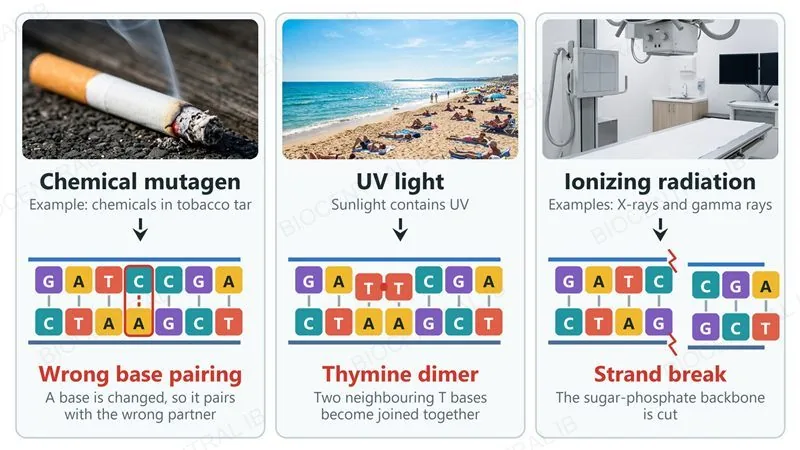
Gene mutations arise from two sources: errors during DNA replication or repair, and exposure to mutagens — agents that damage DNA or raise the mutation rate.
  • Chemical mutagens include 5-bromouracil, a base analogue mistaken for thymine during replication, and compounds such as nitrosamines and the polycyclic aromatic hydrocarbons in tobacco tar, which chemically modify bases.
  • Mutagenic radiation includes UV light, which joins neighbouring thymine bases into thymine dimers, and ionizing radiation such as X-rays and gamma rays, which breaks DNA strands.
  • DNA polymerase's proofreading and a separate mismatch-repair system correct most replication errors — a mutation is what remains once both checks fail.
Why it mattersNaming a specific chemical mutagen and a specific mutagenic radiation type is exam-relevant — 5-bromouracil and UV light are safe, real examples to know.
Three panels, each pairing a photograph of a mutagen with the DNA damage it causes: a cigarette (a chemical mutagen) leaves a wrongly paired base, sunlight (UV light) joins two neighbouring thymine bases into a thymine dimer, and an X-ray room (ionizing radiation) cuts the sugar-phosphate backbone
D1.3.5

Random, but not equal

Mutations can occur anywhere in a genome's base sequence, but not every base is equally likely to mutate.
  • Some bases have a higher probability of mutating than others, due to local sequence context, chemical instability, or uneven exposure to DNA-damaging agents.
  • No natural mechanism is known for making a deliberate change to one particular base for the purpose of changing a trait — mutation cannot be aimed at a target.
  • "Random" here means random with respect to which trait results, not that every base mutates equally often — two separate ideas easy to mix up.
Why it mattersThis is why natural selection, not the organism itself, decides whether a mutation persists — the mutation has no foresight of what's needed.
Mutation sites: random position, uneven density No known mechanism for deliberately targeting a mutation to a trait
D1.3.6

Which cell it happens in matters

The same mutation has very different consequences depending on whether it occurs in a germ cell or a somatic (body) cell.
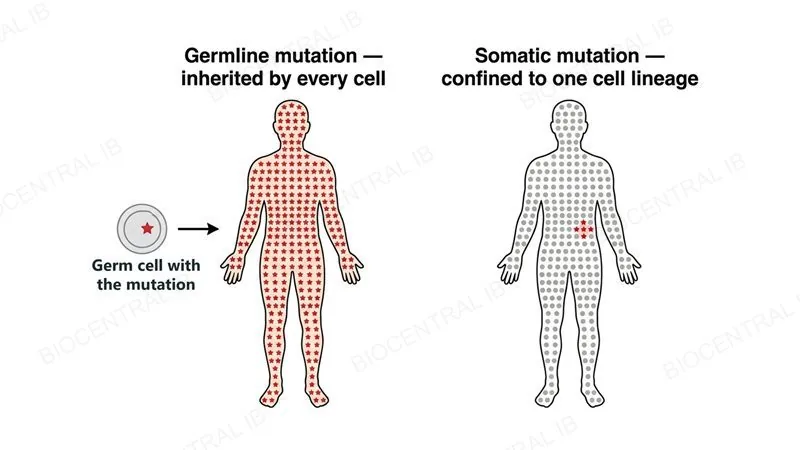
  • A germline mutation occurs in a cell that gives rise to gametes; if that gamete is fertilized, the mutated allele is present in every cell of the offspring and can be inherited.
  • A somatic mutation occurs in an ordinary body cell; it is carried only by that cell and its mitotic descendants, and is never passed to offspring.
  • Somatic mutations that disable genes controlling cell division, apoptosis or DNA repair are a major cause of cancer.
Why it mattersOnly germline mutations feed the pool of heritable variation that evolution acts on — cancer-causing somatic mutations die with the individual.
A germ cell carrying a mutation gives a body in which every cell carries it (germline mutation), compared with a body in which the mutation is confined to one small group of cells descended from a single cell (somatic mutation)
D1.3.7

The only source of new alleles

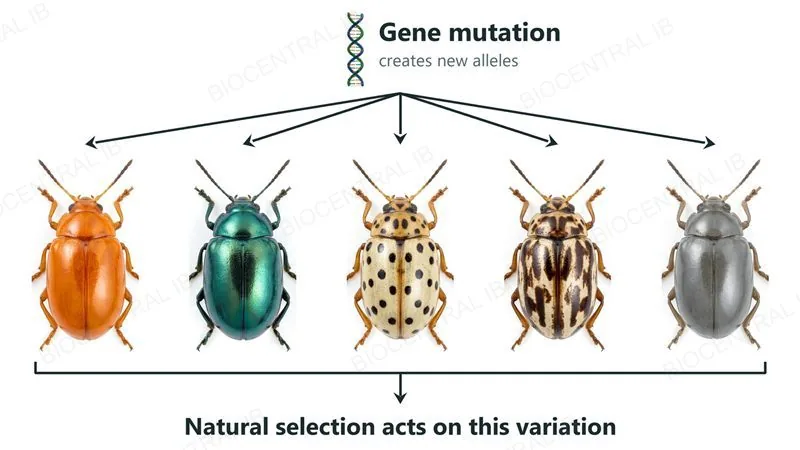
Gene mutation is the original source of all genetic variation — no other process creates a genuinely new allele.
  • Meiosis, crossing over and sexual reproduction reshuffle alleles that already exist, but only mutation can produce an allele that never existed before.
  • Most mutations are harmful or neutral to the individual, but across a species, over long timescales, they are essential — the raw material natural selection acts on.
  • Commercial genetic tests can report future health and disease risk directly from DNA — without expert interpretation, this probabilistic result can be misread as certain, so how it's communicated matters.
Why it mattersNature of science: a test can be scientifically valid and still cause harm if its result is miscommunicated.
Gene mutation, creating new alleles, with arrows to five photographs of the same beetle species in different colours and patterns, all together forming the variation that natural selection acts on
Quick check

Two mutations occur in the same coding region of a gene. Mutation A deletes 3 consecutive nucleotides. Mutation B deletes a single nucleotide. Which mutation is more likely to make the resulting polypeptide stop functioning, and why?

Mutation A — removing 3 nucleotides changes more of the protein overall
Mutation B — deleting 1 nucleotide is not a multiple of three, causing a frameshift that changes every codon downstream
Both are equally damaging, since both mutations are deletions
Neither — deletions only affect function if they occur outside the coding region
Correct answer: Mutation B is more likely to cause loss of function. Removing 1 nucleotide is not a multiple of three, so it shifts the reading frame for every codon after it — usually producing a garbled amino acid sequence and a premature stop codon. Removing 3 nucleotides keeps the reading frame intact and removes only one amino acid, which is far less likely to destroy the protein's overall structure.
Part three

HL — gene editing technology

D1.3.8 – D1.3.10
D1.3.8 · HL

Breaking a gene on purpose

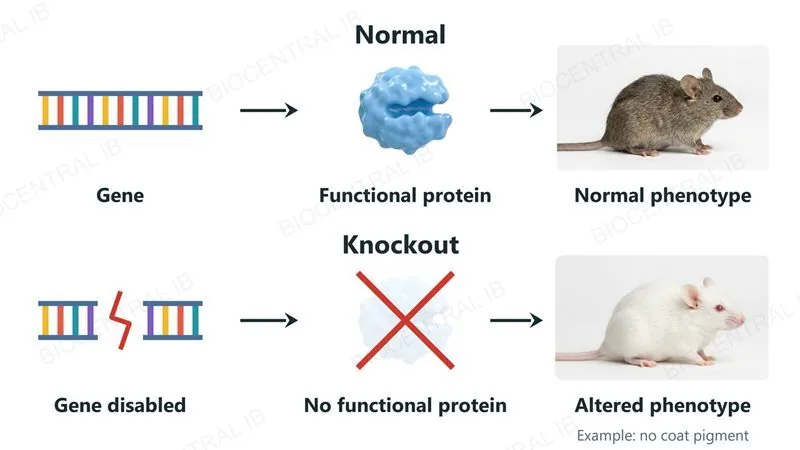
Gene knockout is a technique for investigating a gene's function by deliberately making it inoperative.
  • If disabling a gene produces a clear defect, that defect points to what the gene normally does — function is inferred from the knockout's phenotype.
  • The details of how a specific gene is disabled aren't required at this level — what matters is the logic: switch it off, then see what breaks.
  • A library of knockout organisms — many genes each disabled one at a time — is already available for some common research-model species.
Why it mattersGene knockout answers a different question from the editing on the next two slides: it asks "what does this gene do", not "how do we fix it".
A normal gene makes a functional protein and a normal grey-brown mouse; a knocked-out gene makes no functional protein and gives an altered phenotype, shown by a white mouse without coat pigment
D1.3.9 · HL

A guide RNA finds the target

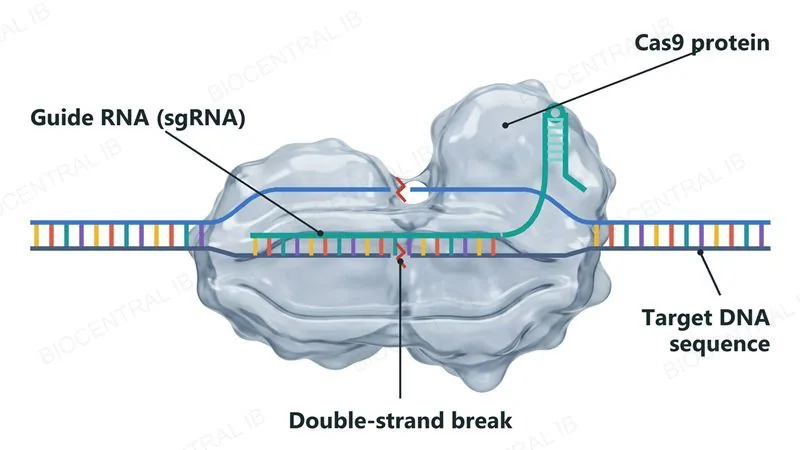
CRISPR-Cas9 is a gene-editing system that uses a short guide RNA to direct the Cas9 enzyme to one specific genome sequence.
  • The guide RNA's sequence is complementary to the target DNA, so it base-pairs with that one site and no other, giving Cas9 its precision.
  • Once positioned at the target site, Cas9 acts as a nuclease, cutting both DNA strands to create a double-strand break exactly there.
  • The CRISPR-Cas system's natural role in prokaryotes isn't required — the focus here is entirely on its repurposing as a genome-editing tool.
Why it mattersThe guide RNA, not Cas9 itself, makes CRISPR programmable — change its sequence and the same enzyme can be redirected to a different gene.
A photographic render of the Cas9 protein with a guide RNA base-paired to one DNA strand at the target site and both DNA strands cut, giving a double-strand break
D1.3.9 · HL

From a cut to a cure

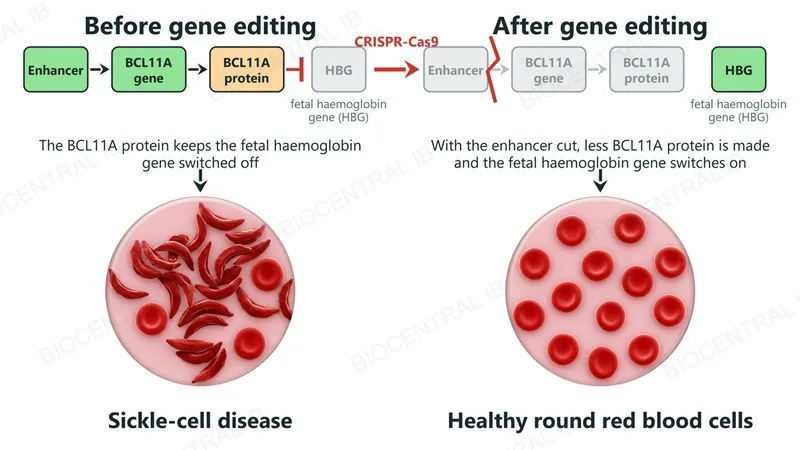
One successful real-world use of CRISPR-Cas9 is exagamglogene autotemcel (Casgevy), an approved gene-editing therapy for sickle-cell disease.
  • A patient's own blood stem cells are edited outside the body: CRISPR-Cas9 disrupts the erythroid enhancer of BCL11A, whose protein normally keeps the fetal haemoglobin gene off. The cells are then reinfused.
  • With BCL11A reduced, fetal haemoglobin switches back on and can substitute for the abnormal adult haemoglobin that causes sickling, reducing the vaso-occlusive crises of severe sickle-cell disease.
  • Nature of science: CRISPR raises real ethical issues to address before any new use, and since countries regulate genome editing differently, there's an active effort to harmonize regulation.
Why it mattersThis therapy edits only somatic blood stem cells, not germ cells — it helps this patient but isn't inherited by their children.
Before editing, the BCL11A enhancer drives the BCL11A gene, whose protein switches off the fetal haemoglobin gene, and sickle-shaped red blood cells are made; after CRISPR-Cas9 cuts the enhancer, less BCL11A protein is made, the fetal haemoglobin gene switches on and healthy round red blood cells are made
D1.3.10 · HL

Some sequences barely change at all

A conserved sequence is identical or similar across a species or group of species; a highly conserved one stays similar over long evolutionary time.
  • One hypothesis is functional constraint: the gene product has strict requirements, so almost any mutation there disrupts function and is removed by selection.
  • A second hypothesis is a genuinely slower mutation rate: some regions may be less exposed to damage or better repaired, so fewer mutations arise there at all.
  • The two hypotheses aren't mutually exclusive — distinguishing which explains a given sequence is an active question, not a settled one.
Why it mattersComparing a sequence across many species is itself evidence for how essential it is — the more conserved, the stronger the implied constraint.
Quick check · HL

A researcher deliberately disables one specific gene in mice, purely to observe what phenotype results. Which technique is this, and how does its purpose differ from that of the CRISPR-Cas9 therapy Casgevy, which edits the BCL11A enhancer in a sickle-cell patient's stem cells?

Gene knockout — its aim is to learn what the gene normally does, whereas the Casgevy edit aims to treat a disease
Gene knockout — its aim is to treat a disease, the same aim as the Casgevy edit
Gene knockout — it can only be carried out with CRISPR-Cas9, whereas Casgevy uses a different system
Random mutagenesis — the mice were exposed to a mutagen, so no particular gene was targeted
Correct answer: gene knockout, used to investigate function rather than to treat disease. A knockout deliberately makes one chosen gene inoperative so a researcher can observe the resulting phenotype and infer the gene's normal role. Casgevy has the opposite goal: it uses CRISPR-Cas9 to edit a specific sequence, the BCL11A enhancer, so that a patient's own cells make fetal haemoglobin. (CRISPR-Cas9 can also be used to make knockouts — the two ideas differ in purpose, not in being rival techniques.)

Key vocabulary

Worth being able to define in a single sentence each

Frameshift mutation
A change in the reading frame of a gene, caused by an insertion or deletion whose length is not a multiple of three.
SNP
Single-nucleotide polymorphism — a single-base difference from the usual sequence at a given position, produced by a substitution mutation.
Mutagen
A chemical or physical agent that damages DNA or increases the rate of mutation.
Germline mutation
A mutation in a gamete-forming cell that can be inherited by offspring.
Somatic mutation
A mutation in a body cell that is not passed to offspring, but can affect that cell's mitotic descendants.
Gene knockoutHL
A technique that deliberately disables a gene to investigate its normal function.
Guide RNAHL
A short RNA sequence, complementary to a target DNA site, that directs the Cas9 enzyme to cut there.
Conserved sequenceHL
A DNA or protein sequence that stays identical or similar across species, or over evolutionary time.

Where this shows up again

D1.1
DNA replication errors that escape proofreading and mismatch repair (D1.1) become mutations. Explain how DNA polymerase III's proofreading function corrects most errors, while the rest persist as gene mutations.
D1.2
The genetic code's degeneracy (D1.2) means many possible substitutions are silent. Explain why insertions and deletions are far less likely than substitutions to be silent mutations.
A4.1
How can natural selection lead to both a reduction in variation and an increase in biological diversity? Gene mutation (D1.3) is the ultimate source of the variation natural selection (A4.1) acts on.
B1.2
How does variation in subunit composition of polymers contribute to function? Relate this to how a missense substitution's amino-acid change (D1.3.2) can alter a protein's (B1.2) structure and function.

D1.3 Mutation and gene editing — one-page recap

Screenshot this slide to revise from

Types of mutation
  • A gene mutation is a permanent change to a gene's nucleotide sequence: substitution, insertion, or deletion.
  • Insertions/deletions change the gene's length; a substitution does not.
Substitutions & SNPs
  • A SNP is a one-base difference produced by a substitution.
  • Degeneracy of the code means a substitution can be silent (GAG→GAA), missense (GAG→GUG, sickle-cell disease) or nonsense (GAG→UAG, a stop codon).
Indels & frameshift
  • An indel not a multiple of 3 causes a frameshift, misreading every downstream codon.
  • Major or in-frame indels can still disable a protein by disrupting folding.
Causes & randomness
  • Mutagens: chemicals (5-bromouracil, nitrosamines) and radiation (UV, ionizing) — plus uncorrected replication/repair errors.
  • Mutations occur randomly across the genome — never deliberately targeted to a trait.
Germline, somatic & variation
  • Germline mutations are inherited; somatic mutations are not, but can cause cancer.
  • Mutation is the original source of all genetic variation — essential, long-term, for evolution.
HL · Gene editing
  • Gene knockout disables a gene to study its function; CRISPR-Cas9 uses a guide RNA to direct Cas9 to cut one target site (e.g. Casgevy, for sickle-cell disease).
  • Conserved sequences persist via functional constraint and/or a slower mutation rate.

One base can change everything — or nothing at all

From a single silent substitution to a guide RNA precisely cutting one chosen site in three billion bases, mutation is both biology's oldest source of change and, through CRISPR-Cas9, its newest tool.
D1.3 Mutation and gene editing · BioCentral IB
Use ↓ ↑ or click to navigate
01 / 22