BioCentral IBBioCentral IB
IB Biology · Theme D · D2.2 · HL only

Gene expression

Every cell in your body carries essentially the same genome, yet a neuron and a liver cell look and behave nothing alike. This is the topic that asks how a cell decides which of its genes to switch on, how that decision can be inherited without ever touching the DNA base sequence, and how the environment can reach in and shift it.
Guiding questions

How is gene expression changed in a cell?

How can patterns of gene expression be conserved through inheritance?

Part one

Controlling transcription and translation

D2.2.1 – D2.2.3
D2.2.1

Genes only matter once they’re expressed

Gene expression is the mechanism by which the information carried in a gene produces an effect on phenotype.
  • The most common stages are transcription (DNA to mRNA), translation (mRNA to polypeptide), and the function of the protein product — for example, an enzyme catalyzing a reaction.
  • Information flows one way: DNA base sequence to mRNA base sequence to amino acid sequence to folded protein to phenotypic effect.
  • A gene only affects phenotype once it is expressed — an unexpressed gene, however "correct" its sequence, has no effect on its own.
Why it mattersEvery mechanism in the rest of this topic is really a way of answering one question: whether, and how much, a given gene reaches this end point.
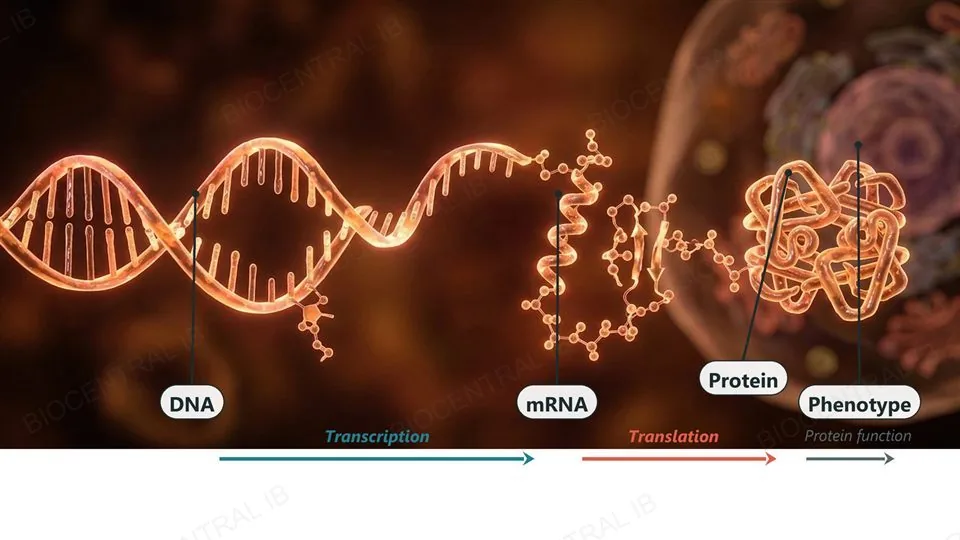
A glowing DNA double helix on the left flowing into a strand of mRNA in the middle, then into a folded protein and a blurred cell on the right, labeled in order DNA, mRNA, Protein, Phenotype, with Transcription and Translation named under the first two arrows.
D2.2.2

Promoters and transcription factors switch genes on

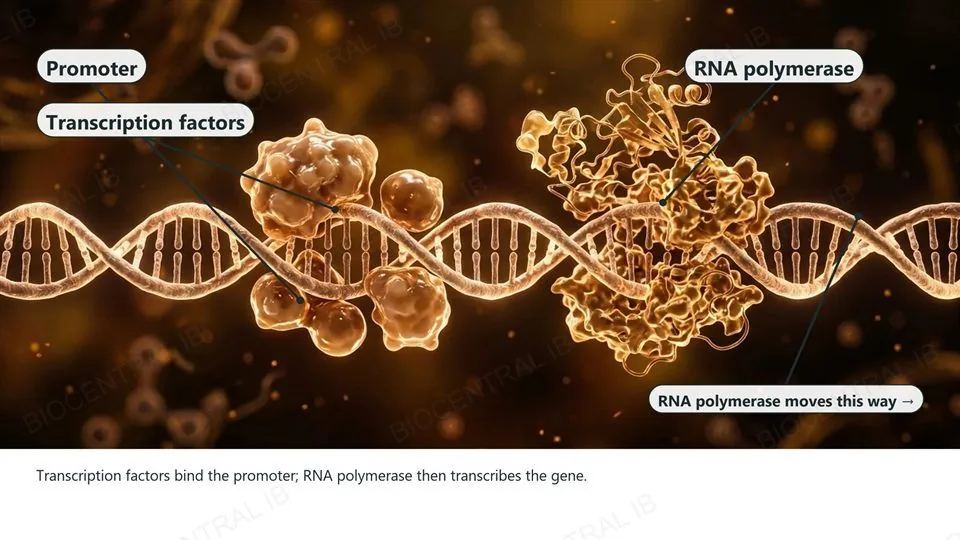
Transcription is regulated by transcription factors: proteins that bind to specific base sequences in DNA.
  • Promoters are specific DNA base sequences, close to a gene’s start, where RNA polymerase and general transcription factors assemble to begin transcription.
  • A transcription factor’s binding can either activate or repress transcription, depending on the factor and the sequence it binds.
  • Because different cell types express different combinations of transcription factors, the same gene’s promoter can be switched on in one cell type and left off in another.
Why it mattersThis is the actual mechanism behind differentiation (D2.2.4) — different transcription factors present, not different genes.
A DNA double helix with a cluster of transcription factor proteins bound near its centre, labeled Promoter and Transcription factors, and a larger RNA polymerase complex bound further along the strand, labeled RNA polymerase and moving this way.
D2.2.2

Enhancers reach genes from a distance

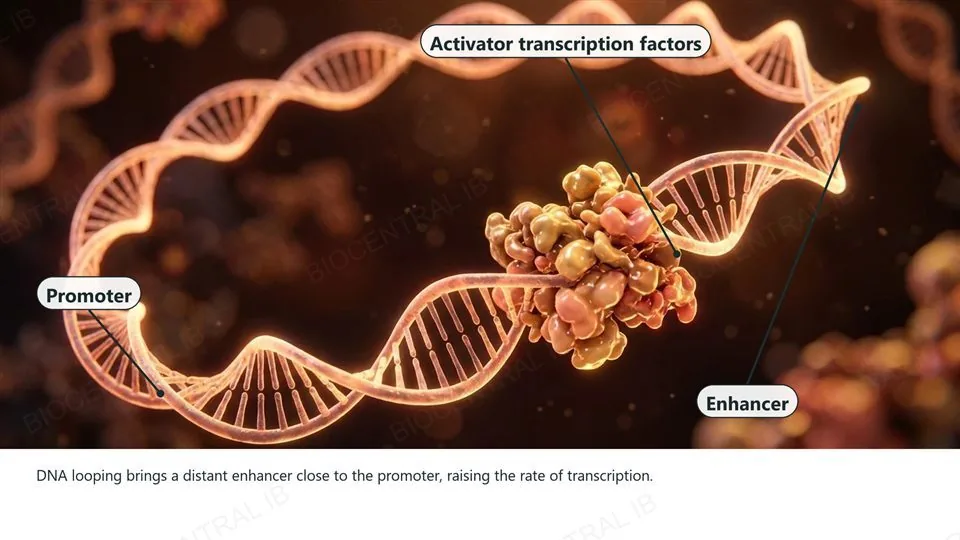
Enhancers are DNA base sequences, which may lie far from the gene they control, that increase the rate of transcription when bound by activator transcription factors.
  • An enhancer can sit a long distance from its target gene along the DNA molecule and still influence it.
  • DNA looping brings a distant enhancer physically close to the promoter, so the activator proteins bound to each region can interact.
  • Bound activators increase the rate at which RNA polymerase initiates transcription at the promoter.
Why it mattersEnhancers let one gene be tuned by several distant switches at once, giving finer control than a promoter alone.
A DNA strand bent into a large loop so that a region labeled Enhancer near one end touches a region labeled Promoter near the other end, with a cluster of protein bridging the two, labeled Activator transcription factors.
D2.2.3

Degrading mRNA controls how much protein gets made

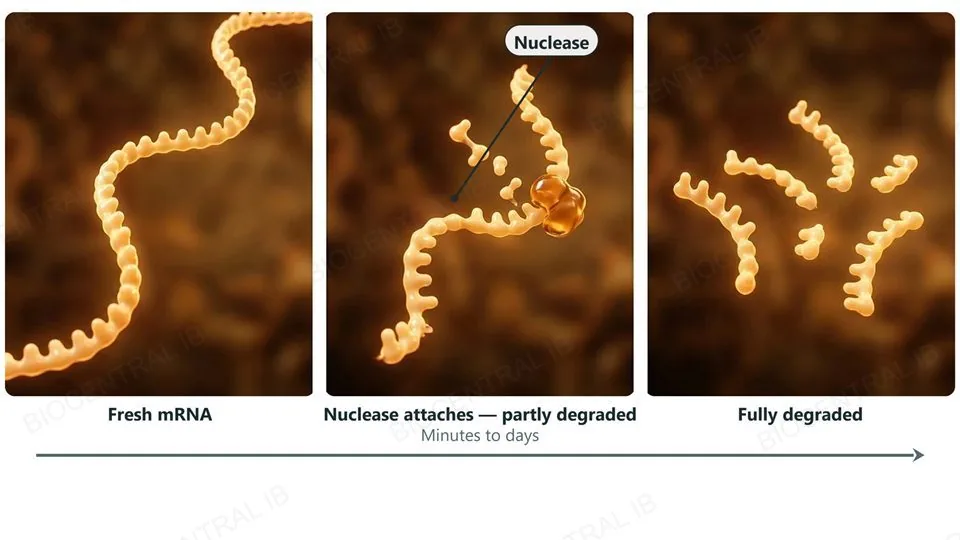
mRNA degradation is a post-transcriptional control point: it acts after transcription is complete, by limiting how long a transcript stays available to be translated.
  • Nucleases are the enzymes that break down mRNA.
  • In human cells, an individual mRNA molecule may persist anywhere from minutes to days before it is broken down.
  • A longer-lived mRNA can be translated repeatedly for longer, yielding more protein overall; a short-lived one yields less.
Why it mattersControlling the rate of degradation tunes the level of translation without changing the rate of transcription at all.
Three panels showing an mRNA strand over time: Fresh mRNA intact and smooth, then partly degraded with a nuclease enzyme attached near a fraying end, then fully degraded into several short disconnected fragments, with a Minutes to days timeline beneath.
Quick check

A liver cell and a neuron contain the same genes but make different proteins. Which of the following best explains why?

The liver cell and the neuron have different genomes
They have different combinations of transcription factors bound to promoters and enhancers, switching different genes on
Only the liver cell’s DNA contains protein-coding genes
mRNA degradation only happens in neurons
Correct answer: different transcription factors switch different genes on. Nearly all somatic cells share the same genome (D2.2.5). Differentiated cell types arise from different, selective patterns of gene expression — which transcription factors are present and which promoters and enhancers they bind — not from different DNA sequences.
Part two

Epigenesis and the epigenome

D2.2.4 – D2.2.7
D2.2.4

One genome, many cell types: epigenesis

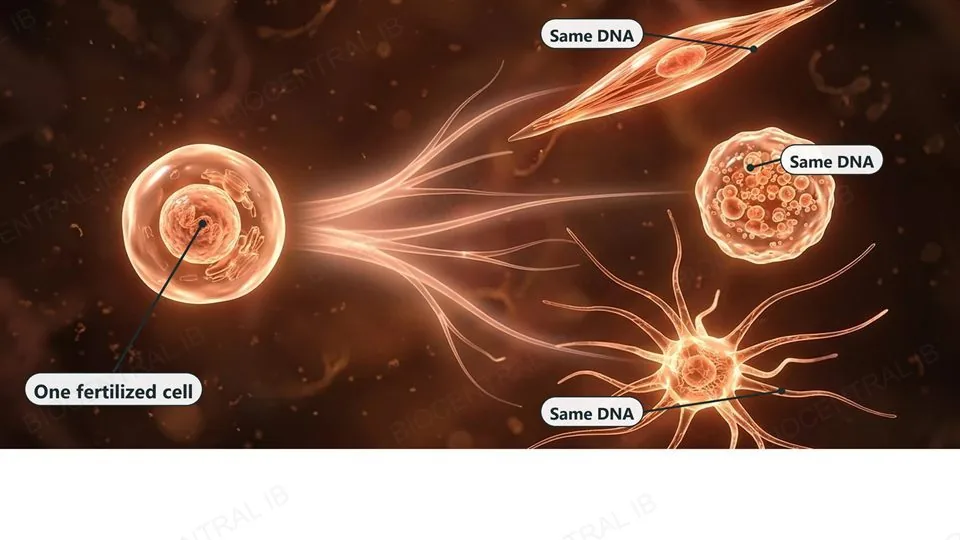
Epigenesis is the development of patterns of differentiation in the cells of a multicellular organism.
  • Differentiated cell types arise from different, selective patterns of gene expression, not from different DNA sequences — nearly all somatic cells in an organism share the same genome.
  • Epigenetic changes do not alter the DNA base sequence. This is the single most important distinction in this whole topic.
  • Because the base sequence is unchanged, an epigenetic change can alter phenotype without altering genotype.
Why it mattersThis directly contrasts with a true gene mutation (D1.3.1), which does change the base sequence — always keep the two mechanisms separate.
One rounded stem-like cell on the left, labeled One fertilized cell, branching by glowing trails into three visually distinct specialized cells on the right — an elongated spindle-shaped cell, a small round granule-packed cell, and a branching star-shaped cell — each labeled Same DNA.
D2.2.5

Genome, transcriptome, proteome: what’s shared, what’s not

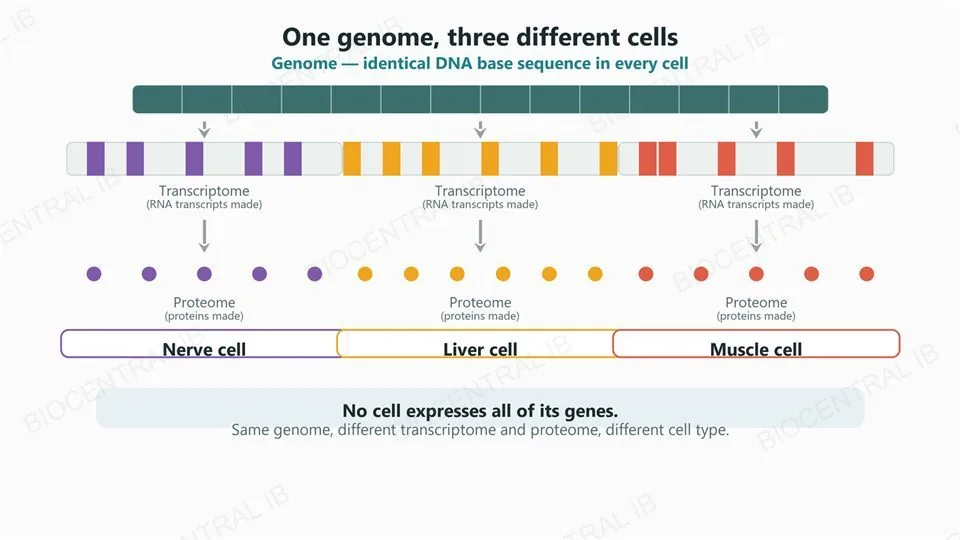
The genome is the complete set of DNA base sequences in a cell; the transcriptome is the complete set of RNA transcripts present at a given time; the proteome is the complete set of proteins present at a given time.
  • No cell expresses all of its genes — every cell type expresses only a subset of the full genome.
  • The genome is essentially identical across a multicellular organism’s somatic cells, but the transcriptome and proteome differ sharply between cell types.
  • It is this pattern of expression, not the genome itself, that determines how a cell differentiates and what it does.
Why it mattersTwo cells can share an identical genome and still be almost unrecognizably different, simply by expressing different parts of it.
A shared teal Genome bar at the top feeding three cell-type panels below — nerve cell, liver cell, muscle cell — each with its own differently coloured subset of highlighted Transcriptome segments and Proteome dots, captioned
D2.2.6

Methyl tags: one mark that always represses, one that can go either way

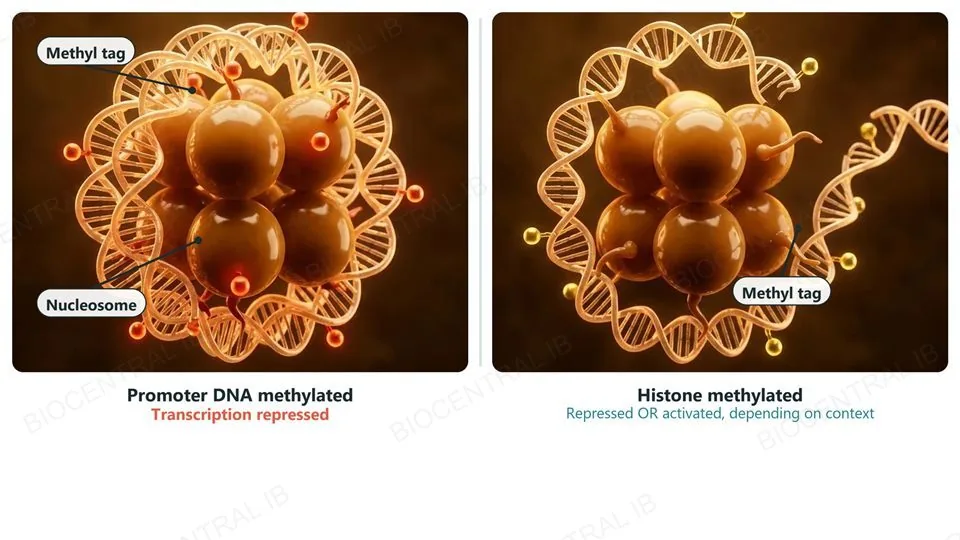
DNA methylation and histone methylation are both epigenetic tags: chemical modifications that affect gene expression without changing the DNA base sequence.
  • Methylation of cytosine in a promoter’s DNA represses transcription of the gene downstream of that promoter.
  • Methylation of amino acids in histones can either repress or activate transcription, depending on which amino acid is modified and the context.
  • Nucleosomes are DNA wrapped around histone proteins; tags added to the histones can alter how tightly the DNA is packaged and how accessible it is to transcription machinery.
Why it mattersPromoter methylation is consistently repressive; histone methylation is not — the two mechanisms do not behave the same way.
Two panels of DNA wrapped around a cluster of histone proteins (a nucleosome): left panel tightly wound and closed, labeled Promoter DNA methylated, Transcription repressed; right panel loosely wound and open, labeled Histone methylated, Repressed OR activated depending on context.
D2.2.7

Tags can outlive the cell that made them

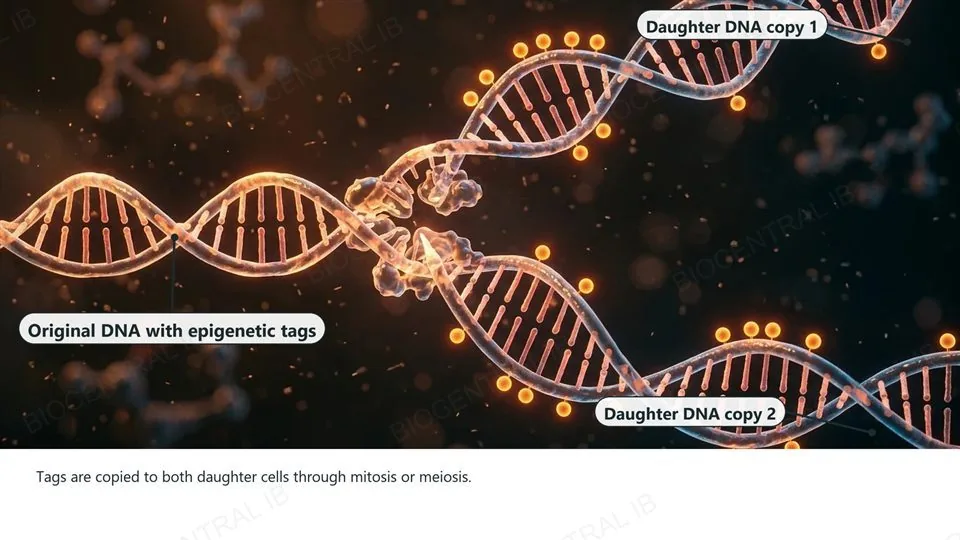
Epigenetic inheritance is the possibility that a phenotypic change in a cell or organism can be passed on to daughter cells or offspring without any change to the DNA nucleotide sequence.
  • This can happen if the epigenetic tags responsible for the change remain in place through mitosis or meiosis, rather than being erased during cell division.
  • What is inherited is a pattern of gene expression, not a change in the genetic code.
  • Because tags can persist through division, epigenetic states can be surprisingly stable across many cell generations, even though they remain chemically reversible in a way a true mutation is not.
Why it mattersThis is the "across generations" counterpart to the "within one organism" differentiation story in D2.2.4.
A single DNA double helix mid-replication, splitting into two complete daughter helices with matching orange tag-spheres attached at the same positions on both, labeled Original DNA with epigenetic tags, Daughter DNA copy 1, and Daughter DNA copy 2.
Quick check

A gene’s promoter is heavily methylated in liver cells but not in neurons. What effect would this have on that gene in liver cells, and why?

The DNA sequence of the gene has mutated
The gene is repressed, because methylation of cytosine in a promoter represses transcription of the gene downstream
The gene is more active, because promoter methylation activates transcription
The gene is now permanently and irreversibly silenced in every future daughter cell
Correct answer: repressed, because promoter methylation represses transcription. Methylation of cytosine in a promoter’s DNA is consistently repressive (D2.2.6). It is an epigenetic tag, not a mutation, so it is chemically reversible — tags can be added or removed across a lifetime or across generations (D2.2.9), unlike a true change to the base sequence.

Key vocabulary

All HL — worth being able to define in a single sentence each

Gene expression
The mechanism by which information carried in a gene produces an effect on phenotype.
Transcription factor
A protein that binds a specific DNA base sequence to regulate the rate of transcription of a nearby gene.
Promoter
A DNA base sequence, close to a gene, where transcription is initiated.
Enhancer
A DNA base sequence that increases the rate of transcription of a gene when bound by an activator transcription factor.
Nuclease
An enzyme that breaks down mRNA, a post-transcriptional control on translation.
Epigenesis
The development of patterns of cell differentiation in a multicellular organism through selective gene expression.
Epigenetic tag
A chemical modification, such as DNA or histone methylation, that affects gene expression without altering the DNA base sequence.
Genome, transcriptome, proteome
The complete set of DNA sequences; of RNA transcripts present; of proteins present, in a cell at a given time.
Epigenetic inheritance
The passing of a heritable change in gene expression to daughter cells or offspring without any change to the DNA nucleotide sequence.
Part three

Gene expression responds to the environment

D2.2.8 – D2.2.11
D2.2.8

Air pollution can reach into the genome

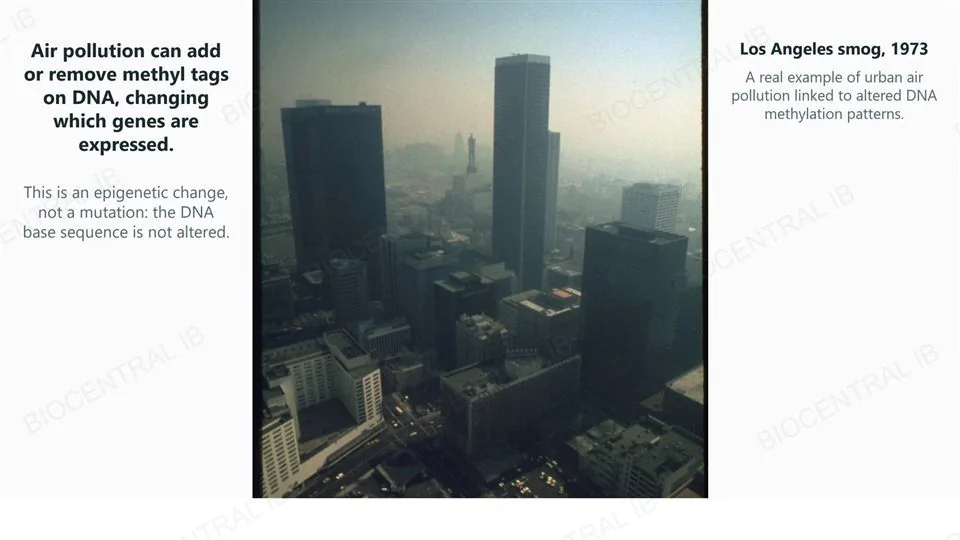
Environmental factors can alter gene expression in cells and organisms by adding or removing epigenetic tags, not by changing the DNA base sequence.
  • Required example: air pollution can alter methyl tags on DNA — exposure to pollutants has been linked to changes in DNA methylation patterns.
  • Changed methylation patterns change which genes are expressed.
  • This is a genuinely environmental, epigenetic effect: reversible in principle, and distinct from the direct DNA damage some pollutants can also cause, which would instead be a mutation (D1.3.4).
Why it mattersEffects like this are the mechanistic bridge between "environment" and "phenotype" this topic keeps returning to.
A real 1973 photograph of heavy smog over the Los Angeles skyline, with skyscrapers fading into brown haze, captioned that air pollution can add or remove methyl tags on DNA and change which genes are expressed.
Gene Daniels · EPA Documerica (NARA) · Public domain
D2.2.9

Tigons and ligers: nearly the same DNA, different phenotypes

During formation of the ovum and sperm, most, but not all, epigenetic tags are removed ("reprogrammed") from the parental genomes.
  • Because a few tags survive this erasure, some epigenetic information can still pass from parent to offspring alongside the DNA sequence itself.
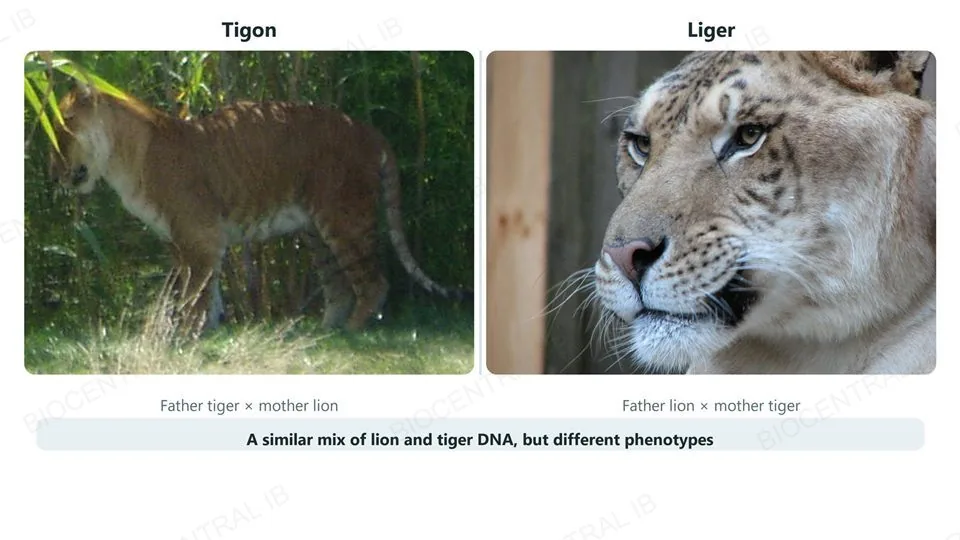
  • Required example: tigons and ligers, lion-tiger hybrids. A tigon has a tiger father and lion mother; a liger has a lion father and tiger mother.
  • Tigons and ligers inherit a broadly similar mix of lion and tiger DNA yet show different phenotypes — ligers grow far larger — best explained by which parent’s tags survived reprogramming, not a DNA difference.
Why it mattersThe clearest single example in the course of "genotype roughly constant, phenotype still different because of epigenetics."
Two real photographs side by side: a tigon, offspring of a father tiger and mother lion, standing in grass; and a liger, offspring of a father lion and mother tiger, in close portrait, captioned that both share a similar mix of lion and tiger DNA but show different phenotypes.
Tigon: The bellman (PD) · Liger: A. West (CC BY 2.0) · Wikimedia
D2.2.10

What monozygotic twins reveal about environment and gene expression

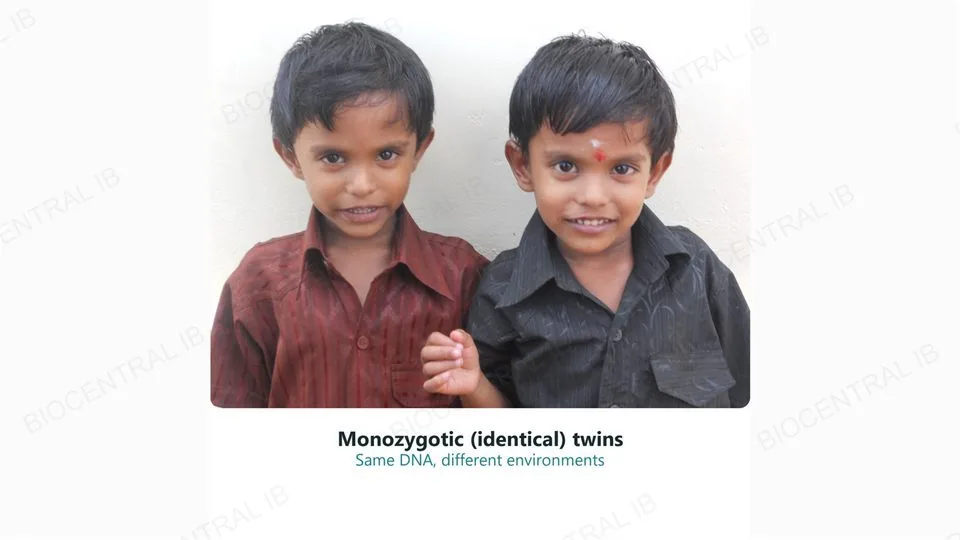
Monozygotic (identical) twins develop from a single fertilized egg and therefore have essentially identical DNA base sequences.
  • This lets researchers use MZ twins to investigate the effects of the environment on gene expression, since the genetic variable is held constant between the two members of a pair.
  • Differences that appear between twins in a pair over their lifetime, including differences in DNA methylation, can be attributed to differing environmental exposures rather than differing genes.
  • Studies typically compare epigenetic marks between twin pairs of different ages: twins tend to be most similar early in life and to diverge the longer they live in different environments.
Why it mattersThe classic finding: young twin pairs are epigenetically almost indistinguishable; older pairs, with different diets and habits, are not.
A real photograph of two young monozygotic twin boys standing side by side against a plain wall, captioned Monozygotic (identical) twins, same DNA, different environments.
Perumalnadar · CC0 · Wikimedia Commons
D2.2.11

A hormone example: oestradiol switches on target genes

External factors outside a cell can change its pattern of gene expression — this statement asks for one hormone example and one biochemical example.
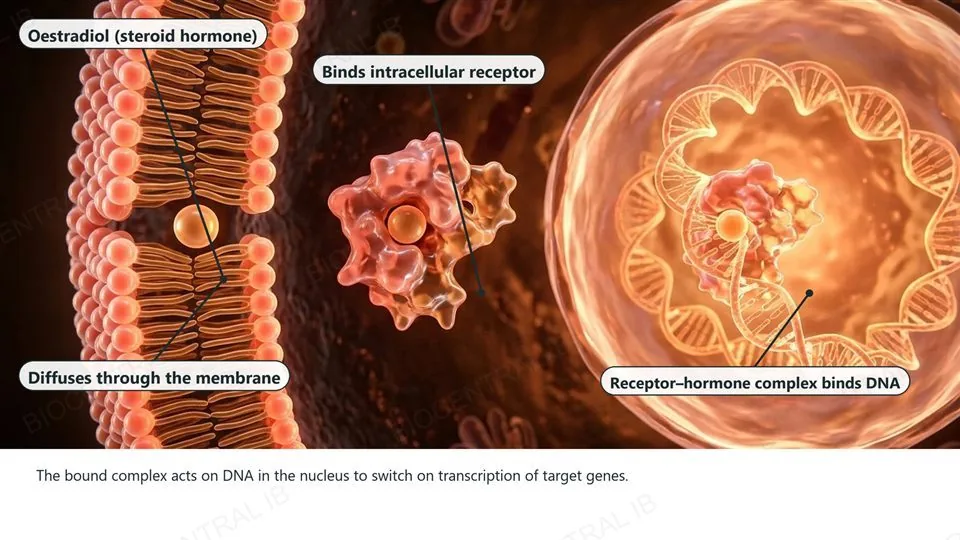
  • Hormone example: oestradiol, a steroid hormone, diffuses through the cell membrane into a target cell and binds an intracellular receptor.
  • The hormone-receptor complex then acts directly on DNA in the nucleus to alter transcription of specific target genes.
  • This is the same intracellular-receptor mechanism already met in Theme C’s chemical signalling content (C2.1.12).
Why it mattersA hormone reaching into the nucleus and switching genes on is one of the most direct environment-to-genome links in the whole course.
A cutaway of a cell membrane on the left with a small hormone molecule passing through it, labeled Oestradiol (steroid hormone) and Diffuses through the membrane; the same molecule bound to a receptor in the middle, labeled Binds intracellular receptor; and the receptor-hormone complex touching DNA inside a nucleus on the right, labeled Receptor-hormone complex binds DNA.
D2.2.11

A biochemical example: lactose availability in bacteria

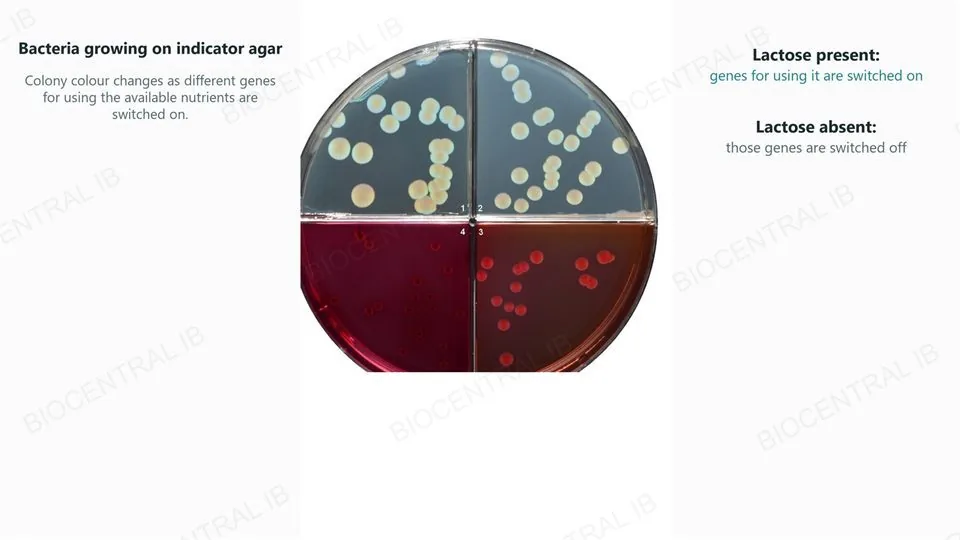
Biochemical example: lactose availability in bacteria. When lactose is present, and glucose is scarce, the genes needed to metabolize it are switched on; when absent, they are switched off.
  • The names and molecular mechanisms involved are not required on this syllabus — only that a bacterium’s gene expression responds to which small molecules are in its environment.
  • Together, D2.2.8 and D2.2.11 make the same point two ways: gene expression is not fixed at fertilization, it keeps responding to the environment throughout life.
  • Visible colony colour differences on indicator agar are a direct outcome of genes being switched on or off by the available nutrients.
Why it mattersEven a single bacterial cell edits its own gene expression in real time — regulation is not only a multicellular story.
A real photograph of bacterial colonies growing on indicator agar in four quadrants, cream-coloured colonies on grey-blue agar and red colonies on magenta and orange agar, captioned that lactose presence switches on the genes for using it and lactose absence switches them off.
HansN. · CC BY-SA 4.0 · Wikimedia Commons

Where this shows up again

D1.2 · Transcription and translation
D2.2 regulates the machinery met in D1.2: promoter binding by RNA polymerase (D1.2.13). Explain how a transcription factor changes the rate at which RNA polymerase can bind a promoter.
D1.3 · Mutation and gene editing
The whole of D2.2 rests on one contrast: mutation changes the DNA base sequence, epigenetic change never does (D1.3.1, D1.3.4). Distinguish a point mutation from a change in DNA methylation, using their effect on the base sequence.
D2.1 · Cell and nuclear division
Epigenetic tags can survive mitosis (D2.1.7) and meiosis (D2.1.9) — the mechanism behind epigenetic inheritance (D2.2.7). Explain why a tag needs to survive DNA replication, not just cell division, to be inherited.
C2.1 · Chemical signalling
D2.2.11’s oestradiol example uses the same intracellular-receptor mechanism as C2.1.12. Outline why steroid hormones, unlike protein hormones, can act on receptors inside the cell rather than on the membrane.

D2.2 Gene expression — one-page recap

Screenshot this slide to revise from

Gene expression
  • Transcription (DNA→mRNA), translation (mRNA→polypeptide), then protein function. A gene only affects phenotype once expressed.
Controlling transcription
  • Promoters and enhancers (DNA looping) are bound by transcription factors. mRNA degradation (nucleases) tunes translation after transcription.
Genome vs transcriptome vs proteome
  • Same genome, different expressed subset. No cell expresses all its genes — that subset, not the genome, makes a cell type what it is.
Epigenetic tags
  • Promoter DNA methylation always represses. Histone methylation can repress or activate. Neither changes the base sequence.
Inheritance & the environment
  • Tags survive mitosis/meiosis (epigenetic inheritance). Most, not all, tags are erased in ovum/sperm — tigons/ligers. Air pollution and MZ twins show environmental effects.
External factors
  • Oestradiol (hormone, intracellular receptor) and lactose availability in bacteria (biochemical) — the two required examples. No operon names needed.

One genome, and a thousand ways to read it

Every cell you have carries essentially the same DNA. What makes a neuron a neuron and a liver cell a liver cell is never the genome itself — it is which parts of it get switched on, and that decision can be shaped by a hormone, by air pollution, by the cell next door, and sometimes even by your parents.
D2.2 Gene expression · BioCentral IB
Use ↓ ↑ or click to navigate
01 / 20