BioCentral IBBioCentral IB
IB Biology · Theme D · D3.1

Reproduction

Reproduction passes genetic information to the next generation, either as an unchanged copy or as a new combination of alleles. This topic follows sexual and asexual reproduction, the human reproductive system and its hormones, and reproduction in flowering plants, and at HL goes on to puberty, gametogenesis, fertilization, pregnancy and childbirth.
Guiding questions

How does asexual or sexual reproduction exemplify themes of change or continuity?

What changes within organisms are required for reproduction?

Part one

Asexual and sexual reproduction

D3.1.1 – D3.1.3
D3.1.1

Asexual reproduction copies; sexual reproduction shuffles

Asexual reproduction produces genetically identical offspring from one parent, while sexual reproduction produces offspring with new combinations of genes.
  • Asexual offspring are clones, so they suit an existing environment in which the parent was already adapted, and no mate is needed.
  • In sexual reproduction two gametes fuse, so each offspring has a new gene combination that differs from both parents and from its siblings.
  • That variation is what allows some offspring to cope when the environment changes, whereas a stress that harms one clone can harm them all.
Why it mattersAsexual reproduction is a good bet in a stable environment; sexual reproduction is the insurance for a changing one.
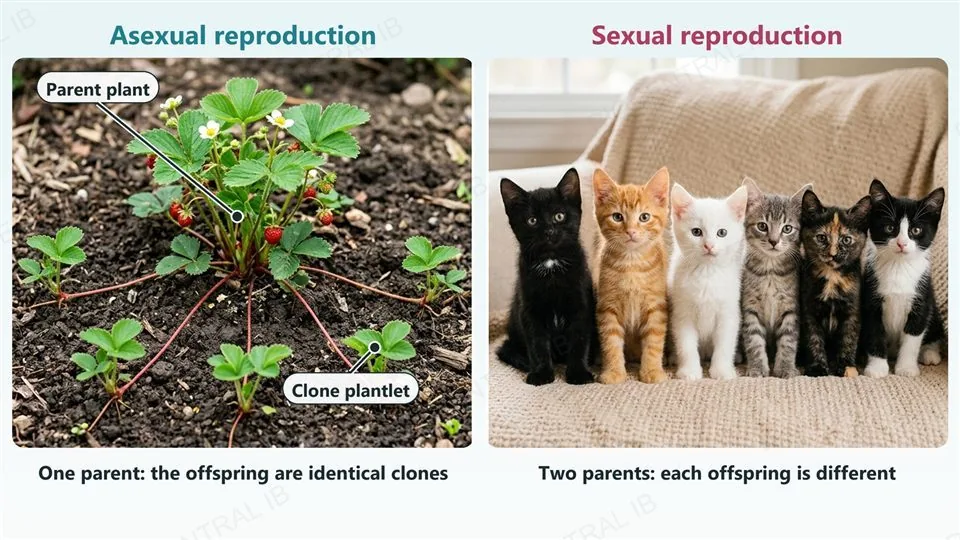
Two photographs. Left, labelled asexual reproduction: a strawberry plant with thin runners each ending in a young plantlet that is a genetically identical clone of the parent. Right, labelled sexual reproduction: a litter of six kittens, each with a different coat colour and pattern, showing variation between offspring.
D3.1.2

Meiosis breaks up allele combinations and fertilization makes new ones

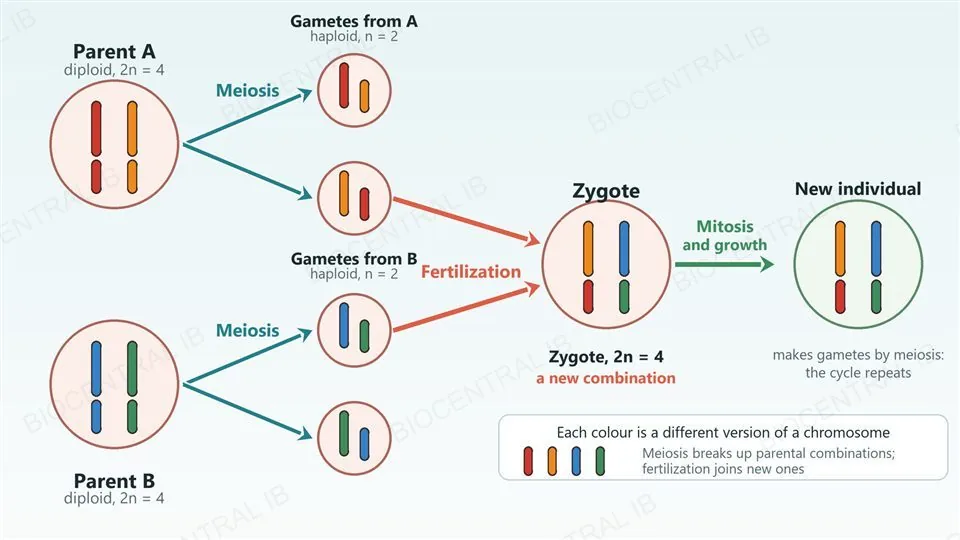
In a sexual life cycle, meiosis produces haploid gametes and the fusion of gametes, also called fertilization, restores the diploid number.
  • Meiosis breaks up the combinations of alleles that each parent inherited, so every gamete carries a different mix.
  • Fertilization brings together alleles from two different parents, producing a zygote with a new combination of alleles.
  • Meiosis halves the chromosome number and fertilization doubles it again, so the number stays constant from one generation to the next.
Why it mattersNew combinations arise twice in every cycle: when gametes are made and when they fuse.
A cycle diagram with two parents shown as diploid cells, each with two pairs of chromosomes. Meiosis turns each parent into haploid gametes with one chromosome of each pair, in different mixtures. Fertilization joins one gamete from each parent to make a diploid zygote with a new combination of chromosomes, which develops by mitosis into an adult that repeats the cycle.
D3.1.3

The male gamete travels, so it is small and the egg is large

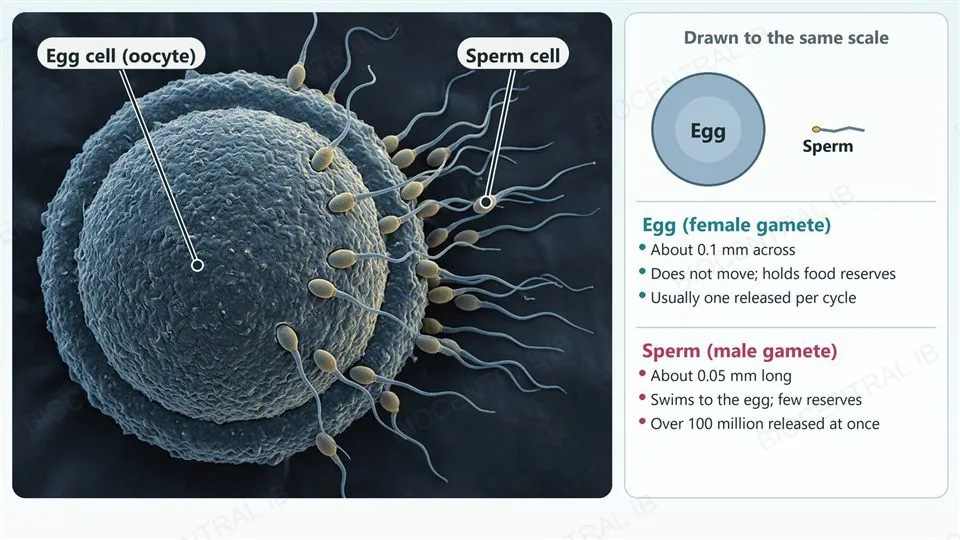
The prime difference between the sexes is that the male gamete travels to the female gamete, so it is smaller and carries less food than the egg.
  • A sperm needs little more than a nucleus and a means of movement, so a male can make enormous numbers of them.
  • The egg’s cytoplasm holds food reserves for the earliest stages of development, so each egg is costly and far fewer are made.
  • These differences in the numbers and cost of gametes lead to different reproductive strategies in males and females.
Why it mattersEvery difference between the sexes follows from one asymmetry: which gamete has to travel.
A false-colour scanning electron micrograph of a large round human egg with a thick outer coat and about thirty much smaller tadpole-shaped sperm around it, with labels for the egg and a sperm and a comparison: the egg is about 0.1 millimetres across and does not move, a sperm is about 0.05 millimetres long and swims, and a male typically releases over one hundred million sperm at once while usually one egg is released per cycle.
Part two

The human reproductive system

D3.1.4 – D3.1.7
D3.1.4

The female-typical system: where eggs are made, met and nurtured

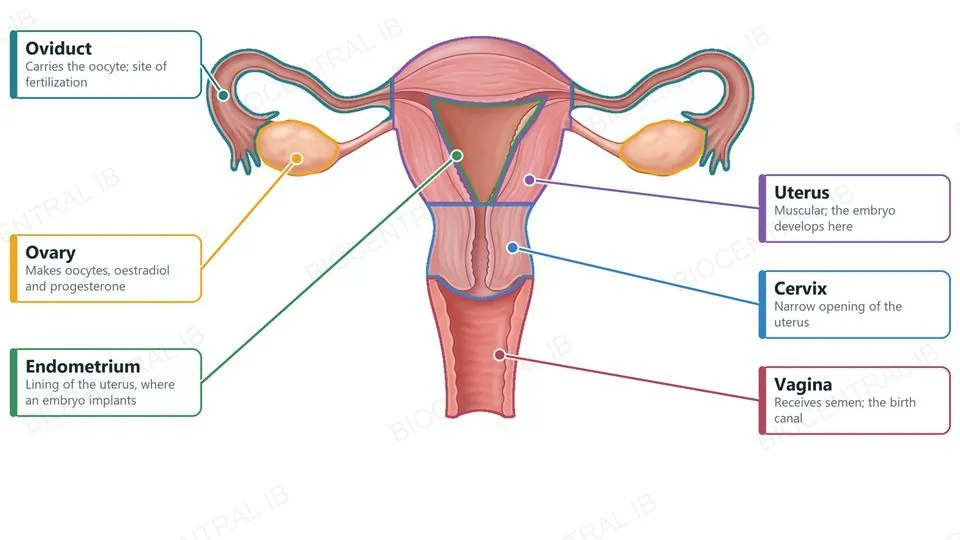
The female reproductive system produces oocytes and provides the sites for fertilization, implantation and the growth of an embryo.
  • The ovaries produce oocytes and secrete oestradiol and progesterone.
  • The oviduct carries the oocyte towards the uterus and is where fertilization occurs.
  • The uterus is a muscular organ lined by the endometrium, where an embryo implants and develops.
  • The cervix is the narrow opening to the uterus, and the vagina receives semen and forms the birth canal.
Why it mattersIn the exam you may be asked to draw this system and annotate each structure with its name and its function.
A front-view anatomical illustration of the female reproductive system with each structure outlined in its own colour and labelled with its function: ovary makes oocytes, oestradiol and progesterone; oviduct carries the oocyte and is the site of fertilization; uterus, muscular, where the embryo develops; endometrium, the lining where an embryo implants; cervix, the narrow opening; vagina, receives semen and is the birth canal.
D3.1.4

The male-typical system: making, storing and delivering sperm

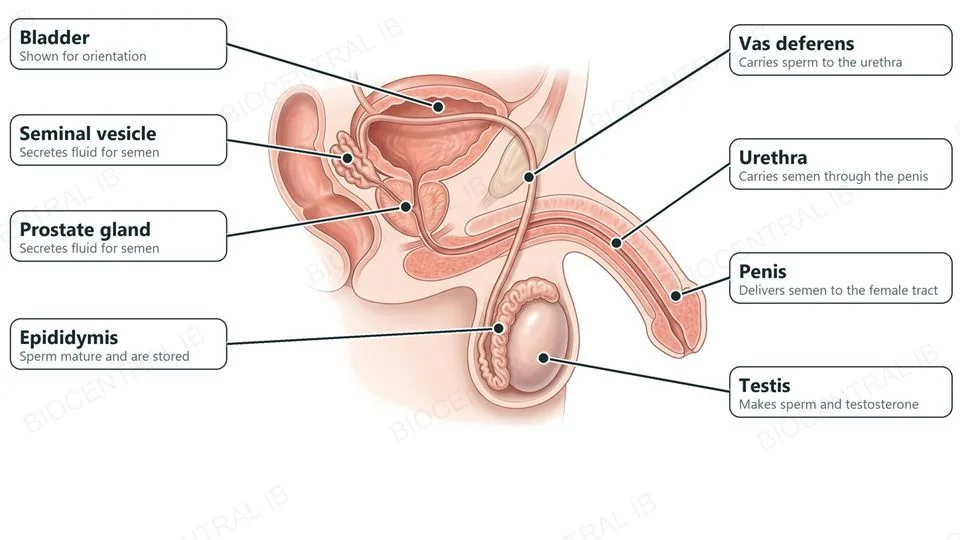
The male reproductive system produces sperm and testosterone and delivers sperm, mixed with fluids as semen, into the female tract.
  • The testes produce sperm and secrete testosterone; the epididymis is where sperm mature and are stored.
  • The vas deferens is a muscular tube that carries sperm from the epididymis towards the urethra.
  • The seminal vesicles and prostate gland secrete the fluids that combine with sperm to form semen.
  • The urethra runs through the penis, which delivers semen into the female reproductive tract.
Why it mattersAgain, be ready to draw the system and give each structure’s name and function.
A side-view anatomical illustration of the male reproductive system labelled with each structure and its function: testis makes sperm and testosterone; epididymis, where sperm mature and are stored; vas deferens carries sperm; seminal vesicle and prostate gland secrete the fluids of semen; urethra and penis deliver semen; bladder shown for orientation.
D3.1.5

The menstrual cycle: ovarian and uterine events run together

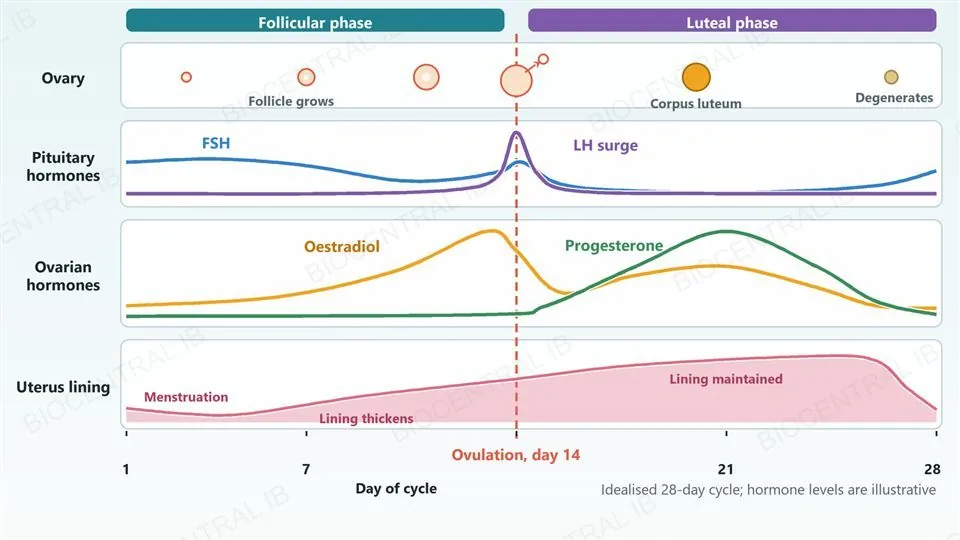
The ovarian and uterine cycles, regulated by FSH, LH, oestradiol and progesterone, together make up the menstrual cycle.
  • FSH stimulates follicle growth; the follicle secretes oestradiol, which thickens the endometrium.
  • A mid-cycle LH surge triggers ovulation, and the ruptured follicle becomes the corpus luteum, which secretes progesterone to maintain the endometrium.
  • If there is no fertilization the corpus luteum degenerates, hormone levels fall and the endometrium is shed as menstruation.
Why it mattersThe curves are idealised; real cycles vary in length and in hormone levels.
An idealised 28-day menstrual cycle in four stacked panels sharing one day axis: the follicle growing, ovulating on day 14 and becoming the corpus luteum; FSH with a small peak and LH with a sharp surge at day 14; oestradiol peaking just before day 14 and a lower second rise, with progesterone rising in the second half; and the endometrium thickening then breaking down in menstruation.
D3.1.5

Positive feedback triggers ovulation; negative feedback steadies the cycle

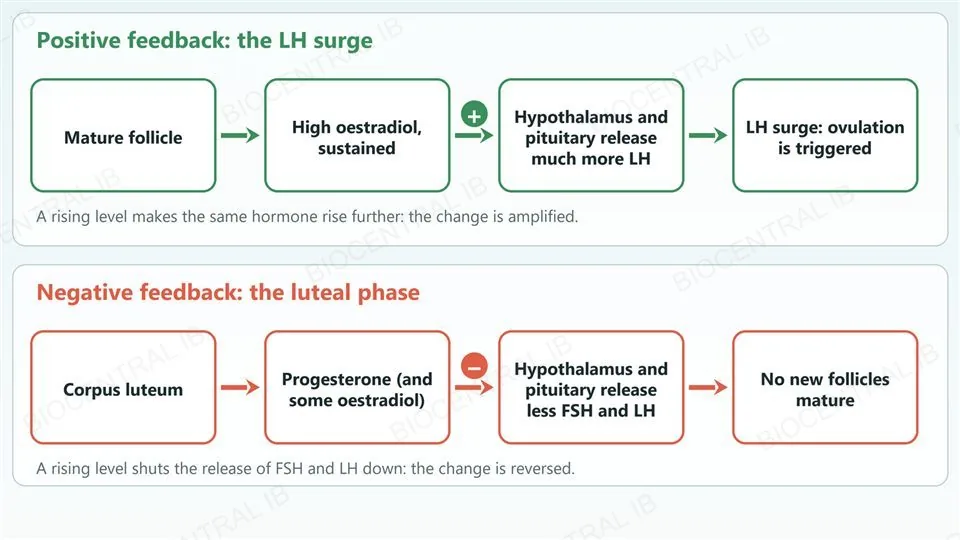
Both positive and negative feedback act on the hypothalamus and pituitary to regulate the hormones of the cycle.
  • Sustained high oestradiol from the mature follicle has a positive feedback effect: it increases LH release, producing the LH surge that triggers ovulation.
  • In the luteal phase, progesterone from the corpus luteum has a negative feedback effect, suppressing FSH and LH release so that no new follicles mature.
  • When the corpus luteum degenerates progesterone falls, the suppression is lifted, FSH rises and the next cycle begins.
Why it mattersPositive feedback amplifies a change; negative feedback reverses it. One cycle uses both.
Two feedback diagrams. Top, positive feedback: the mature follicle makes high oestradiol, which stimulates the hypothalamus and pituitary to release more LH, giving the LH surge that triggers ovulation. Bottom, negative feedback: the corpus luteum makes progesterone, which inhibits the hypothalamus and pituitary, keeping FSH and LH low.
D3.1.6

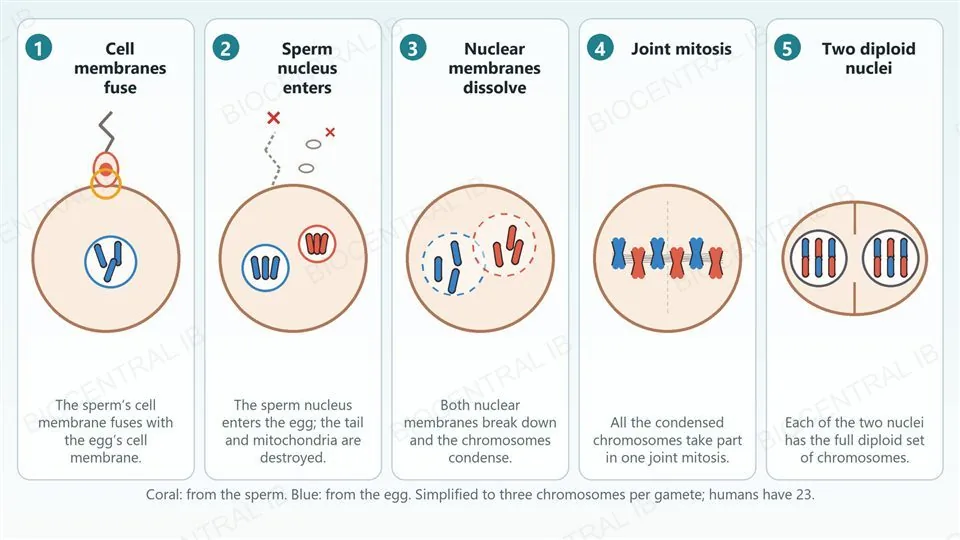
Fertilization ends in one joint mitosis

In human fertilization the cell membranes of sperm and egg fuse and the two sets of chromosomes then divide together in a single mitosis.
  • The sperm nucleus enters the egg, but the sperm’s tail and mitochondria are destroyed.
  • The nuclear membranes of the sperm nucleus and egg nucleus dissolve, and the chromosomes condense.
  • All the condensed chromosomes take part in one joint mitosis, producing two diploid nuclei.
Why it mattersThe two diploid nuclei are the first step towards the two-cell embryo.
Five numbered steps drawn as cells, simplified to three chromosomes per gamete instead of the human 23: 1 the sperm cell membrane fuses with the egg cell membrane; 2 the sperm nucleus enters while the tail and mitochondria are destroyed; 3 the nuclear membranes dissolve; 4 all the condensed chromosomes line up together in one joint mitosis; 5 two diploid nuclei form.
D3.1.7

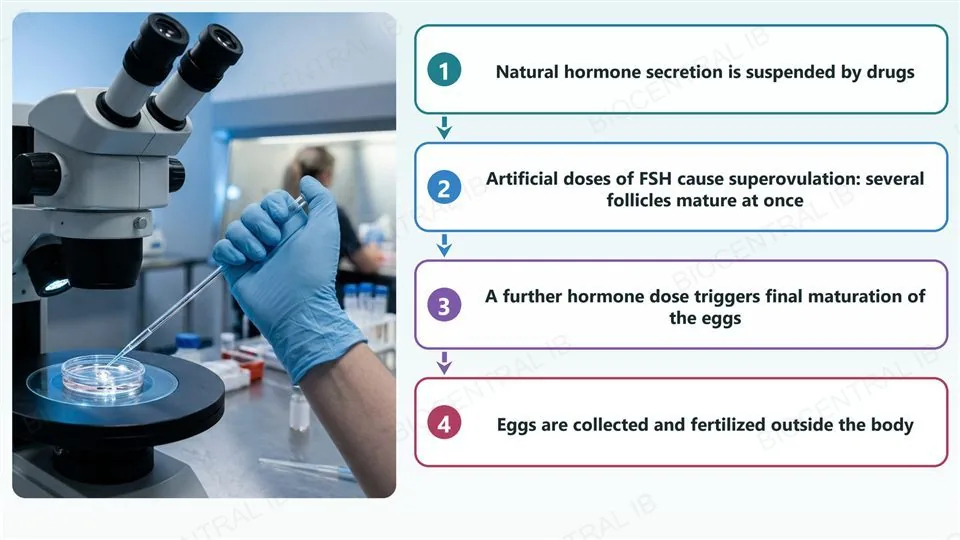
IVF uses hormones to override the natural cycle

In IVF treatment the normal secretion of hormones is suspended, and artificial doses of hormones induce superovulation.
  • Drugs first suspend the patient’s own hormone secretion, which gives the clinic control over the timing of the cycle.
  • Artificial doses of FSH then make several follicles mature at once, instead of the single follicle of a natural cycle: this is superovulation.
  • A further hormone dose triggers the final maturation of the eggs before they are collected and fertilized outside the body.
Why it mattersSeveral eggs from one cycle give more chances of producing a viable embryo.
A photograph of a gloved hand holding a glass pipette over a culture dish under a stereo microscope in a fertility laboratory, beside a four-step flow chart: 1 the natural hormone secretion is suspended; 2 artificial FSH causes superovulation; 3 a further hormone dose triggers final egg maturation; 4 eggs are collected and fertilized outside the body.
Part three

Reproduction in flowering plants

D3.1.8 – D3.1.12
D3.1.8

Flowering plants reproduce sexually, even when one flower has both sexes

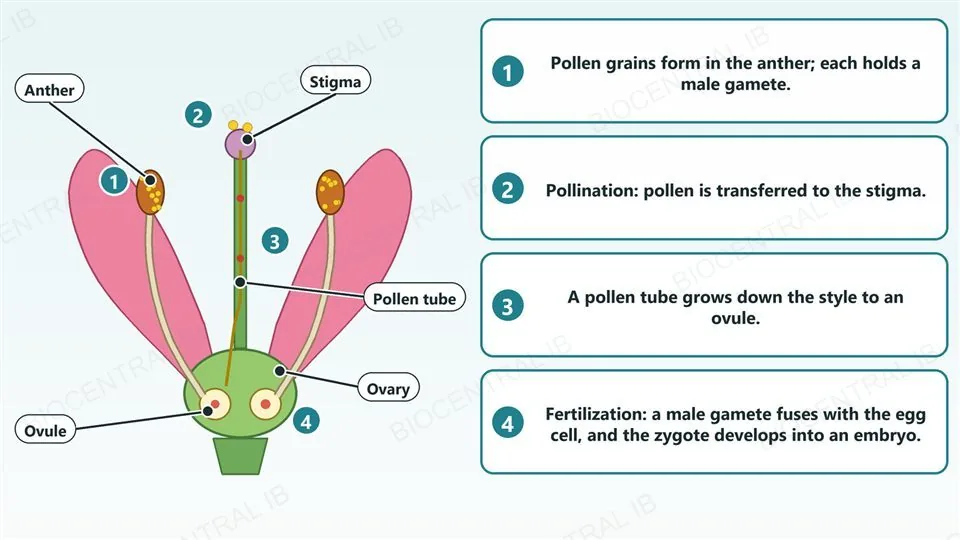
In flowering plants gametes are produced inside pollen grains and ovules, and their fusion at fertilization produces an embryo.
  • Male gametes develop inside pollen grains, which form in the anthers; female gametes develop inside ovules, which are in the ovary.
  • Pollination carries pollen to a stigma, and a pollen tube then grows to an ovule, where fertilization produces a zygote that develops into an embryo.
  • A hermaphroditic flower has both male and female parts, but the reproduction is still sexual because gametes fuse.
Why it mattersSexual describes what happens to the gametes, not whether a plant has separate sexes.
A cutaway flower diagram with four numbered steps: 1 pollen grains form in the anther; 2 pollination puts pollen on the stigma; 3 a pollen tube grows down through the style towards an ovule in the ovary; 4 a male gamete fuses with the egg cell in the ovule at fertilization, producing a zygote that develops into an embryo.
D3.1.9

An insect-pollinated flower is built to attract and dust its visitor

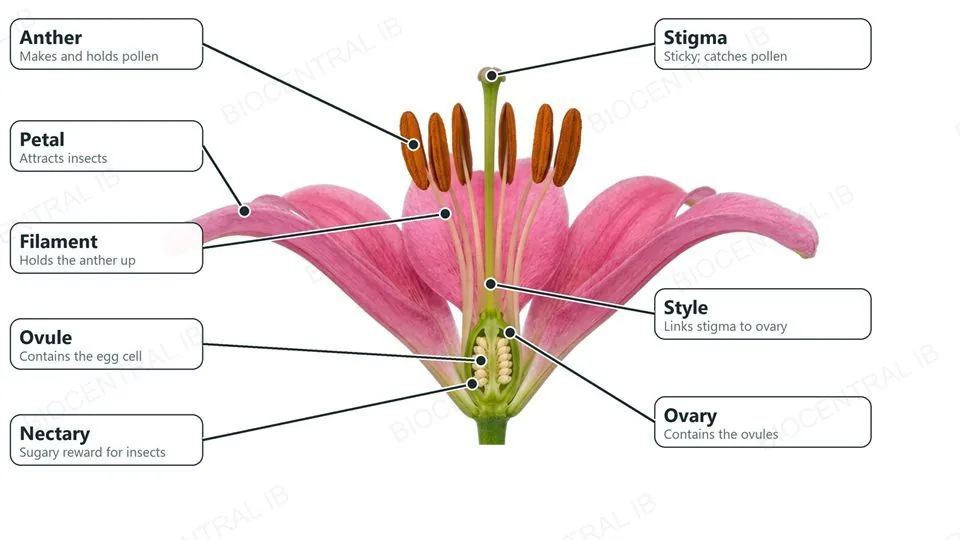
The structures of an insect-pollinated flower each have a function in attracting insects and in transferring pollen.
  • Large, coloured, often scented petals attract insects, and nectaries provide a sugary reward.
  • The anthers, on filaments, hold pollen where a visitor will brush against them.
  • The stigma is sticky, to catch pollen carried from another flower, and is joined by the style to the ovary, which holds the ovules.
Why it mattersIn the exam, draw these structures and annotate each with its name and function.
A photograph of a lily flower cut in half lengthwise with labels and functions: petal attracts insects; anther makes pollen; filament holds up the anther; stigma catches pollen; style; ovary; ovule, which contains the egg cell.
D3.1.10

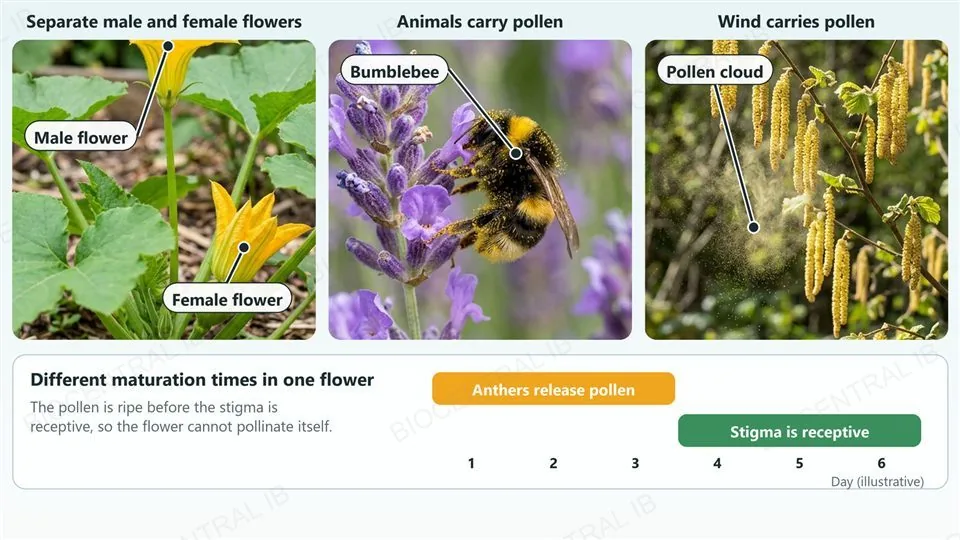
Flowers have several ways to promote cross-pollination

Cross-pollination moves pollen between different plants, and several methods make it more likely than self-pollination.
  • Pollen and stigma in one flower can mature at different times, so the flower cannot pollinate itself.
  • Male and female flowers can be separate on one plant, or male and female plants can be separate individuals.
  • Animals such as insects, or the wind, carry pollen from one plant to another.
Why it mattersEach method lowers the chance of self-pollination and so raises genetic variation.
Three photographs and a timeline. Separate male and female flowers: a squash plant with a yellow male flower and a yellow female flower with a small fruit. Animals: a bumblebee carrying pollen between flowers. Wind: a hazel catkin releasing a cloud of pollen. Below, a timeline of different maturation times: pollen is ripe on days one to three and the stigma is receptive on days four to six.
D3.1.11

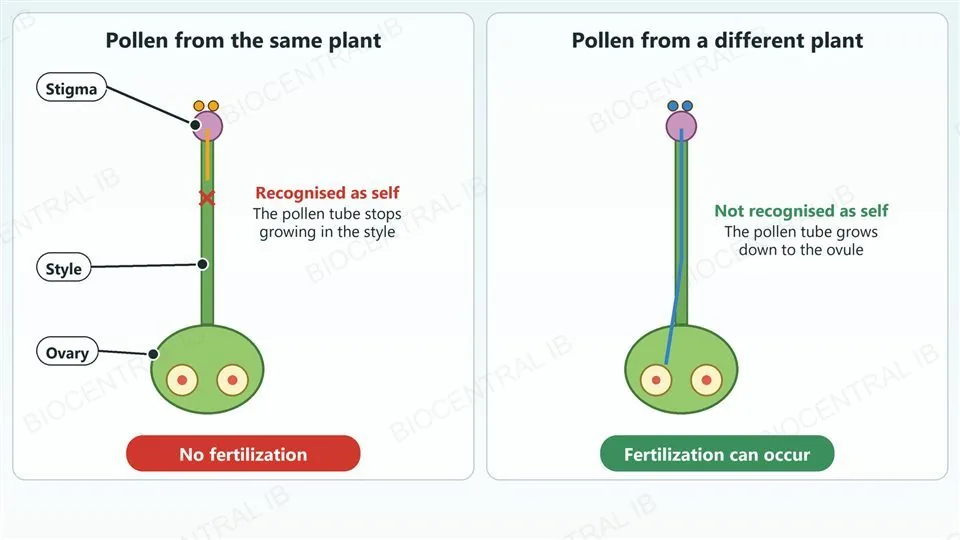
Self-incompatibility blocks a plant’s own pollen

Self-pollination leads to inbreeding, which decreases genetic diversity and vigour, so many plants have genetic mechanisms that ensure gametes from different plants fuse.
  • Inbred offspring share more of the same alleles, so the genetic diversity of the species falls and offspring vigour may drop.
  • In self-incompatibility the plant recognises pollen that is genetically like itself and stops it before fertilization, for example by halting the pollen tube in the style.
  • Pollen from a different plant is not recognised as self, so its pollen tube can reach the ovule.
Why it mattersEven when pollen lands on a stigma, genetics decides whether it may fertilize.
Two flowers side by side. Left, pollen from the same plant lands on the stigma, is recognised as self, and its pollen tube stops growing in the style, so there is no fertilization. Right, pollen from a different plant is not recognised as self, its pollen tube grows down the style to the ovule and fertilization occurs.
D3.1.12

Seed dispersal moves seeds away; it is not pollination

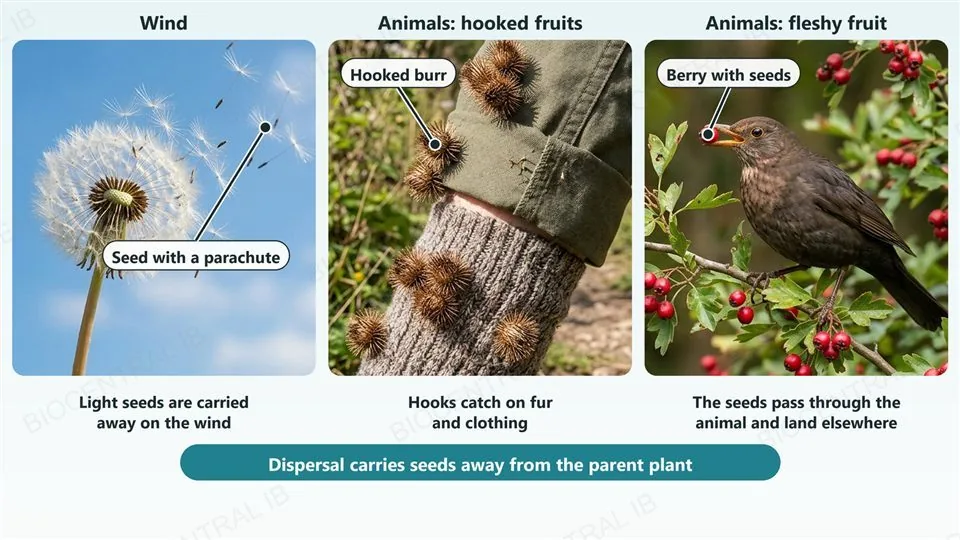
Seed dispersal is the movement of seeds away from the parent plant, and it happens after pollination and fertilization have already produced the seed.
  • Pollination transfers pollen to a stigma, while dispersal moves the finished seed, so they involve different structures at different times.
  • Seeds and fruits are adapted for dispersal by wind, by animals (hooks that catch on fur, or fleshy fruits that are eaten) or by water.
  • Dispersal reduces competition between parent and offspring and allows new areas to be colonized.
Why it mattersPollination is about gametes; dispersal is about seeds.
Three photographs of seed dispersal: wind carrying the parachute-like seeds of a dandelion; an animal carrying hooked burdock burrs on its fur (shown here on a hiker’s sock); and a bird eating a red berry, with the seeds carried inside it.
D3.1.12

Germination mobilizes food reserves to grow the embryo

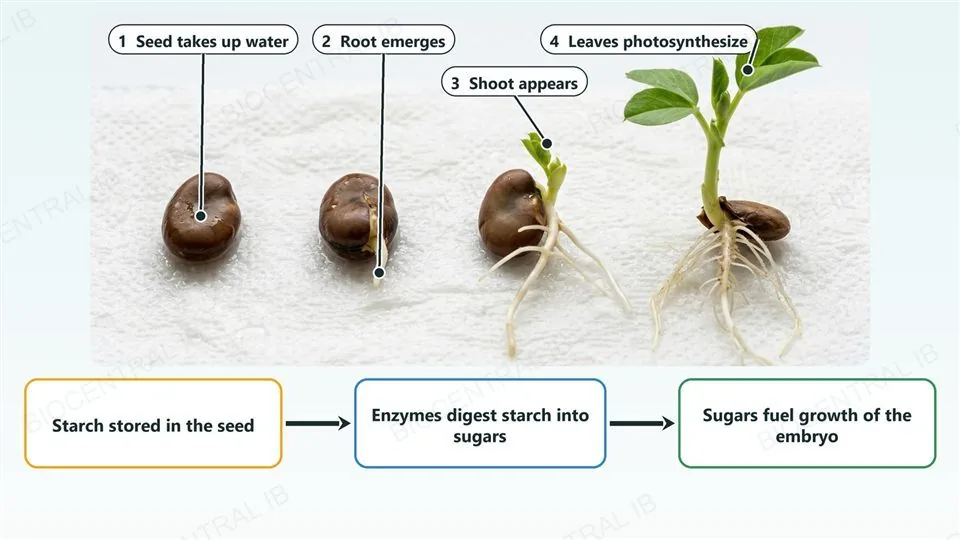
Germination is the growth and development of the embryo inside a seed, and it begins when conditions such as water, oxygen and warmth allow it.
  • The seed takes up water, which activates enzymes.
  • The enzymes mobilize the seed’s food reserves, for example by digesting starch into sugars, to fuel growth of the embryo.
  • The root emerges first, then the shoot, and the seedling depends on the stored reserves until its leaves can photosynthesize.
Why it mattersUntil the first leaves are working, the young plant lives entirely on what the seed stored.
Four broad bean seeds in stages of germination from left to right: an intact seed that takes up water, the seed coat split with a root emerging, the root growing longer with a shoot, and a seedling with a long root and green leaves that can photosynthesize. A banner below says stored starch is digested by enzymes into sugars for growth.
Quick check

Which event in the menstrual cycle is an example of positive feedback?

Progesterone from the corpus luteum suppresses the release of FSH and LH
High oestradiol from the mature follicle increases LH release, giving the LH surge that triggers ovulation
FSH stimulates a follicle to grow and to secrete oestradiol
Falling progesterone at the end of the cycle allows FSH to rise again
Correct answer: high oestradiol increases LH release, giving the LH surge that triggers ovulation. In positive feedback a change causes more of the same change: oestradiol high enough for long enough increases LH release rather than reducing it (D3.1.5). Progesterone suppressing FSH and LH is negative feedback, and the rise of FSH when progesterone falls is release from that suppression.

Key vocabulary — human reproduction

D3.1.1 – D3.1.7: worth being able to define each in a sentence

Asexual reproduction
Reproduction by one parent that produces genetically identical offspring.
Sexual reproduction
Reproduction in which gametes fuse, producing offspring with new combinations of genes.
Fertilization
The fusion of a male gamete with a female gamete, restoring the diploid number.
Zygote
The diploid cell formed when two gametes fuse.
Endometrium
The lining of the uterus, where an embryo implants.
Menstrual cycle
The ovarian and uterine cycles together, regulated by FSH, LH, oestradiol and progesterone.
Corpus luteum
The structure formed from the ruptured follicle after ovulation, which secretes progesterone.
Superovulation
The maturation of several follicles at once, induced in IVF by artificial doses of hormones.

Key vocabulary — flowering plants

D3.1.8 – D3.1.12: worth being able to define each in a sentence

Pollination
The transfer of pollen from an anther to a stigma.
Cross-pollination
Pollination in which pollen is carried to a different plant.
Hermaphroditic
Having both male and female reproductive parts in the same flower.
Self-incompatibility
Genetic mechanisms that stop a plant’s own pollen from fertilizing its ovules.
Inbreeding
Reproduction between closely related individuals, which reduces genetic diversity and vigour.
Seed dispersal
The movement of seeds away from the parent plant.
Germination
The growth and development of the embryo in a seed, supported by mobilization of food reserves.
Part four · HL

HL — puberty, gametes, pregnancy and evidence

D3.1.13 – D3.1.20
D3.1.13 · HL

GnRH switches puberty on; sex hormones make the changes

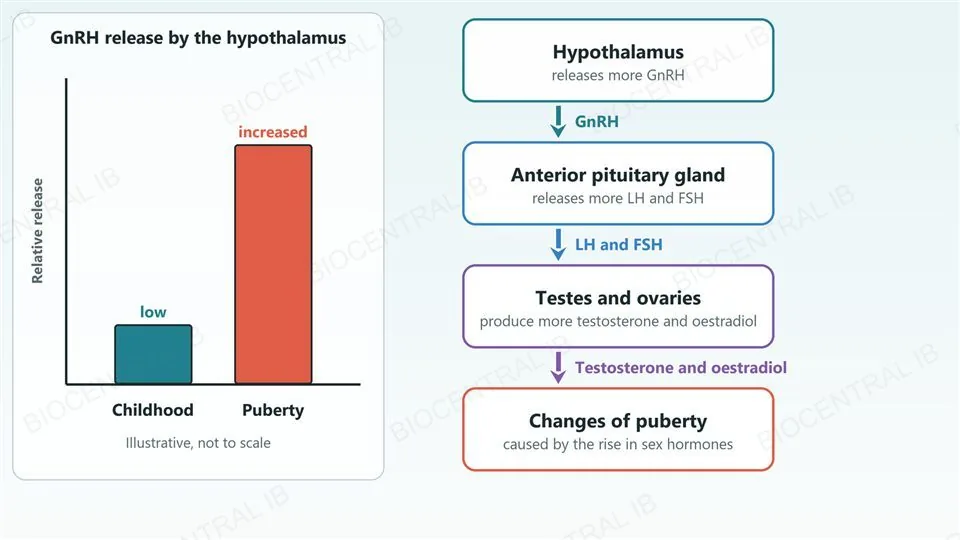
Puberty begins when the hypothalamus increases its release of gonadotropin-releasing hormone (GnRH), which triggers a rise in LH and FSH release.
  • GnRH acts on the pituitary gland, which releases more luteinizing hormone (LH) and follicle-stimulating hormone (FSH).
  • LH and FSH act on the testes and ovaries, which increase their production of the steroid sex hormones testosterone and oestradiol.
  • The increased sex hormone production ultimately leads to the changes associated with puberty.
Why it mattersOne chain of command, hypothalamus to pituitary to gonads, drives puberty in both sexes.
A flow chart: in childhood, low GnRH release; at puberty the hypothalamus increases GnRH release, which makes the pituitary release more LH and FSH, which act on the testes and ovaries to raise testosterone and oestradiol, which cause the changes of puberty.
D3.1.14 · HL

Gametogenesis gives four small sperm but one large egg

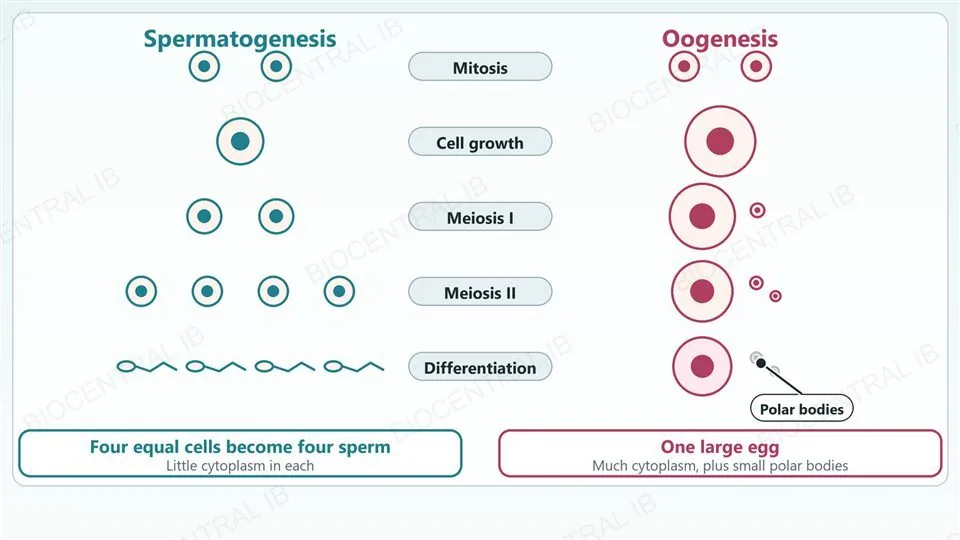
Spermatogenesis and oogenesis both use mitosis, cell growth, two divisions of meiosis and differentiation, but they divide the cytoplasm differently.
  • In spermatogenesis each primary spermatocyte gives four equal cells, which differentiate into sperm with very little cytoplasm.
  • In oogenesis the divisions of cytoplasm are unequal, so one large egg forms together with small polar bodies that degenerate.
  • As a result typical male bodies make vast numbers of sperm, while typical female bodies make far fewer eggs, each with a large amount of cytoplasm.
Why it mattersEqual division makes many small gametes; unequal division makes one gamete that keeps the food reserves.
Two parallel pathways. Spermatogenesis: a diploid cell divides by mitosis, grows, undergoes meiosis I and meiosis II, giving four equal cells that differentiate into four small sperm. Oogenesis: a diploid cell divides by mitosis, grows large, and meiosis I and II divide the cytoplasm unequally, giving one large egg and small polar bodies that degenerate.
D3.1.15 · HL

Two reactions let one sperm in and keep the rest out

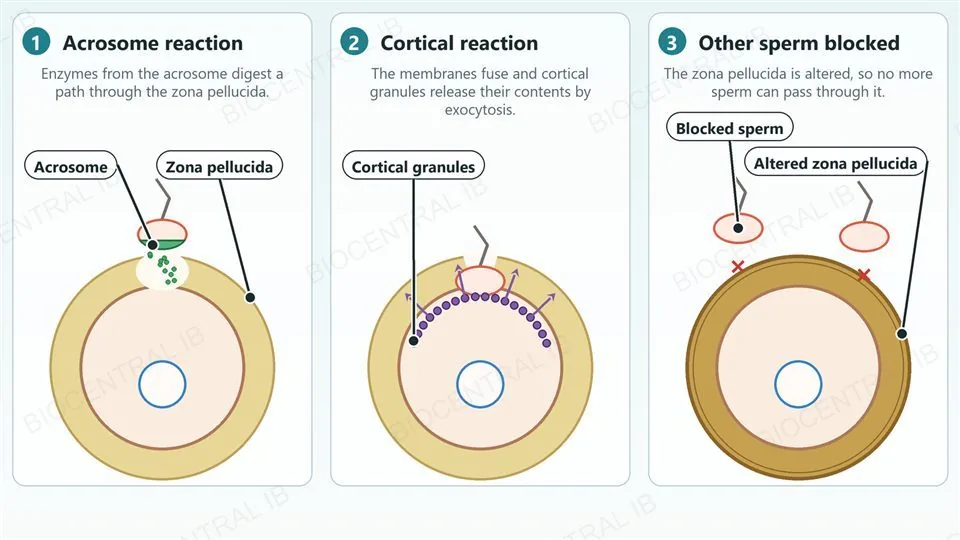
The acrosome reaction allows a sperm to penetrate the zona pellucida, and the cortical reaction prevents other sperm from passing through it.
  • In the acrosome reaction, the sperm’s acrosome releases enzymes that digest a path through the zona pellucida.
  • When the sperm and egg membranes fuse, the egg’s cortical granules release their contents by exocytosis: this is the cortical reaction.
  • The contents alter the zona pellucida so that no further sperm can pass, which prevents polyspermy, fertilization by more than one sperm.
Why it mattersOne sperm nucleus plus one egg nucleus gives the correct diploid number of chromosomes.
Three panels. 1 Acrosome reaction: a sperm head releases enzymes from its acrosome and digests a path through the zona pellucida around the egg. 2 Cortical reaction: after the sperm membrane fuses with the egg membrane, cortical granules beneath the egg surface release their contents by exocytosis. 3 The changed zona pellucida blocks other sperm.
D3.1.16 · HL

The embryo becomes a hollow ball that implants

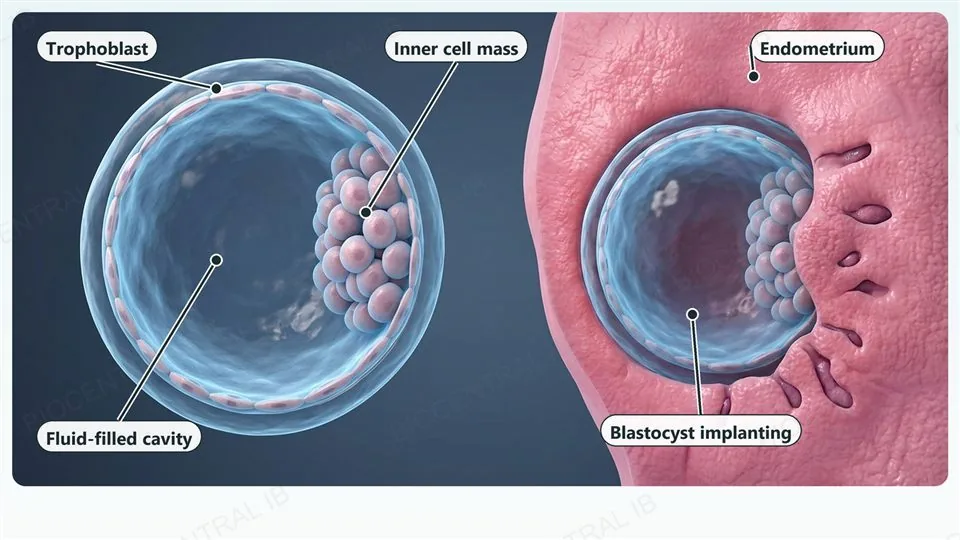
After fertilization, repeated mitotic divisions produce a hollow ball of cells called a blastocyst, which implants in the endometrium.
  • The blastocyst has an outer layer, the trophoblast, which goes on to form the placenta, and an inner cell mass, which forms the embryo.
  • A fluid-filled cavity lies inside the outer layer.
  • The blastocyst embeds itself in the endometrium, the lining of the uterus, in a process called implantation.
Why it mattersOnly the blastocyst needs to be named; other stages of embryo development are not required.
A cutaway illustration of a blastocyst, labelled trophoblast (outer layer), fluid-filled cavity and inner cell mass, and beside it a blastocyst partly embedded in the thick endometrium of the uterus wall, labelled implantation.
D3.1.17 · HL

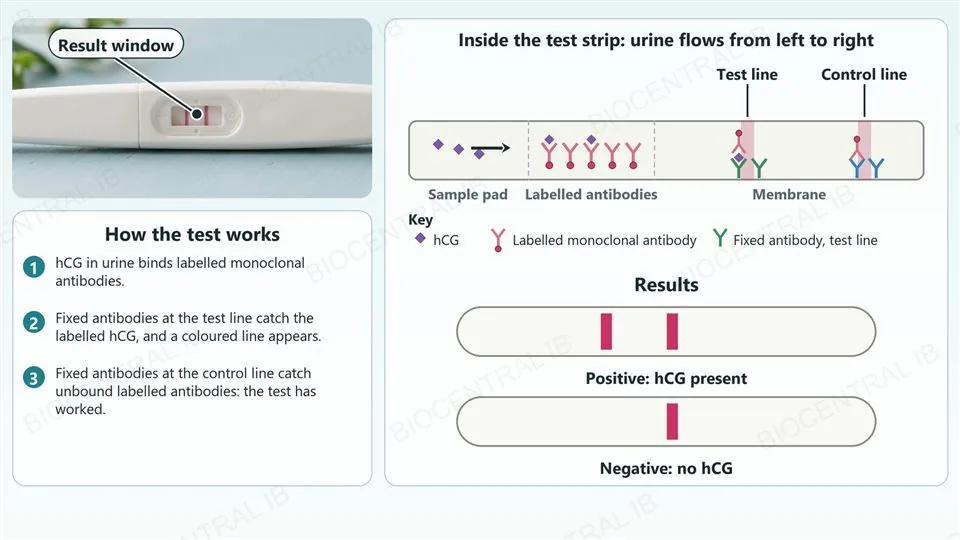
Pregnancy tests detect hCG with monoclonal antibodies

Human chorionic gonadotropin (hCG) is produced by the embryo and then the developing placenta, and pregnancy tests detect it in urine.
  • hCG passes into the mother’s blood and is excreted in her urine.
  • On the test strip, monoclonal antibodies that bind only to hCG carry a coloured label, and a second set of antibodies fixed at the test line catches the hCG.
  • A coloured test line shows that hCG is present, and a control line shows that the test has worked.
Why it mattersMonoclonal antibodies bind one antigen only, so other hormones in urine give no signal.
A photograph of a home pregnancy test stick showing two lines, beside a diagram of the test strip: urine flows past labelled antibodies that bind hCG, fixed antibodies at the test line catch the labelled hCG and make a coloured line, and a control line catches unbound labelled antibodies. Below, a positive result has two lines and a negative result has only the control line.
D3.1.18 · HL

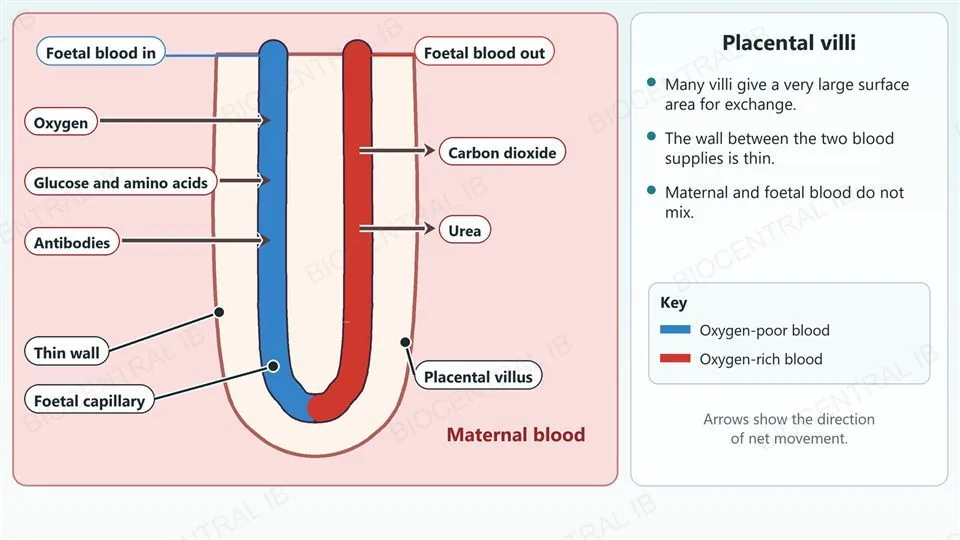
The placenta exchanges materials across a huge surface

The placental villi give a large surface area over which maternal and foetal blood exchange materials without mixing.
  • Oxygen, nutrients and antibodies pass from the mother to the foetus, and carbon dioxide and nitrogenous waste pass from the foetus to the mother.
  • Maternal blood surrounds the villi and foetal blood flows inside them, and the two supplies stay separate.
  • Because the placenta supports the foetus inside the uterus, development can continue to a later stage than in mammals without a placenta.
Why it mattersA large surface area and a thin barrier make exchange fast, as in other exchange surfaces.
A diagram of one placental villus containing a foetal capillary, surrounded by maternal blood, with arrows across the thin wall: oxygen, glucose, amino acids and antibodies moving from maternal blood to the foetus, and carbon dioxide and urea moving from the foetus to the mother. Foetal and maternal blood do not mix.
D3.1.19 · HL

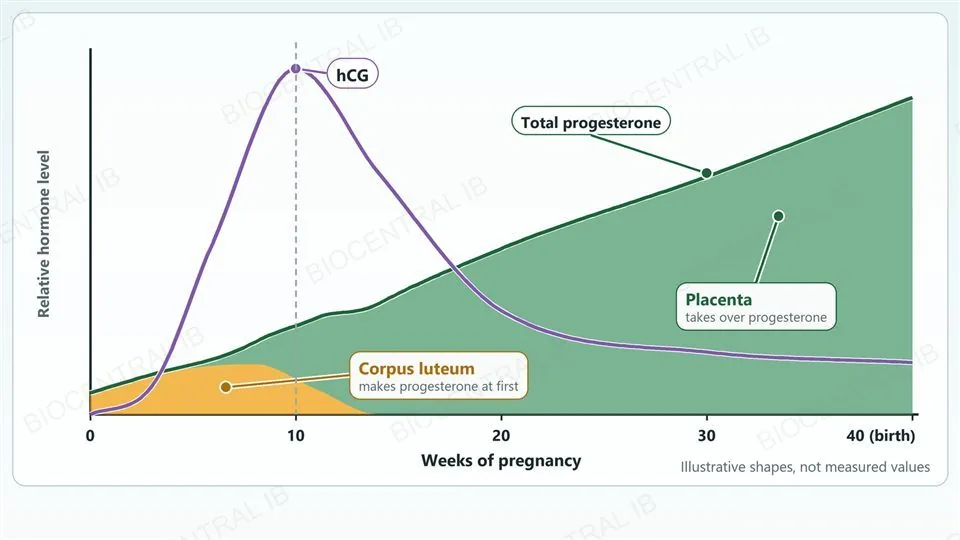
Progesterone keeps pregnancy going: first the corpus luteum, then the placenta

The continuity of pregnancy is maintained by progesterone, secreted first by the corpus luteum and then by the placenta.
  • hCG from the embryo keeps the corpus luteum active, so it goes on secreting progesterone instead of degenerating.
  • Progesterone maintains the endometrium and keeps the muscle of the uterus from contracting.
  • Later the placenta itself secretes progesterone, so pregnancy no longer depends on the corpus luteum.
Why it mattersA drop in progesterone during pregnancy would end the support that the endometrium needs.
An illustrative graph over 40 weeks of pregnancy: hCG rises early and peaks at about ten weeks then falls; progesterone from the corpus luteum is high early and then declines while progesterone from the placenta takes over and rises steadily until birth.
D3.1.19 · HL

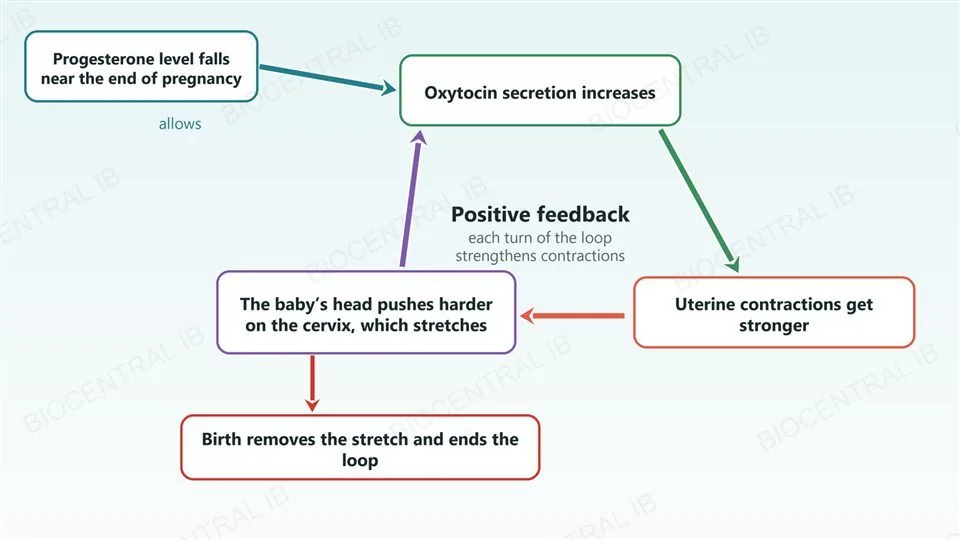
Falling progesterone lets oxytocin drive childbirth by positive feedback

Childbirth is triggered by a decrease in progesterone levels, which allows oxytocin secretion to increase.
  • Oxytocin stimulates stronger contractions of the uterine muscle.
  • The contractions push the baby’s head against the cervix, and the stretching stimulates the release of still more oxytocin.
  • This positive feedback loop intensifies until the baby is born, which removes the stretch and ends the stimulus.
Why it mattersPositive feedback amplifies a change, so the contractions get stronger and stronger until birth.
A loop diagram: progesterone falls, which allows oxytocin to be released; oxytocin strengthens uterine contractions; the contractions push the baby’s head harder against the cervix; the stretched cervix stimulates more oxytocin release, and the loop repeats. Birth of the baby ends the loop.
D3.1.20 · HL

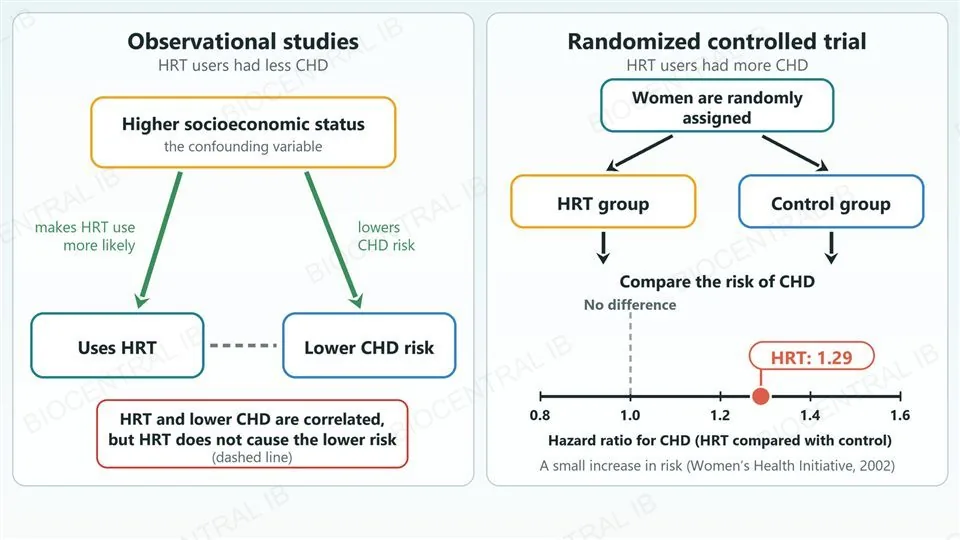
Correlation is not causation: the HRT and heart disease story

Early studies found less coronary heart disease (CHD) in women taking hormone replacement therapy (HRT), but later randomized controlled trials found a small increase in risk.
  • The early studies were observational, and the correlation was taken to be cause and effect.
  • HRT users tended to have a higher socioeconomic status, which itself lowers the risk of CHD, so status was a confounding variable.
  • Randomized controlled trials assign women to HRT or to a control at random, which spreads confounding variables evenly between the groups.
Why it mattersNature of science: a correlation is only evidence of causation once confounding variables are ruled out.
Left, an observational study: higher socioeconomic status leads both to using HRT and to lower CHD risk, so HRT and lower CHD are correlated without a cause-and-effect link. Right, a randomized controlled trial: women are randomly assigned to HRT or a control, and the Women’s Health Initiative trial found a hazard ratio for CHD of about 1.29 for HRT, a small increase in risk.
Quick check · HL

Near the end of pregnancy the progesterone level falls. What does this fall allow?

The placenta to begin secreting progesterone
An increase in hCG secretion by the corpus luteum
An increase in oxytocin secretion, which strengthens contractions by positive feedback
The blastocyst to implant in the endometrium
Correct answer: an increase in oxytocin secretion, which strengthens contractions by positive feedback. Progesterone keeps the uterine muscle relaxed during pregnancy, so its fall allows oxytocin secretion to increase, and stretching of the cervix by the baby releases more oxytocin in a positive feedback loop (D3.1.19). The placenta takes over progesterone secretion early in pregnancy, and implantation happens near its start.

Key vocabulary — HL

HL only: D3.1.13 – D3.1.20

GnRH
Gonadotropin-releasing hormone, released by the hypothalamus; its increase triggers the rise in LH and FSH at puberty.
Polar body
A small cell formed by unequal division of cytoplasm in oogenesis, which degenerates.
Acrosome reaction
Release of enzymes from the sperm’s acrosome that digest a path through the zona pellucida.
Cortical reaction
Release of the egg’s cortical granules after fusion, which alters the zona pellucida to block other sperm.
Polyspermy
Fertilization of an egg by more than one sperm.
Blastocyst
A hollow ball of cells with a trophoblast and an inner cell mass, which implants in the endometrium.
hCG
Human chorionic gonadotropin, secreted by the embryo and placenta and detected by pregnancy tests.
Oxytocin
The hormone whose positive feedback loop drives the contractions of childbirth.
Confounding variable
A variable linked to both the supposed cause and the outcome, which can create a misleading correlation.

Where this shows up again

D2.1 · Meiosis
D3.1.2 relies on meiosis as a reduction division (D2.1.9) and a source of variation (D2.1.11), and D3.2.1 follows the haploid gametes into inheritance. Explain how meiosis and fertilization together create new allele combinations.
C3.1 · Hormones and feedback
The menstrual cycle and puberty (D3.1.5, D3.1.13 · HL) use hypothalamus and pituitary control (C3.1.13), and positive feedback also drives fruit ripening (C3.1.23). Compare positive feedback in the LH surge and in ripening.
B3.1 · Exchange surfaces · HL link
Placental villi (D3.1.18 · HL) are an exchange surface like those in B3.1.2. State two features that make an exchange surface efficient.
D3.1 · Linking questions from the guide
How can interspecific relationships assist in the reproductive strategies of living organisms? What are the roles of barriers in living systems?

D3.1 Reproduction — one-page recap

Screenshot this slide to revise from

Sexual and asexual
  • Asexual: identical clones, one parent, suits a stable environment. Sexual: meiosis and fertilization make new allele combinations. The male gamete travels, so it is small; the egg is large.
Human system and cycle
  • Draw and annotate both systems. FSH grows a follicle, an LH surge (positive feedback) triggers ovulation, the corpus luteum makes progesterone (negative feedback). IVF: suspend hormones, FSH for superovulation.
Fertilization
  • Membranes fuse, nucleus enters, tail and mitochondria destroyed, nuclear membranes dissolve, one joint mitosis gives two diploid nuclei.
Flowering plants
  • Gametes in pollen grains and ovules; pollination then fertilization: always sexual. Cross-pollination by timing, separate flowers or plants, animals, wind; self-incompatibility blocks own pollen. Dispersal is not pollination; germination mobilizes reserves.
HL · Gametes and puberty
  • GnRH then LH and FSH then testosterone and oestradiol. Spermatogenesis: four equal sperm. Oogenesis: one large egg and polar bodies. Acrosome reaction lets one sperm in; cortical reaction blocks the rest.
HL · Pregnancy and evidence
  • Blastocyst implants; hCG test uses monoclonal antibodies; placental villi exchange. Progesterone (corpus luteum then placenta) sustains pregnancy; its fall allows oxytocin positive feedback. HRT: confounding by status; RCTs show small CHD increase.

Continuity and change, in every generation

Reproduction passes genes on, either as an unchanged copy or as a new combination made by meiosis and fertilization. In humans and in flowering plants it depends on tightly controlled changes inside the organism: hormones that time the cycle, structures that bring gametes together, and mechanisms that let exactly one sperm fertilize an egg, protect the embryo and see it through to birth.
D3.1 Reproduction · BioCentral IB
Use ↓ ↑ or click to navigate
01 / 20