BioCentral IBBioCentral IB
IB Biology · Theme D · D4.1

Natural selection

Natural selection is the mechanism that drives evolutionary change: heritable variation, a selection pressure, and differential survival and reproduction, repeated generation after generation. This topic follows that mechanism through real examples — sexual selection, Endler's guppies — and at HL goes on to the gene pool, allele frequencies, the Hardy–Weinberg equation and artificial selection.
Guiding questions

What processes can cause changes in allele frequencies within a population?

What is the role of reproduction in the process of natural selection?

Part one

Natural selection as a mechanism

D4.1.1
D4.1.1

Natural selection is one continuous mechanism, not four separate facts

Natural selection is the process by which heritable variation, acted on by a selection pressure, causes some individuals to survive and reproduce more than others, so that favourable alleles become more frequent over generations.
  • It runs as a repeating cycle: variation exists, a selection pressure acts, survival and reproduction differ, and allele frequencies shift — then the cycle repeats next generation.
  • Darwin’s theory was a paradigm shift: a fundamental change in the accepted explanation, replacing Lamarckism (inheritance of acquired characteristics).
  • It has acted continuously for billions of years, not just for dramatic events, and no single generation “decides” to evolve.
Why it mattersEvery other statement in this lesson is one part of this one repeating cycle.
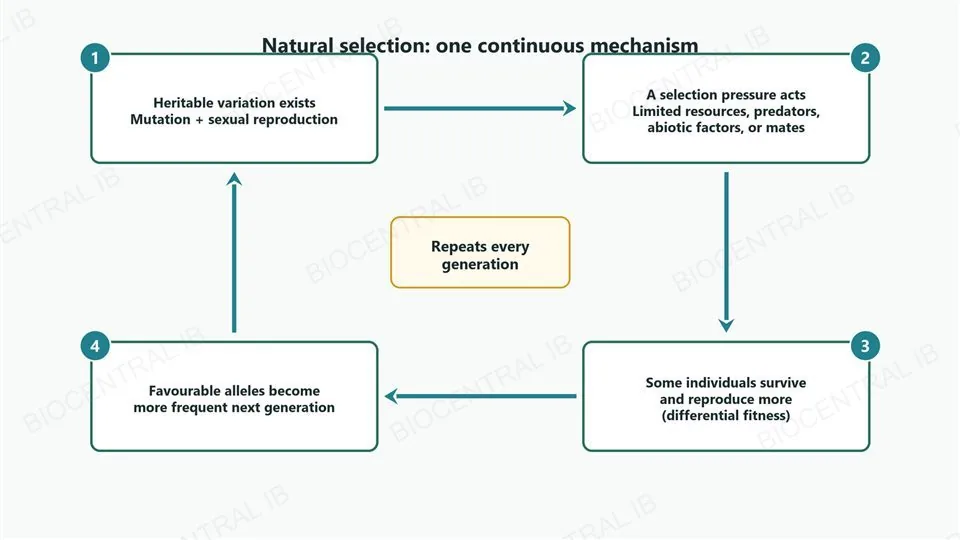
A four-box cycle diagram with arrows running clockwise around the outside. Box 1: heritable variation exists, from mutation and sexual reproduction. Box 2: a selection pressure acts, from limited resources, predators, abiotic factors or mates. Box 3: some individuals survive and reproduce more, differential fitness. Box 4: favourable alleles become more frequent in the next generation. A small box in the centre reads repeats every generation.
Part two

Variation and selection pressures

D4.1.2 – D4.1.8
D4.1.2

Mutation and sexual reproduction generate variation

A population needs heritable variation before natural selection can act on it at all.
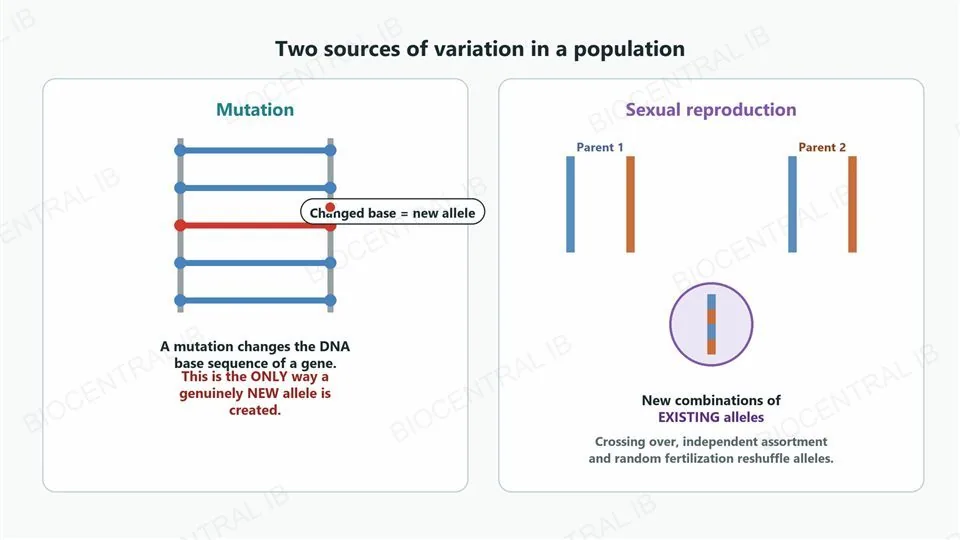
  • Mutation changes the base sequence of DNA — it is the ONLY way a genuinely new allele is created.
  • Sexual reproduction does not create new alleles: crossing over, independent assortment and random fertilization only produce new combinations of alleles that already exist.
  • Both processes matter, but confusing them is a very common exam error: reversing which one creates new alleles.
Why it mattersWithout new alleles from mutation, a population would have nothing new to select between.
Left panel, mutation: a DNA ladder with one rung recoloured red and a label, changed base equals new allele; caption explains this is the only way a genuinely new allele is created. Right panel, sexual reproduction: two parent chromosome pairs feed into a circle showing a recombined offspring chromosome with alternating segments, captioned new combinations of existing alleles, with crossing over, independent assortment and random fertilization named below.
D4.1.3

Overproduction of offspring causes competition for resources

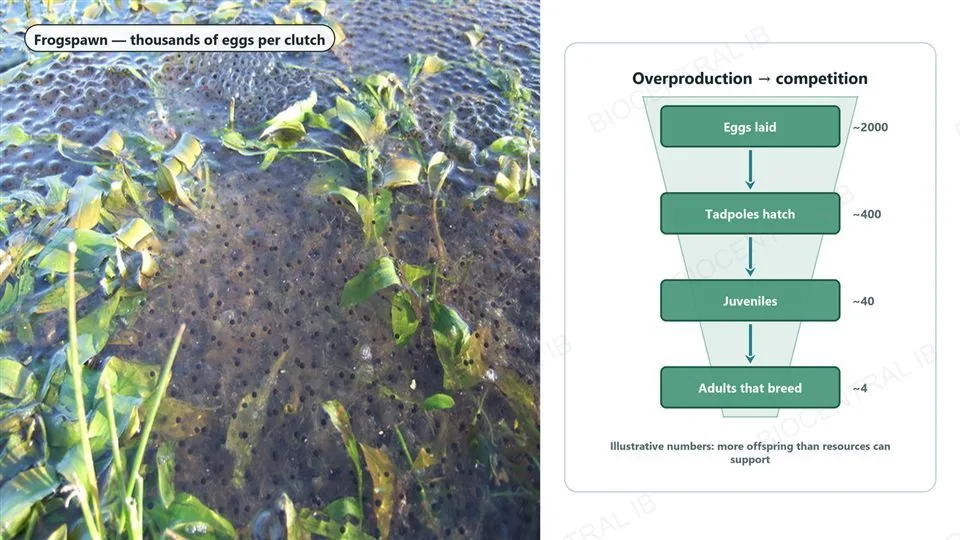
Populations produce far more offspring than the environment’s resources can support.
  • The maximum population size an environment can sustain is its carrying capacity, set by limited food, space, light or nesting sites.
  • Because far more offspring are produced than can survive, individuals compete for the same limited resources.
  • This competition for resources is what makes differential survival possible in the first place.
Why it mattersWithout overproduction there would be enough resources for everyone, and no competition to drive selection.
Left, a real photograph of frogspawn, thousands of eggs in shallow water among pond weed, labelled thousands of eggs per clutch. Right, a narrowing funnel diagram with four stages: eggs laid about 2000, tadpoles hatch about 400, juveniles about 40, adults that breed about 4, each stage narrower than the last, captioned illustrative numbers, more offspring than resources can support.
Photo: ceridwen, CC BY-SA 2.0 · Wikimedia Commons
D4.1.4

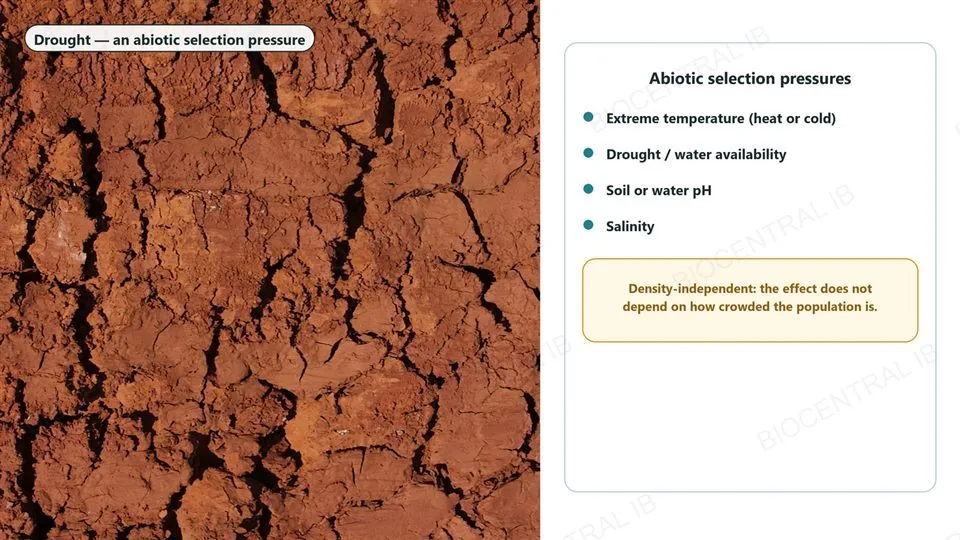
Abiotic factors act as selection pressures too

Non-living, physical features of the environment can select just as strongly as living things like predators.
  • Examples include extreme temperature, drought or water availability, soil or water pH, and salinity.
  • Abiotic pressures are usually density-independent: their effect does not depend on how crowded the population is, unlike competition for resources.
  • A severe drought or frost can kill individuals regardless of population size, selecting for whichever variants happen to tolerate it.
Why it mattersSelection pressures are not only predators and competitors — the physical environment selects too.
Left, a real photograph of cracked, dried mud from drought, labelled drought, an abiotic selection pressure. Right, a bulleted list of abiotic selection pressures: extreme temperature, drought or water availability, soil or water pH, salinity, with a highlighted note that these are density-independent, their effect does not depend on how crowded the population is.
Photo: Al Jazeera English, CC BY-SA 2.0 · Wikimedia Commons
D4.1.5

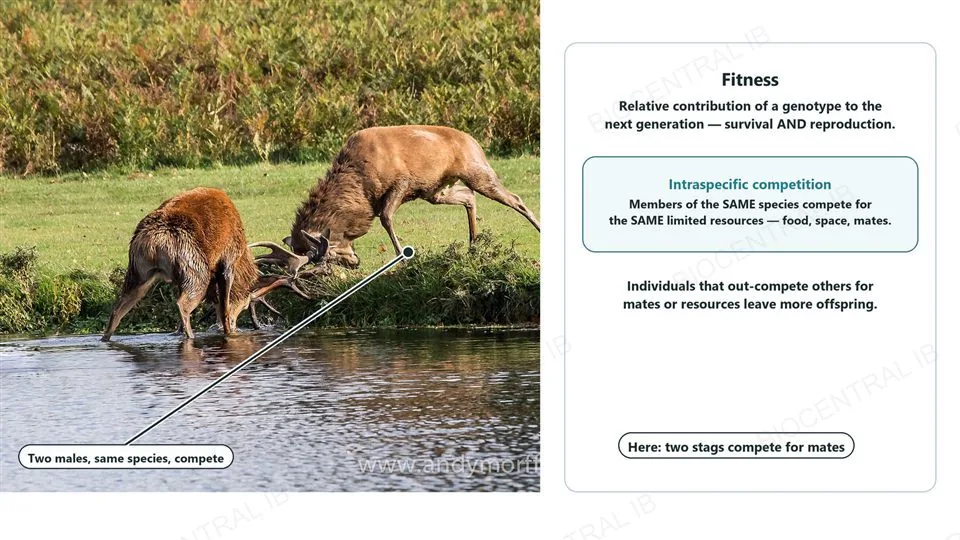
Individuals differ in fitness, and compete within their species

Fitness is the relative contribution of a genotype to the next generation, combining both survival and reproduction.
  • Two individuals with equal survival can still differ in fitness if one leaves more surviving offspring.
  • Intraspecific competition is competition between individuals of the SAME species for the same limited resources, such as food, space or mates.
  • Because members of a species share the most similar needs, intraspecific competition is usually the most intense kind of competition an individual faces.
Why it mattersFitness is about reproduction as much as survival — a very common exam misconception is to equate it with physical strength alone.
Left, a real photograph of two male red deer stags with antlers locked, fighting beside a river, labelled two males, same species, compete. Right, a definition of fitness as relative contribution of a genotype to the next generation, survival and reproduction, a highlighted box defining intraspecific competition as members of the same species competing for the same limited resources, and a note that here two stags compete for mates.
Photo: Andy Morffew, CC BY 2.0 · Wikimedia Commons
D4.1.6

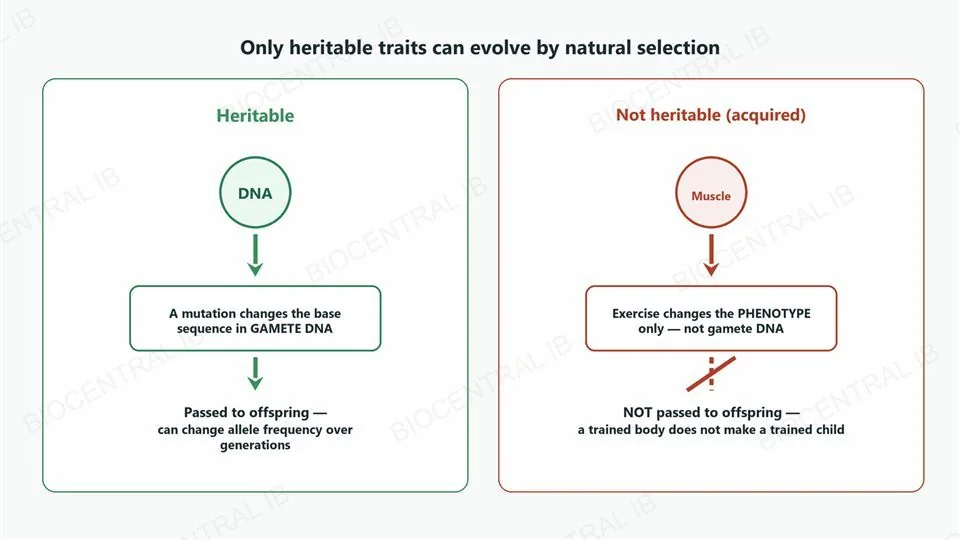
Only heritable traits can evolve by natural selection

For a trait to change by natural selection across generations, it must be controlled by alleles that can be passed on through gametes.
  • A mutation that changes the base sequence in gamete DNA is heritable and can be passed to offspring.
  • A trait acquired during an individual’s lifetime, such as muscle built by exercise, changes only the phenotype, not gamete DNA — it is NOT passed on.
  • This is exactly why Lamarckism failed: it required that acquired characteristics be inherited, which does not happen.
Why it mattersA trained body does not make a trained child — this is the clearest test of whether the heritability requirement has really been understood.
Two panels side by side. Left, heritable, outlined in green: a DNA icon with an arrow down to a box reading a mutation changes the base sequence in gamete DNA, then an arrow down to passed to offspring, can change allele frequency over generations. Right, not heritable, acquired, outlined in red: a muscle icon with an arrow down to exercise changes the phenotype only, not gamete DNA, then a crossed-out arrow down to not passed to offspring, a trained body does not make a trained child.
D4.1.7

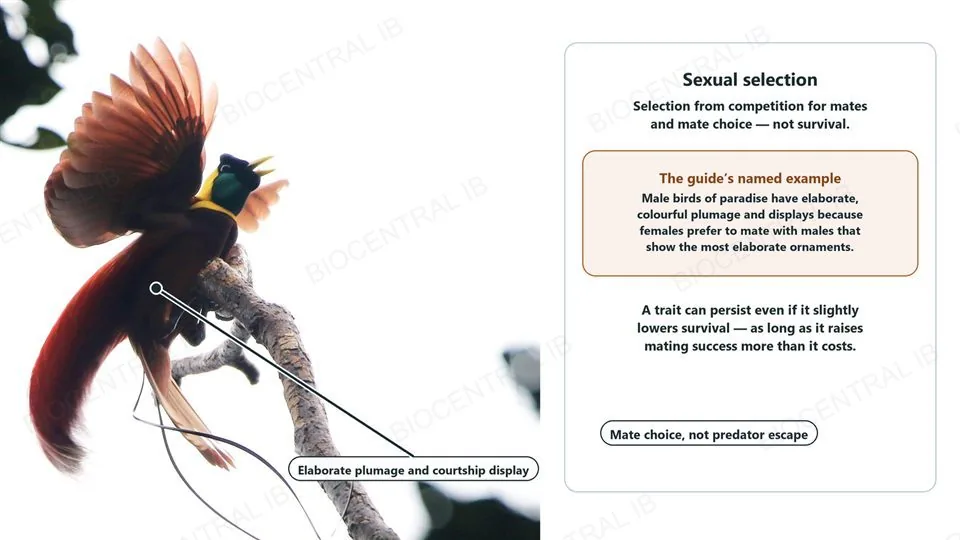
Sexual selection is driven by mate choice, not survival

Sexual selection is selection that arises from competition for mates and mate choice, which can act differently from survival-based natural selection.
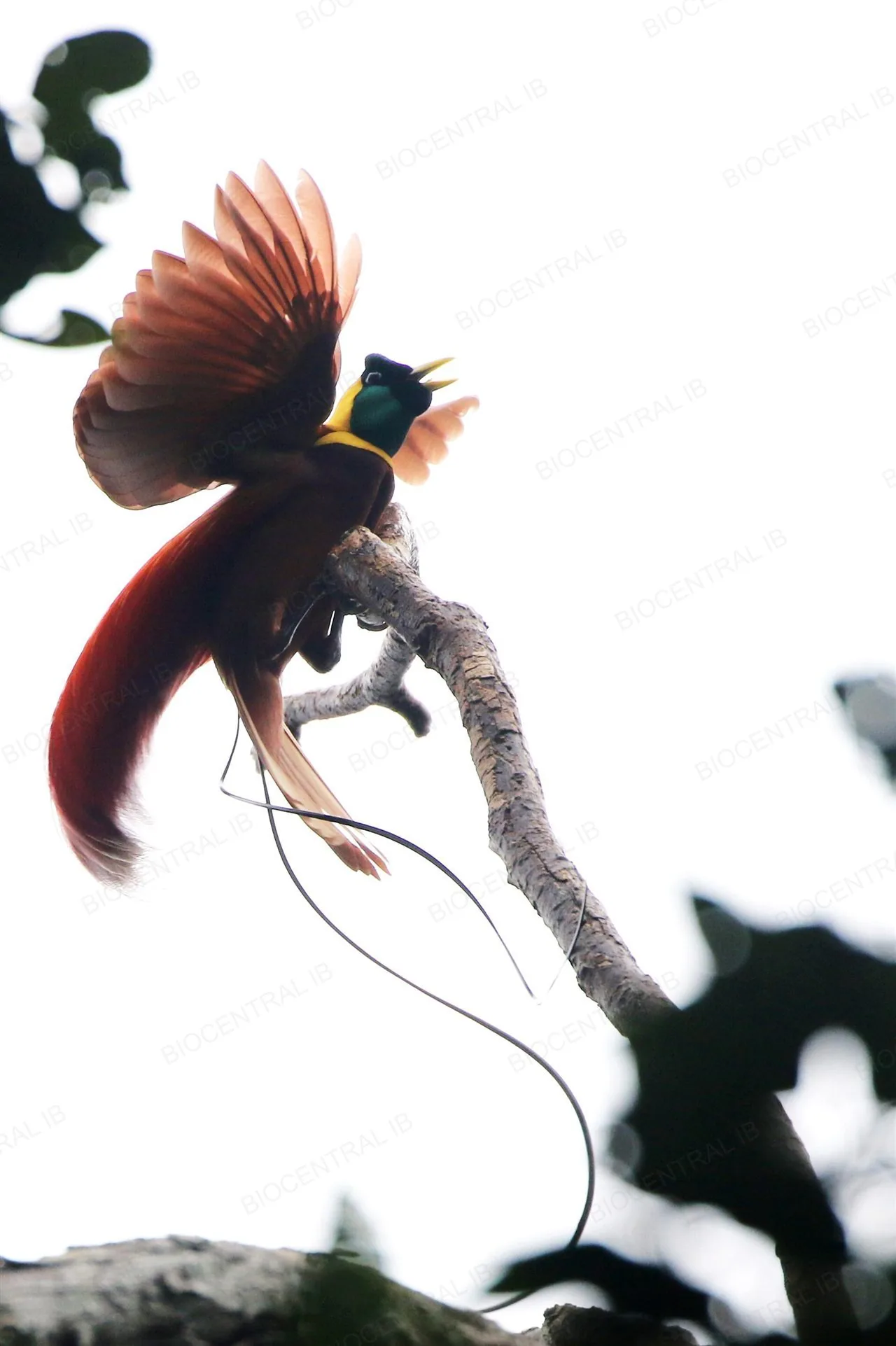
  • The guide’s own example: male birds of paradise have evolved elaborate, colourful plumage and courtship displays because females prefer to mate with the most elaborate males.
  • A trait favoured by sexual selection can persist even if it slightly reduces survival, as long as the reproductive benefit outweighs that cost.
  • Fitness combines survival AND reproduction, so a trait that helps one while costing a little of the other can still spread.
Why it mattersA strikingly showy trait is not always explained by survival — mate choice can be the real driver.
Left, a real photograph of a male bird of paradise in full courtship display, wings spread and long tail streamers visible, perched on a branch, labelled elaborate plumage and courtship display. Right, a definition of sexual selection as selection from competition for mates and mate choice, not survival, a highlighted box naming the guide’s example of male birds of paradise and female mate choice, and a note that a trait can persist even if it slightly lowers survival as long as it raises mating success more than it costs.
Photo: Joshua Bergmark, Ornis Birding Expeditions, CC BY 4.0 · Wikimedia Commons
D4.1.8

Endler modelled selection by experimentally controlling predation

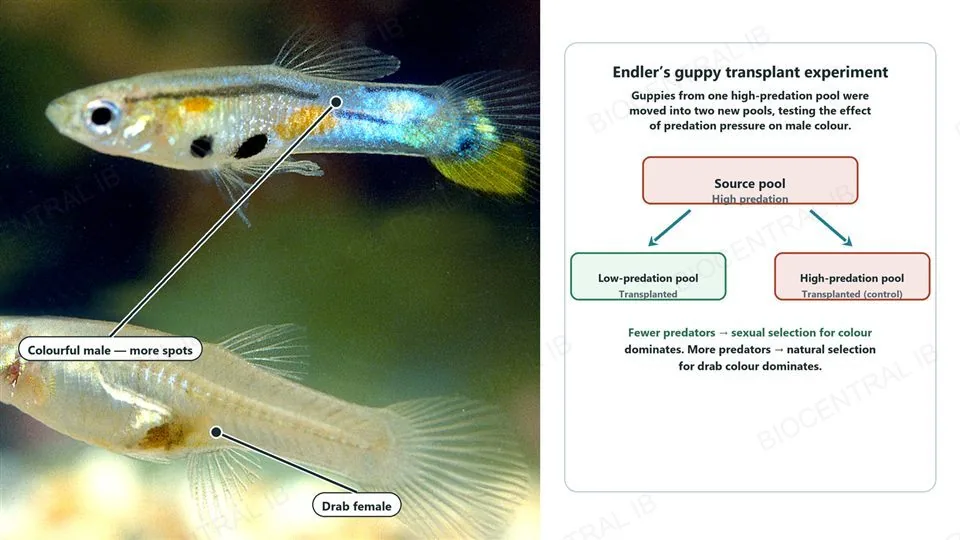
John Endler tested natural and sexual selection on guppies by transplanting fish between pools with different predation pressure.
  • Guppies from one high-predation source pool were transplanted into a new low-predation pool and, as a control, into a new high-predation pool.
  • Controlling which predators were present, rather than only observing wild populations, is what allows a causal claim about natural selection, not just a correlation.
  • Male guppies from high-predation pools are typically drabber, with fewer and smaller colour spots, than males from low-predation pools.
Why it mattersThis experimental control, not just observation, is what makes Endler’s guppies a genuine model of natural and sexual selection.
Left, a real photograph of a colourful male guppy above a drab female guppy, labelled colourful male, more spots and drab female. Right, a diagram of Endler’s transplant experiment: a source pool, high predation, with two arrows leading to a low-predation pool, transplanted, and a high-predation pool, transplanted control, captioned that fewer predators lets sexual selection for colour dominate while more predators lets natural selection for drab colour dominate.
Photo: Amy E. Deacon et al., CC BY 4.0 · Wikimedia Commons
D4.1.8

Removing predation let colour increase over 15 generations

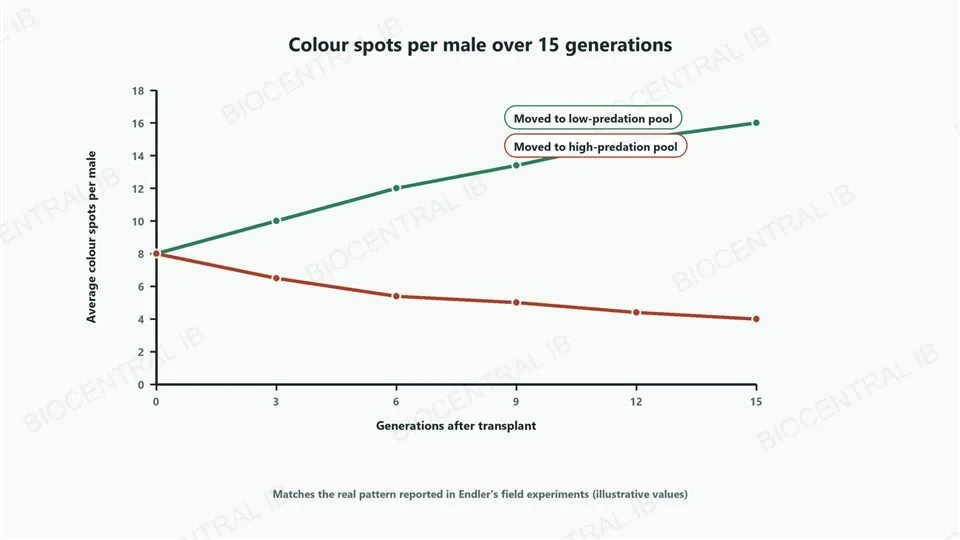
When predation pressure was removed, average colour spot number rose steadily; where it stayed high, colour kept falling.
  • Both transplanted populations started from the same source pool, averaging 8 colour spots per male at generation 0.
  • In the low-predation pool, colour spot number rose to about 16 by generation 15, as sexual selection for bright colour was no longer opposed by strong predation.
  • In the high-predation pool, colour spot number fell to about 4, as natural selection continued to favour drab, inconspicuous males.
Why it mattersThe same starting population diverged in opposite directions, purely because of which selection pressure dominated.
A line graph of average colour spots per male against generations after transplant, 0 to 15. Both lines start at 8 spots. The green line, moved to low-predation pool, rises steadily to 16 by generation 15. The red line, moved to high-predation pool, falls to about 4 by generation 15. A caption notes this matches the real pattern reported in Endler’s field experiments, illustrative values.
Quick check

A severe frost kills most seedlings in a population, except a few with unusually thick, insulating stems. Which statement correctly explains this?

The frost caused the survivors to grow thicker stems, which they will now pass on to offspring
Overproduction gave variation for frost (abiotic pressure) to act on; the heritable thick-stem trait increases in frequency
This is artificial selection, since humans are indirectly responsible for climate change
Because frost is density-independent, it cannot act as a selection pressure here
Correct answer: overproduction gave variation for frost (abiotic pressure) to act on; the heritable thick-stem trait increases in frequency. Overproduction supplied variation in stem thickness; frost (abiotic, density-independent) killed thin-stemmed seedlings; survivors’ heritable trait becomes more frequent. Frost did not CAUSE the trait (that is Lamarckism), and no human chose the survivors, so this is natural selection.

Key vocabulary — natural selection basics

D4.1.1 – D4.1.8: worth being able to define each in a sentence

Natural selection
The mechanism by which heritable variation, acted on by a selection pressure, causes differential survival and reproduction, changing allele frequencies over generations.
Mutation
A change in the DNA base sequence; the only source of genuinely new alleles.
Carrying capacity
The maximum population size an environment’s resources can sustain.
Selection pressure
Any factor, biotic or abiotic, that causes differential survival or reproduction.
Fitness
The relative contribution of a genotype to the next generation: survival AND reproduction.
Intraspecific competition
Competition between individuals of the SAME species for the same limited resources.
Heritable
Controlled by alleles that can be passed to offspring through gametes.
Sexual selection
Selection arising from competition for mates and mate choice.
Part three · HL

The gene pool and allele frequencies

D4.1.9 – D4.1.11
D4.1.9 · HL

The gene pool is all the alleles in a population

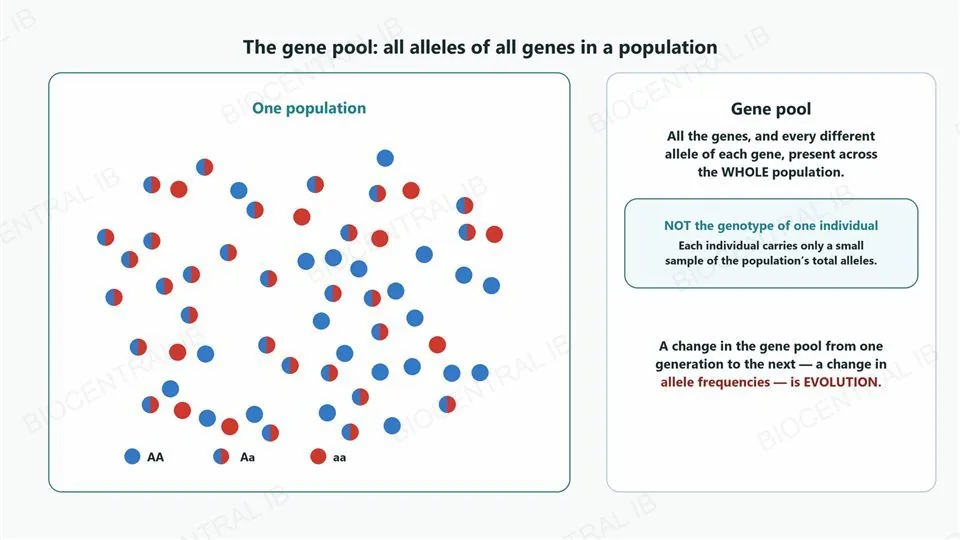
The gene pool is all the genes, and every different allele of each gene, present across a whole population — not the genotype of any one individual.
  • Each individual carries only a small sample of the population’s total alleles.
  • Allele frequency is the proportion of one specific allele among all alleles for that gene in the population.
  • A change in the gene pool from one generation to the next — a change in allele frequencies — is, by definition, evolution.
Why it mattersEvolution is defined at the population level, not the individual level: it is a change in a population’s allele frequencies.
Left, a scattered population of about 60 small circles inside an oval boundary, coloured blue for the AA genotype, red for aa, and half-blue-half-red for Aa, with a key. Right, a definition of the gene pool as all the genes and alleles across the whole population, not one individual’s genotype, and a highlighted statement that a change in the gene pool from one generation to the next, a change in allele frequencies, is evolution.
D4.1.10 · HL

Geographically isolated populations can have different allele frequencies

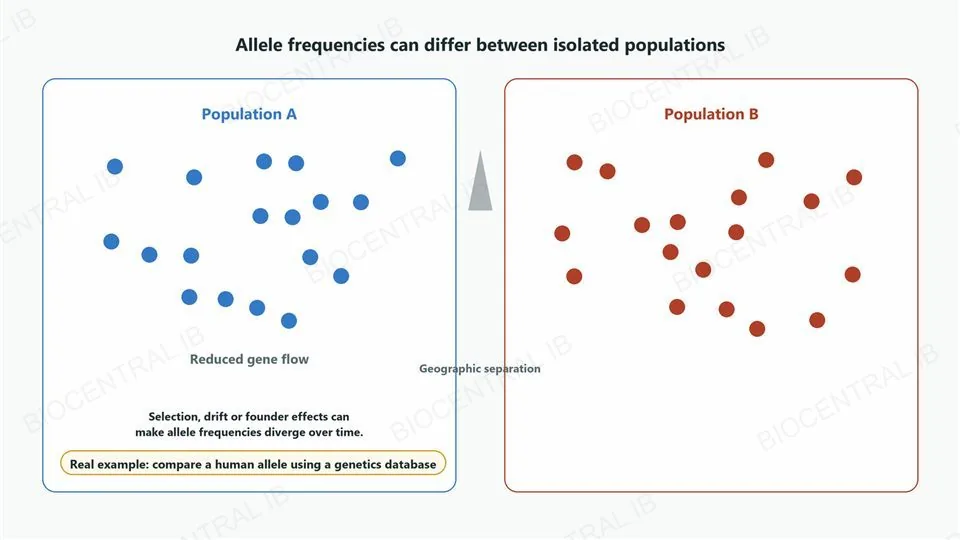
Reduced gene flow between geographically separated populations of the same species lets their allele frequencies diverge over time.
  • With less migration between them, selection, genetic drift or founder effects can push each population’s allele frequencies in different directions.
  • A real, documented human example is the sickle-cell allele (HbS), which occurs at higher frequency in some populations from historically malaria-endemic regions.
  • The required skill is to use a biological database to search for and interpret real allele frequency data — not to memorize exact numeric frequencies.
Why it mattersGeographic isolation alone is not the mechanism — it is the reduced gene flow it causes that lets frequencies diverge.
Two bordered panels, population A on the left in blue dots and population B on the right in red dots, separated by a grey triangular barrier icon labelled geographic separation, with reduced gene flow captioned beneath population A. A footer pill reads real example, compare a human allele using a genetics database.
D4.1.11 · HL

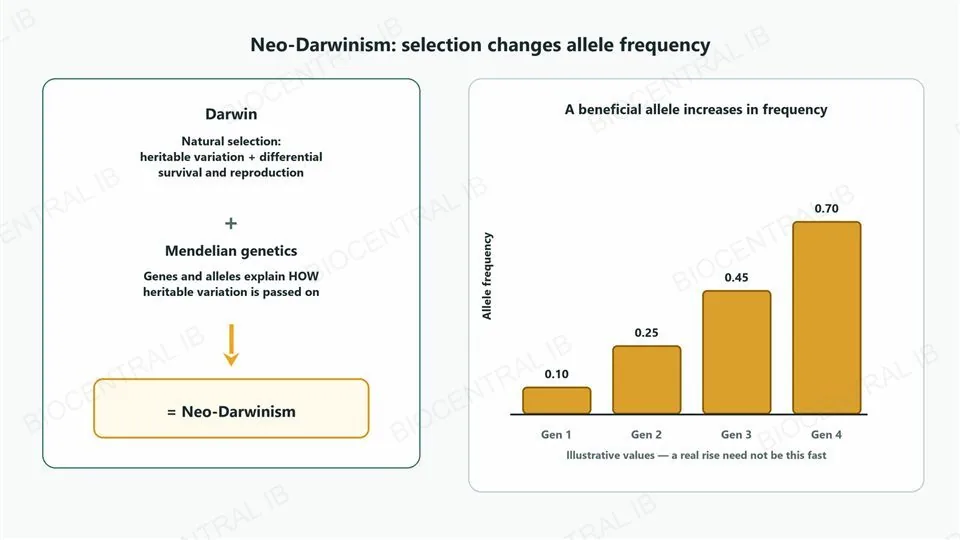
Neo-Darwinism: genetics explains how selection changes allele frequency

Darwin’s theory of natural selection, integrated with Mendelian and population genetics, is called neo-Darwinism.
  • Darwin developed natural selection without knowing the mechanism of heredity; genetics supplied that missing piece.
  • An allele that confers a heritable survival or reproductive advantage tends to increase in frequency over generations — gradually, not instantly.
  • Genetics did not replace natural selection: it explained HOW heritable variation is passed on, completing Darwin’s theory.
Why it mattersGenetics plus natural selection, together, is neo-Darwinism — neither alone is the complete modern theory.
Left, two stacked boxes, Darwin, natural selection, heritable variation plus differential survival and reproduction, a plus sign, then Mendelian genetics, genes and alleles explain how heritable variation is passed on, with an arrow down to a box reading equals neo-Darwinism. Right, a bar chart of allele frequency rising over four generations, 0.10, 0.25, 0.45, 0.70, captioned a beneficial allele increases in frequency, illustrative values.
Part four · HL

Types of selection

D4.1.12
D4.1.12 · HL

Directional, disruptive and stabilizing selection shape a trait differently

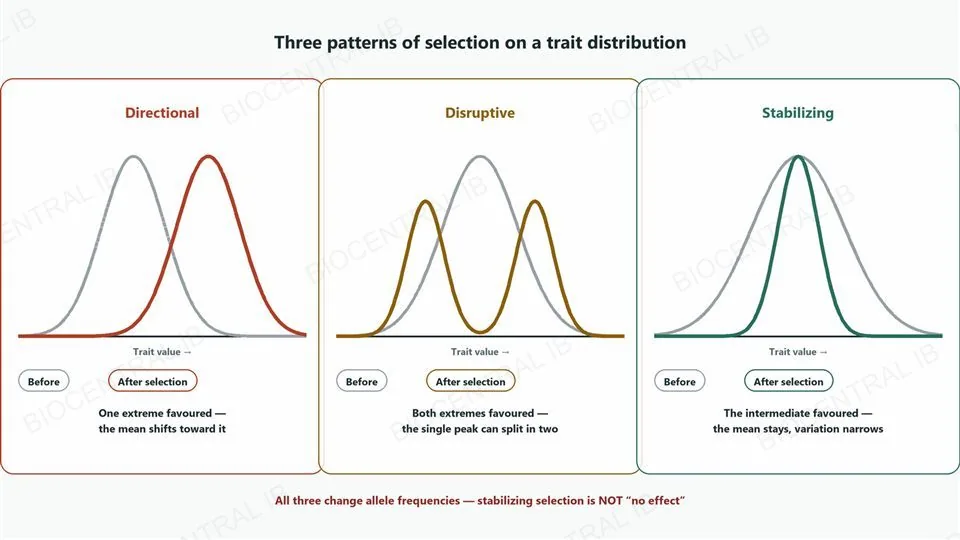
Selection can act on a trait’s distribution in three distinct patterns, each with a different effect on the population mean and spread.
  • Directional selection favours one extreme phenotype, shifting the population mean toward that extreme.
  • Disruptive selection favours both extremes over the intermediate, which can split a single peak into two.
  • Stabilizing selection favours the intermediate phenotype, narrowing variation around the SAME mean.
  • All three change allele frequencies — stabilizing selection still has a real evolutionary effect, even though the mean does not shift; this is a commonly tested misconception.
Why it matters“Stabilizing selection does nothing” is a flagged misconception: it changes frequencies, it just does not move the mean.
Three bordered panels side by side, each with a grey dashed before curve and a solid coloured after curve on a trait-value axis. Directional, red: the after curve is shifted right of the before curve, one extreme favoured, the mean shifts toward it. Disruptive, amber: the after curve has split into two peaks either side of the before curve, both extremes favoured, the single peak can split in two. Stabilizing, teal: the after curve is narrower than the before curve but centred on the same position, the intermediate favoured, the mean stays, variation narrows. A footer notes all three change allele frequencies, stabilizing selection is not no effect.
Part five · HL

The Hardy–Weinberg equation

D4.1.13 – D4.1.14
D4.1.13 · HL

The Hardy–Weinberg equation predicts genotype frequencies

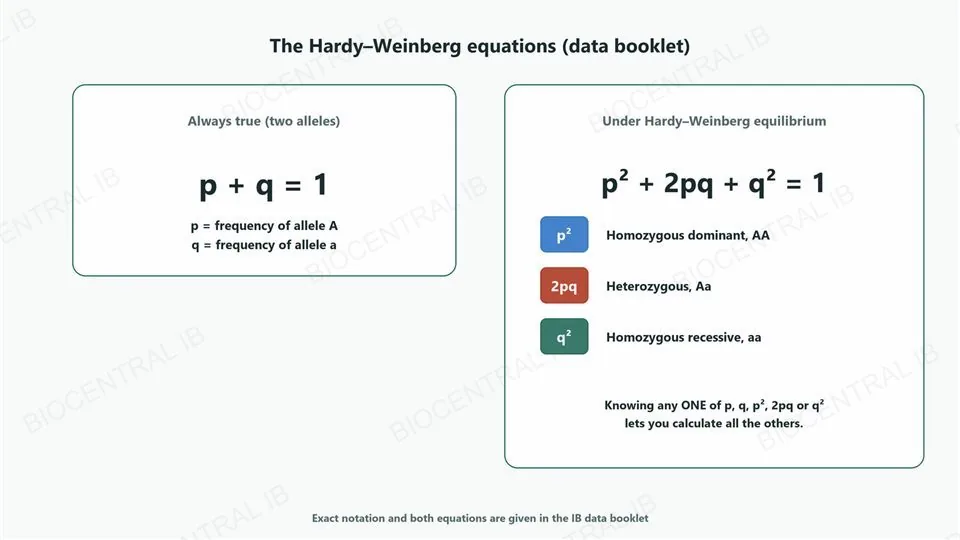
For a two-allele gene locus, p + q = 1 always holds, and under Hardy–Weinberg equilibrium p² + 2pq + q² = 1 predicts genotype frequencies from allele frequencies.
  • p is the frequency of one allele (commonly the dominant allele) and q is the frequency of the other; since there are only two alleles, p + q = 1 is always true.
  • Under equilibrium, p² predicts the frequency of the homozygous dominant genotype, 2pq the heterozygous genotype, and q² the homozygous recessive genotype.
  • Knowing any ONE of p, q, p², 2pq or q² lets you calculate all the others — this is the calculation skill the guide requires.
Why it mattersBoth equations, in this exact notation, are given in the IB data booklet.
Left card, always true for two alleles: the equation p plus q equals 1, with p defined as frequency of allele A and q as frequency of allele a. Right card, under Hardy-Weinberg equilibrium: the equation p squared plus 2pq plus q squared equals 1, with three coloured rows defining p squared as homozygous dominant AA, 2pq as heterozygous Aa, and q squared as homozygous recessive aa, and a note that knowing any one value lets you calculate all the others.
D4.1.13 · HL

Worked example: calculating allele frequencies from genotype counts

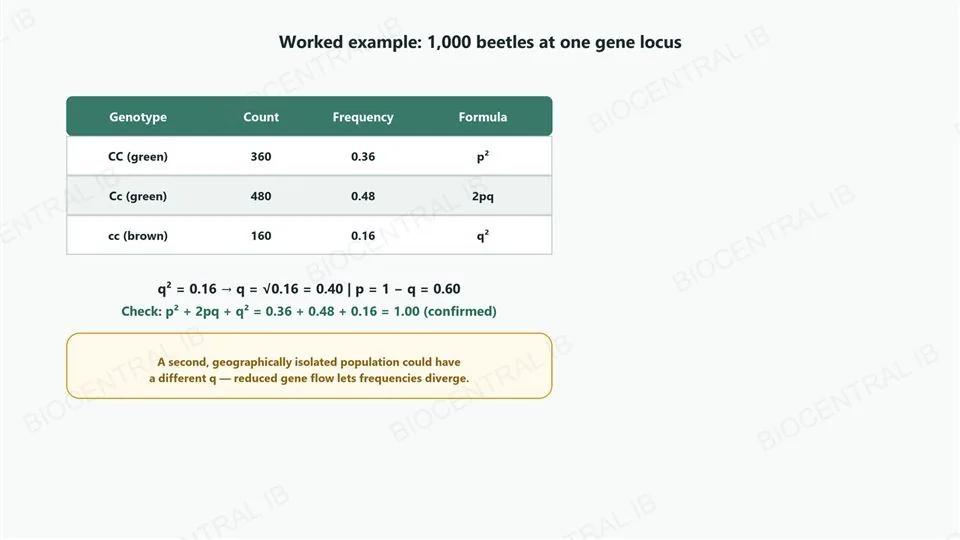
From real genotype counts in a population, the Hardy–Weinberg equation gives the underlying allele frequencies.
  • In 1,000 beetles: 360 are CC, 480 are Cc, and 160 are cc, giving genotype frequencies 0.36, 0.48 and 0.16.
  • Since q² = 0.16, q = √0.16 = 0.40, and since p + q = 1, p = 0.60.
  • Checking: p² + 2pq + q² = 0.36 + 0.48 + 0.16 = 1.00, confirming the values are consistent.
Why it mattersAlways start from the homozygous recessive frequency (q²) — it is the only genotype you can identify by eye without a cross.
A table with four columns, genotype, count, frequency, formula, and three rows: CC green 360 0.36 p squared, Cc green 480 0.48 2pq, cc brown 160 0.16 q squared. Below, the calculation q squared equals 0.16 so q equals the square root of 0.16 equals 0.40, p equals 1 minus q equals 0.60, then a check that p squared plus 2pq plus q squared equals 0.36 plus 0.48 plus 0.16 equals 1.00, confirmed. A footer note says a second, geographically isolated population could have a different q, since reduced gene flow lets frequencies diverge.
D4.1.14 · HL

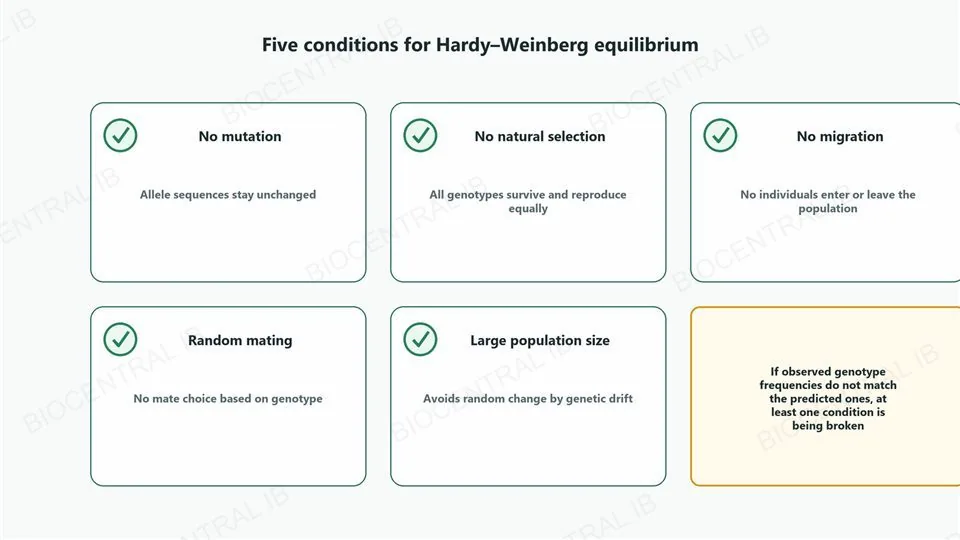
Five conditions must hold for Hardy–Weinberg equilibrium

The Hardy–Weinberg equation only predicts real genotype frequencies if five conditions are maintained in the population.
  • No mutation, no natural selection, and no migration into or out of the population.
  • Random mating, with no mate choice based on genotype, and a large population size, which avoids random change by genetic drift.
  • If observed genotype frequencies do not match the predicted ones, at least one of these conditions is being broken — not a flaw in the equation itself.
Why it mattersThese conditions describe a population that is NOT evolving; real populations rarely meet all five, which is exactly why allele frequencies change.
A grid of five cards, each with a green circular checkmark icon: no mutation, allele sequences stay unchanged; no natural selection, all genotypes survive and reproduce equally; no migration, no individuals enter or leave the population; random mating, no mate choice based on genotype; large population size, avoids random change by genetic drift. A sixth amber card notes that if observed genotype frequencies do not match the predicted ones, at least one condition is being broken.
Quick check · HL

In a population at equilibrium, q = 0.2. A later sample shows far fewer heterozygotes than 2pq predicts. What does this most likely mean?

The population now has zero genetic variation
At least one Hardy–Weinberg condition (e.g. selection, non-random mating) is now being broken
The mismatch is definitely caused by migration and nothing else
The Hardy–Weinberg equation itself must be wrong and should not be used
Correct answer: at least one Hardy–Weinberg condition (e.g. selection, non-random mating) is now being broken. 2pq = 2 × 0.8 × 0.2 = 0.32 is the EXPECTED frequency (D4.1.13). A mismatch with the observed frequency shows one of the five equilibrium conditions is no longer met (D4.1.14) — not that the equation is flawed.
Part six · HL

Artificial selection

D4.1.15
D4.1.15 · HL

Artificial selection requires deliberate human choice of which individuals breed

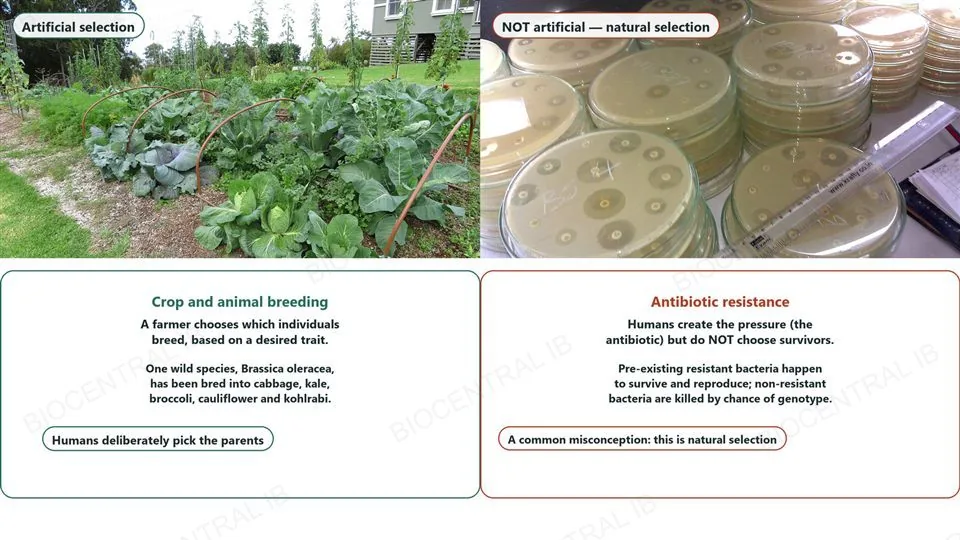
Artificial selection is selection where humans deliberately choose which individuals breed, based on a desired trait — the key difference from natural selection.
  • Crop and animal breeding is artificial selection: a farmer repeatedly chooses which individuals to breed from, for example the single wild species Brassica oleracea, bred into cabbage, kale, broccoli, cauliflower and kohlrabi.
  • Antibiotic resistance evolving in bacteria is NOT artificial selection: humans create the pressure (the antibiotic) but do not choose which bacteria survive.
  • Pre-existing resistant bacteria happen to survive and reproduce by chance of their existing genotype — this makes it natural selection.
Why it mattersThis is the single most important misconception in this topic: human involvement alone does not make something artificial selection.
Two real photographs side by side. Left, a vegetable garden with several Brassica oleracea varieties, cabbage and kale, growing together, labelled artificial selection. Right, a laboratory bench with many stacked petri dishes showing antibiotic disk diffusion zones of inhibition, labelled not artificial, natural selection. Below each photo, a card: left explains crop and animal breeding as a farmer deliberately choosing parents, with the Brassica oleracea example; right explains antibiotic resistance as humans creating the pressure but not choosing survivors, pre-existing resistant bacteria surviving by chance of genotype, flagged as a common misconception.
Photos: Forest & Kim Starr, CC BY 2.0 (left) · Microrao, CC BY-SA 4.0 (right) · Wikimedia Commons

Key vocabulary — HL

HL only: D4.1.9 – D4.1.15

Gene pool
All the genes, and every different allele of each gene, present across a population.
Allele frequency
The proportion of one specific allele among all alleles for that gene in a population.
Neo-Darwinism
The integration of Darwin’s natural selection with Mendelian and population genetics.
Directional selection
Selection favouring one extreme phenotype, shifting the population mean toward it.
Disruptive selection
Selection favouring both extremes over the intermediate phenotype.
Stabilizing selection
Selection favouring the intermediate phenotype, narrowing variation around the same mean.
Hardy–Weinberg equation
p² + 2pq + q² = 1 and p + q = 1; predicts genotype frequencies under equilibrium.
Hardy–Weinberg equilibrium
A population with no mutation, no selection, no migration, random mating and a large population size.
Artificial selection
Selection where humans deliberately choose which individuals breed, based on a desired trait.

Where this shows up again

D2.1 · Meiosis
Crossing over, independent assortment and random fertilization (D2.1) are the three processes of sexual reproduction that generate new combinations of alleles (D4.1.2). How does meiosis itself generate the variation natural selection then acts on?
D3.2 · Inheritance · HL link
Genotype, phenotype, dominant and recessive alleles (D3.2) are the vocabulary the Hardy–Weinberg equation uses to predict genotype frequencies (D4.1.13). How does a Punnett grid relate to a Hardy–Weinberg calculation for the same locus?
D3.1 · Reproduction
Sexual reproduction’s role in producing variation (D3.1) underlies D4.1.2’s claim that it reshuffles existing alleles rather than creating new ones. Why does sexual, but not asexual, reproduction generate new allele combinations each generation?
C4.1 · Populations
Carrying capacity and intraspecific competition for resources (C4.1) are exactly the overproduction and competition described in D4.1.3 and D4.1.5. How do predator-prey and competition relationships change the strength of a selection pressure?

D4.1 Natural selection — one-page recap

Screenshot this slide to revise from

The mechanism
  • Heritable variation (mutation + sexual reproduction) → a selection pressure acts → differential fitness (survival and reproduction) → favourable alleles more frequent. Repeats every generation. A real paradigm shift replacing Lamarckism.
Pressures and examples
  • Overproduction → competition for resources (carrying capacity). Abiotic pressures (temperature, drought, pH, salinity) are density-independent. Only heritable traits evolve — acquired traits (Lamarckism) do not.
Sexual selection & modelling
  • Sexual selection: mate choice, not survival — birds of paradise. Endler’s guppies: transplant experiment, low predation → colour rises, high predation → colour falls, both from 8 spots.
HL · Gene pool & allele frequency
  • Gene pool = all alleles of all genes in a population. Allele frequency change = evolution. Isolated populations diverge (reduced gene flow). Neo-Darwinism = Darwin + Mendelian genetics.
HL · Selection types & Hardy–Weinberg
  • Directional (mean shifts), disruptive (splits in two), stabilizing (narrows, same mean) — all change frequencies. p + q = 1; p² + 2pq + q² = 1 needs no mutation/selection/migration, random mating, large population.
HL · Artificial selection
  • Artificial selection: humans deliberately choose which individuals breed (crop/animal breeding, e.g. Brassica oleracea). Antibiotic resistance is NATURAL selection — humans create the pressure but do not choose survivors.
Next step

Now test yourself on D4.1

Reading the slides is half the job. The other half is answering questions the way the exam asks them.

51 quiz questions10 data questions6 exam questionsmarkschemes included

Unlock every lesson with Pro — quizzes, data questions and exam papers. Two lessons are completely free to try: A1.1 Water and B1.1 Carbohydrates and lipids.

One mechanism, repeated every generation

Natural selection is not a list of separate facts: heritable variation meets a selection pressure, some individuals survive and reproduce more than others, and favourable alleles become more frequent — then it happens again. Endler’s guppies and the birds of paradise show the mechanism in real populations; at HL, the gene pool, allele frequencies and the Hardy–Weinberg equation give it a precise, calculable form, and artificial selection shows what changes when humans, not the environment, choose the parents.
D4.1 Natural selection · BioCentral IB
Use ↓ ↑ or click to navigate
01 / 20