BioCentral IBBioCentral IB
IB Biology · Theme D · D4.2

Stability and change

Some ecosystems have persisted for millions of years, yet human pressures from deforestation to plastic can push them past a point of no return. What holds an ecosystem steady, what breaks it, and how can it be repaired?
Guiding questions

What features of ecosystems allow stability over unlimited time periods?

What changes caused by humans threaten the stability of ecosystems?

Part one

What keeps an ecosystem stable

D4.2.1 – D4.2.4
D4.2.1

Stable, but never still

Ecosystem stability is the ability of a natural ecosystem to keep its overall structure and function over long periods, even though everything in it keeps changing.
  • Individual organisms are born, die and are replaced all the time, yet the same kinds of producers, consumers and decomposers stay in the same relationships.
  • Evidence comes from fossils and preserved remains. The Daintree rainforest in Queensland is estimated to be well over 100 million years old, and the Namib desert about 55 million years old.
  • Stable does not mean unchanged: a stable ecosystem absorbs seasonal cycles, storms and moderate disturbance, then returns to a similar state.
Why it mattersThe rest of this topic asks what makes such continuity possible, and what human activity does to break it.
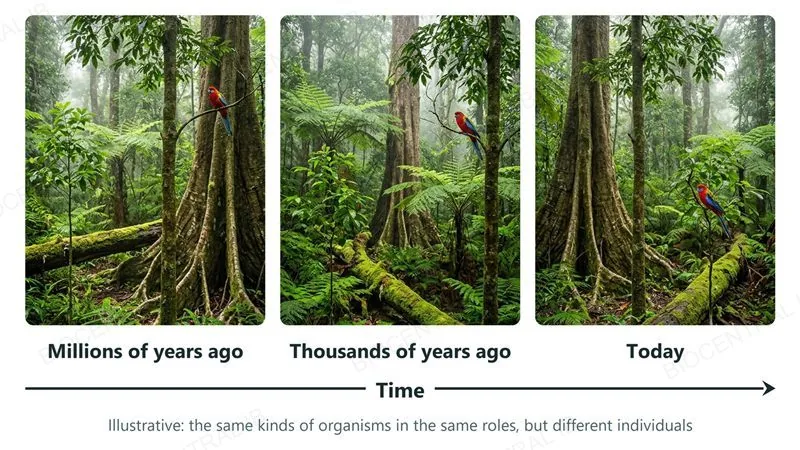
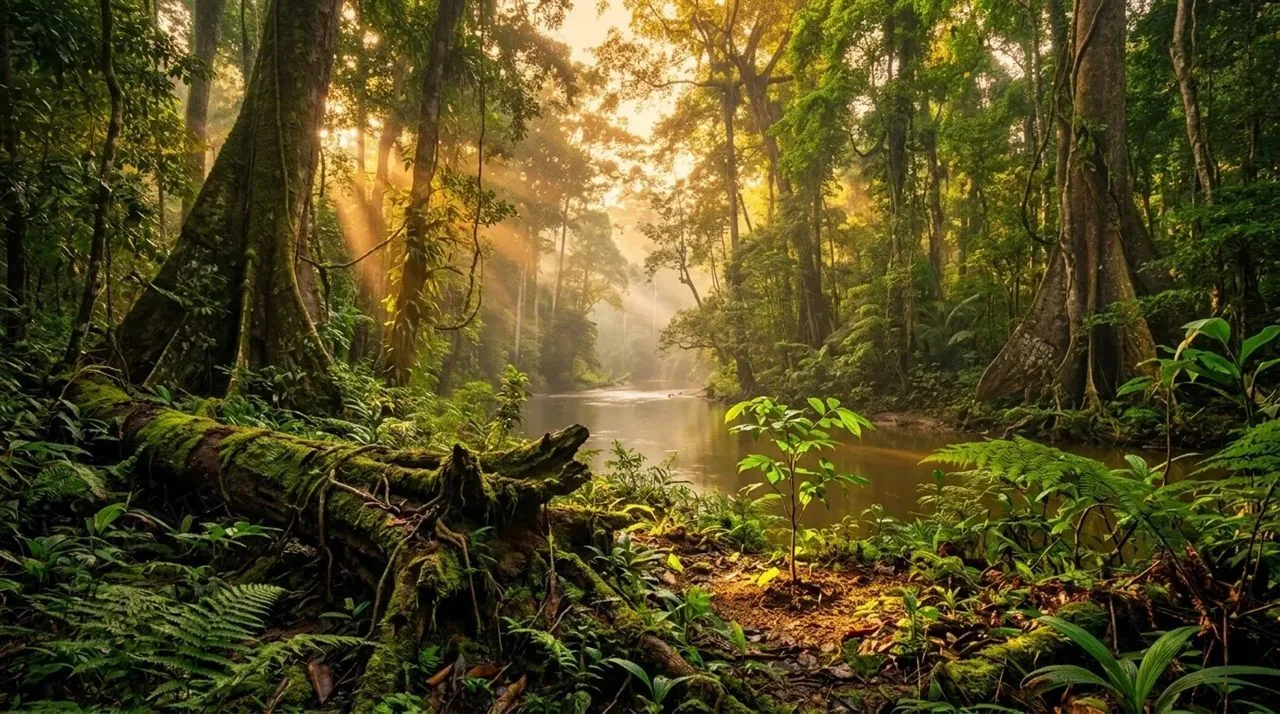
Three photographs of the same kind of rainforest at three times, millions of years ago, thousands of years ago and today (an illustrative reconstruction). Each has a tall buttressed tree, a smaller tree, a sapling, tree ferns, a bird and a fallen mossy log, but the individuals stand in different positions
D4.2.2

Energy flows through, nutrients go round

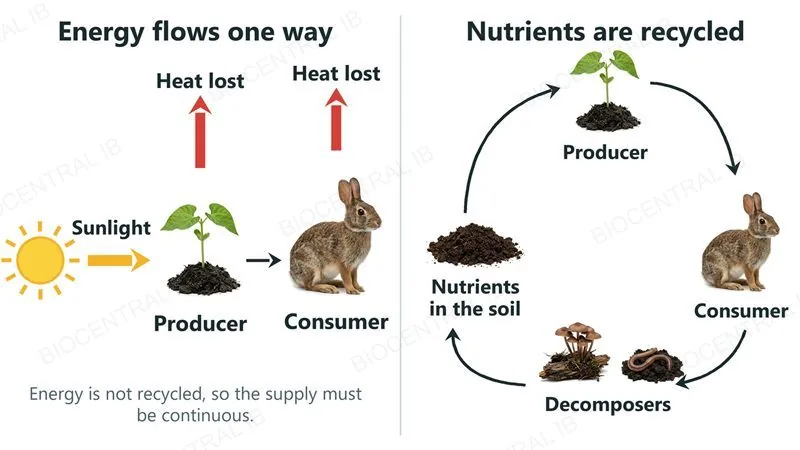
Two of the four requirements for stability are supplies: a continuous input of energy, and the recycling of nutrients.
  • Energy usually enters as sunlight, is captured by producers, passes along food chains and leaves as heat. It is never recycled, so the supply must be continuous.
  • Nutrients such as carbon, nitrogen and phosphorus are finite. Decomposers return them from dead matter to the soil or water, where producers take them up again.
  • If nutrient recycling failed, producers would run out of usable minerals and the whole food web would decline, however much sunlight arrived.
Why it mattersThis difference is why a sealed mesocosm (D4.2.4) lets light in but keeps matter inside.
Left: energy flowing one way from the sun to a plant (the producer) and a rabbit (the consumer), with heat lost from both. Right: nutrients cycling from a plant to a rabbit to decomposers (mushrooms and an earthworm) to nutrients in the soil and back to the plant
D4.2.2

Diversity and a tolerable climate

The other two requirements are genetic diversity within populations, and climatic variables that stay within the tolerance levels of the species living there.
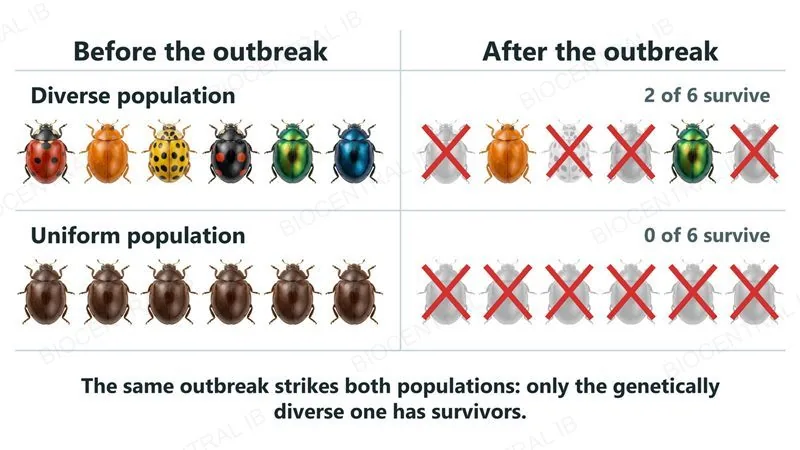
  • Genetic diversity means individuals differ in heritable traits, so when disease, drought or heat arrives, some individuals are likely to survive and the population is not lost.
  • A population with little genetic diversity can be wiped out by a single stress, because all its members share the same weakness.
  • Each species survives only within a range of temperature, rainfall and other climatic conditions. If these move outside its tolerance levels, species are lost and the community changes.
Why it mattersThe four requirements are linked: losing species or genetic diversity weakens the energy capture and nutrient recycling the ecosystem depends on.
Two rows of six beetles before and after a disease outbreak: the diverse population (six different colours and patterns) keeps two survivors, while the uniform population (six identical dark brown beetles) loses all six
D4.2.3

The forest that makes its own rain

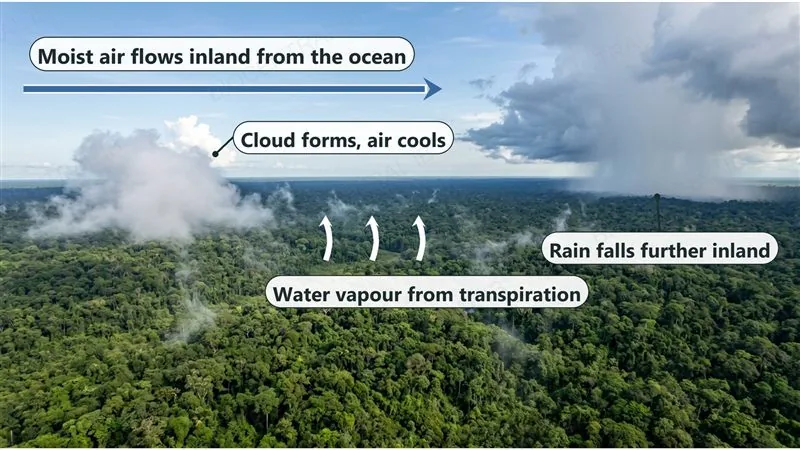
The Amazon rainforest recycles much of its own rainfall: water vapour released by its trees returns as rain further inland.
  • Trees take up soil water and release water vapour by transpiration, which cools the air and helps form clouds.
  • Air flows carry the moist air further inland, where it falls as rain, so the same water is recycled repeatedly on its way across the forest.
  • This works only if a large area of forest is present: a small remnant cannot release enough vapour to sustain the cooling, air flows and rainfall.
  • Scientists are uncertain how small the forest area can become before these processes fail.
An aerial photograph of Amazon rainforest with labelled arrows: moist air flows inland from the ocean, a cloud forms and the air cools, water vapour rises from the trees by transpiration, and rain falls further inland
D4.2.3

Past the tipping point

A tipping point is a threshold beyond which a change becomes self-reinforcing and pushes an ecosystem into a different state.
  • Clearing forest reduces transpiration, so less water vapour is released and less rain falls on the forest that remains.
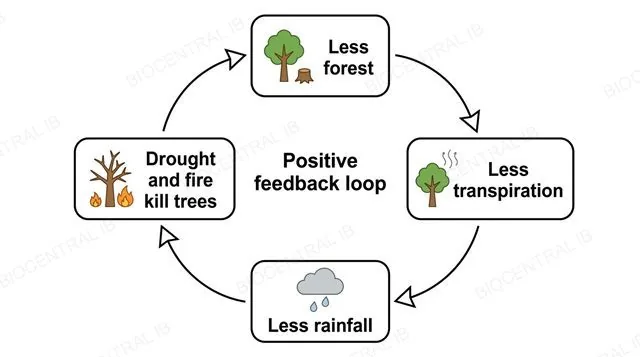
  • A drier forest is more likely to suffer drought and fire, which kill more trees, so the change causes more of the same change: a positive feedback loop.
  • Beyond the threshold, large areas could shift to a drier, savanna-type ecosystem even without further clearing.
  • Some scientists have estimated the threshold at about 20 to 25% forest loss, but the true figure is uncertain.
A loop of four linked boxes: less forest, less transpiration, less rainfall, more drought and fire with more trees dying, which leads back to less forest
D4.2.3

Measuring loss: percentage change

Percentage change compares a change with the original value: (new value − original value) ÷ original value × 100.
  • The extent of deforestation is assessed by comparing the current forest area with the original area, so the original area is always the denominator.
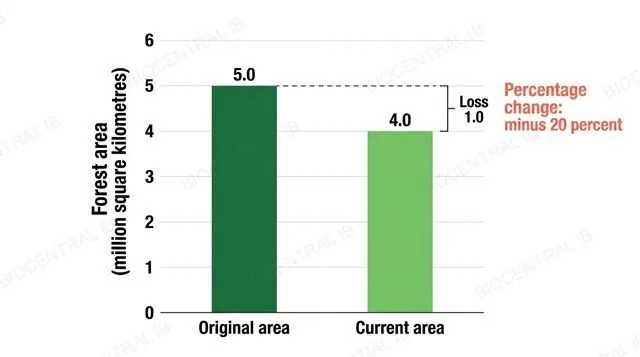
  • Worked example: a forest of 5.0 million km² shrinks to 4.0 million km². The change is 4.0 − 5.0 = −1.0 million km².
  • Then −1.0 ÷ 5.0 × 100 = −20%, a 20% decrease in forest area. The numbers in this example are illustrative, not measured Amazon data.
Why it mattersAlways divide by the original value, not the new one. Comparing the result with an estimated tipping-point range shows how close a forest might be to it.
A bar chart of forest area with an original bar of 5.0 million square kilometres and a current bar of 4.0 million, and a bracket marking the 1.0 million loss as a 20 percent decrease
D4.2.4

A model ecosystem in a jar

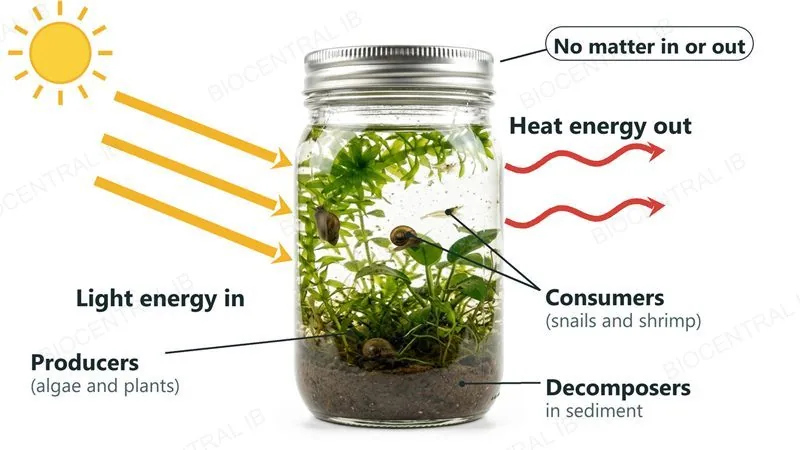
A mesocosm is a small, enclosed model ecosystem used to investigate how one variable affects ecosystem stability.
  • One variable, such as light, temperature, nutrient level or species number, is changed while everything else is kept the same, and the effect on the community is measured.
  • Sealed glass vessels are preferable to open tanks: matter cannot enter or leave, but energy can still pass through, as in a real ecosystem.
  • Aquatic or microbial ecosystems are more likely to succeed than terrestrial ones.
  • Nature of science: care and maintenance of mesocosms must follow IB experimental guidelines.
A sealed glass jar containing pond water, water plants, snails, shrimp and sediment, labelled producers, consumers and decomposers, with light energy arrows entering, heat energy arrows leaving through the glass, and a label saying no matter enters or leaves through the sealed lid
Part two

Keystone species and sustainable use

D4.2.5 – D4.2.7
D4.2.5

Small numbers, huge impact

A keystone species has a disproportionately large effect on community structure compared with its abundance, so its removal risks ecosystem collapse.
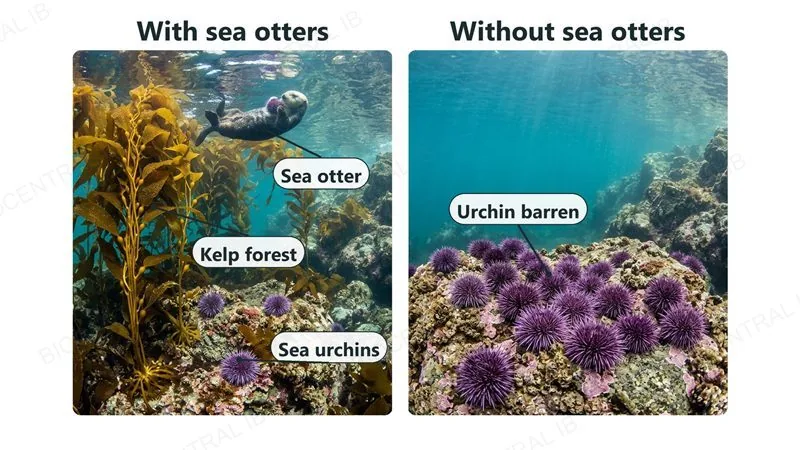
  • Sea otters eat sea urchins. Where otters are present, urchin numbers stay low and kelp forests thrive, sheltering many other species.
  • When otters were hunted out for their fur, urchins multiplied and overgrazed the kelp, leaving bare "urchin barrens": a top-down trophic cascade.
  • Keystone species are not always predators. Beavers, for example, reshape whole habitats by damming streams.
Why it mattersLosing one keystone species can change many other populations at once, which is why its removal can trigger collapse.
Two underwater photographs: with sea otters, a dense kelp forest, an otter holding an urchin and only three sea urchins; without sea otters, no kelp and a rock covered in purple sea urchins, an urchin barren
D4.2.6

Harvest rate versus replacement rate

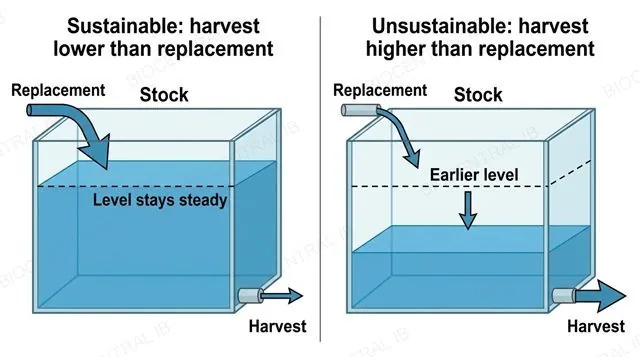
Harvesting a resource from a natural ecosystem is sustainable only if the rate of harvesting is lower than the rate of replacement.
  • Replacement comes from the growth and reproduction of the harvested species. Harvesting removes individuals from the same stock.
  • If harvesting is below replacement, the stock stays the same size or recovers. If harvesting is above replacement, the stock falls year after year and may collapse.
  • Sustainability is assessed by measuring both rates for the species, for example the number of seeds or fish taken compared with the number growing or reproducing.
Why it mattersA resource being renewable does not make its harvest sustainable: the two rates have to be compared.
Two tanks representing a stock: in the first, replacement inflow is larger than harvest outflow and the level stays high; in the second, harvest outflow is larger and the level falls
D4.2.6

Brazil nuts: harvest without felling the tree

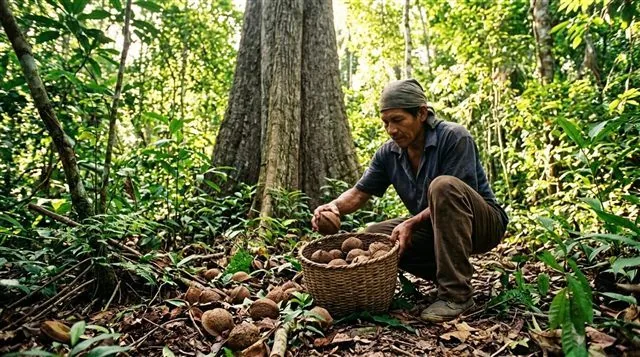
The Brazil nut tree (Bertholletia excelsa) is a terrestrial plant harvested from natural rainforest by collecting only the fallen fruits, so the trees stay alive.
  • Because the trees are not cut down, they keep producing seeds year after year, so the harvest is less likely to exceed the rate of replacement.
  • Assessing sustainability means checking that enough seeds are left to grow into new trees: heavily harvested stands can end up with few young trees.
  • The trees rely on large-bodied bees for pollination and on animals such as agoutis for seed dispersal, so a lasting harvest also needs the wider forest to survive.
Why it mattersA renewable resource is only as sustainable as the ecosystem that supports it.
A collector gathering fallen Brazil nut pods from the rainforest floor beneath a tall living Brazil nut tree
D4.2.6

Atlantic cod: when catch outruns replacement

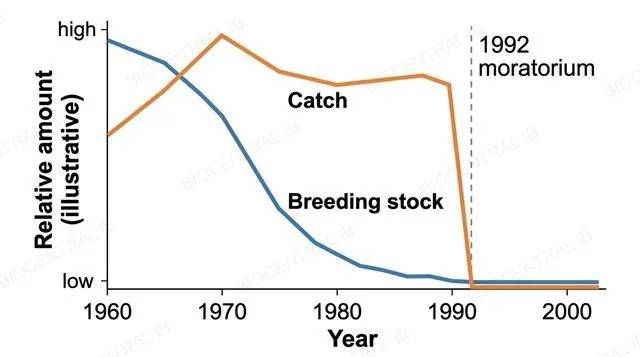
The northern cod (Gadus morhua) fishery off Newfoundland shows what happens when harvesting exceeds replacement: the stock collapsed and fishing was stopped in 1992.
  • Decades of intensive industrial fishing removed cod faster than they could reproduce. The breeding (spawning) stock fell by more than 90% between 1962 and 1992.
  • Catches stayed high for years after the breeding stock had begun to shrink, so catch alone hid the problem. A sustainability assessment tracks the size of the breeding stock as well.
  • Canada closed the fishery with a moratorium in 1992, and recovery has been slow.
NoteThe graph is a simplified sketch of the pattern, not measured data.
A simplified graph over time in which the catch stays high while the breeding stock of cod falls steeply, ending at a marked 1992 moratorium
D4.2.7

Can farming go on forever?

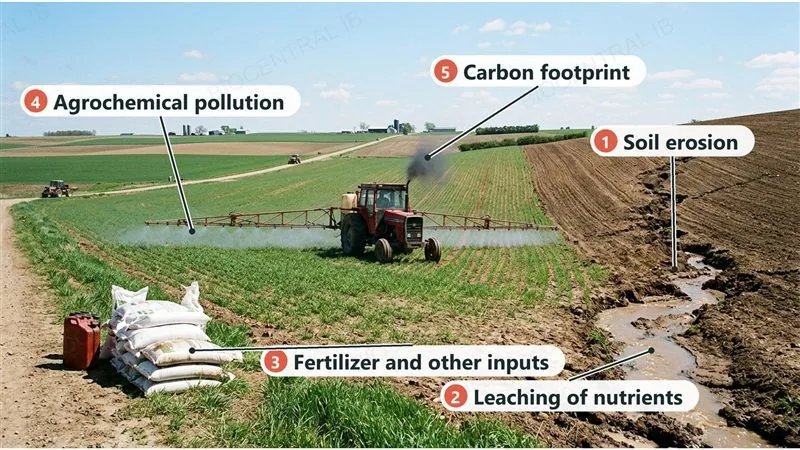
Agriculture is sustainable only if it can continue without degrading the soil, water, atmosphere and inputs it depends on. Five factors matter.
  • Soil erosion: bare, ploughed soil is washed and blown away faster than new soil forms.
  • Leaching of nutrients: fertilizer not taken up by crops is washed down into groundwater and streams, wasted and polluting.
  • Supply of fertilizers and other inputs: fertilizer, fuel and water must keep being supplied, and some sources, such as phosphate rock, are finite.
  • Pollution due to agrochemicals: pesticides and herbicides can harm non-target species.
  • Carbon footprint: fuel, fertilizer manufacture and livestock all release greenhouse gases.
A photograph of a farm with five numbered labels: 1 soil erosion (a gully on a bare ploughed slope), 2 leaching of nutrients (muddy water in a stream), 3 fertilizer and other inputs (sacks of fertilizer and a fuel can), 4 agrochemical pollution (a tractor spraying crops), 5 carbon footprint (exhaust smoke from the tractor)
Part three

Pollution and restoration

D4.2.8 – D4.2.11
D4.2.8

From fertilizer to fish kill

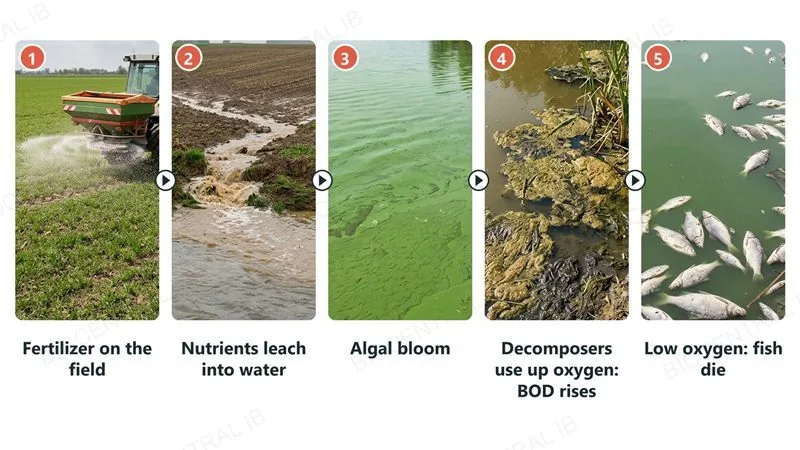
Eutrophication is the enrichment of a water body with nutrients, mainly nitrate and phosphate leached from fertilizers, which ends in oxygen depletion.
  • Rain washes nitrate and phosphate from fertilized fields into rivers, lakes and coastal seas by leaching and run-off.
  • The extra nutrients cause an algal bloom. Dense algae block light so plants below die, and then the algae die too.
  • Aerobic decomposers multiply on the dead matter and use up dissolved oxygen in respiration, so the biochemical oxygen demand (BOD), the oxygen used by microorganisms in a water sample, rises.
  • With little oxygen left, fish and other aerobic animals die and the community loses diversity.
Why it mattersA high BOD signals organic pollution: it means decomposers are consuming a lot of the water's oxygen.
Five numbered photographs in sequence: 1 fertilizer spread on a field, 2 nutrients leaching into water as muddy run-off, 3 an algal bloom turning a lake bright green, 4 decomposers using up oxygen in rotting algae as the BOD rises, 5 many dead fish floating in low-oxygen water
D4.2.9

Toxins that climb the food chain

Biomagnification is the increase in the concentration of a toxin in the tissues of consumers at each higher trophic level.
  • A pollutant biomagnifies if it is persistent (not broken down) and is taken into the body faster than it is lost, so it stays stored in the tissues.
  • Each consumer eats many organisms from the level below and keeps the toxin they carried, so the amount in its body builds up.
  • Top consumers therefore hold the highest concentrations, even when the toxin is barely detectable in the surrounding water.
Why it mattersIt runs opposite to energy flow: the energy available falls at each trophic level, while the concentration of a persistent toxin rises.
Toxin concentration in body tissue increases1Algae3Small fish9Large fish27Fish-eatingbirdEach square is the same amount of body tissue.Each red dot is one toxin particle. Arrows show who eats whom.Illustrative numbers.
D4.2.9

DDT and mercury

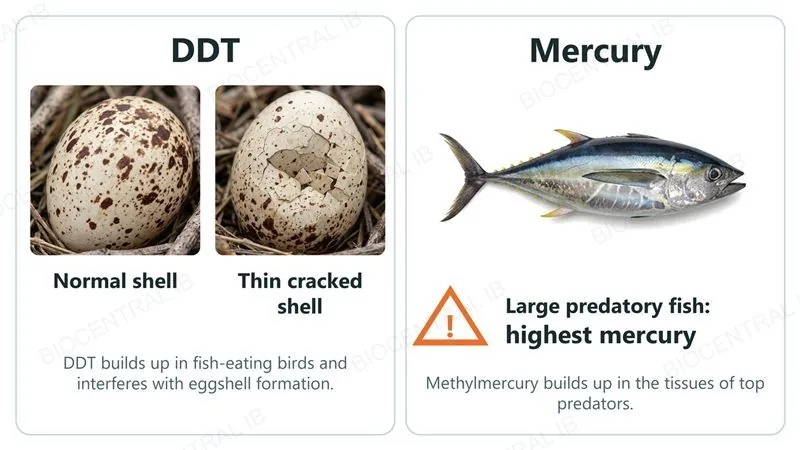
Two well-known biomagnified pollutants are the insecticide DDT and the metal mercury.
  • DDT is persistent and stored in fat. It builds up in fish-eating birds such as ospreys and eagles, where it interferes with eggshell formation, so thin shells break and populations fall.
  • Mercury from industry and mining is converted by microorganisms into methylmercury, which biomagnifies. Large predatory fish such as tuna and swordfish carry the highest levels.
  • Methylmercury is a neurotoxin, so health agencies advise people, especially pregnant women, to limit eating these fish.
Why it mattersBoth cases show toxins released at the base of a food chain ending up in the top predators, including humans.
Two cards: DDT, showing a normal speckled egg beside a thin cracked egg; and mercury, showing a tuna labelled large predatory fish, highest mercury
D4.2.10

Plastic that never goes away

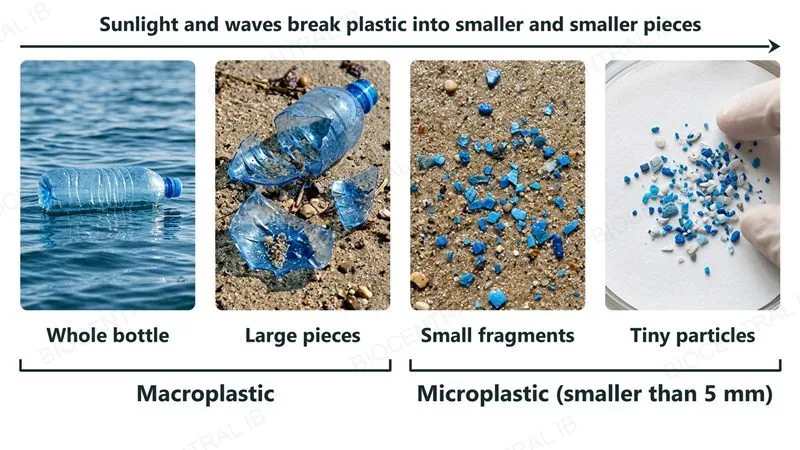
Plastics persist in the ocean because they are non-biodegradable: decomposers cannot break them down into harmless natural substances.
  • Macroplastic, such as bottles, bags and fishing nets, is slowly broken by sunlight and waves into smaller and smaller pieces.
  • Microplastics, typically pieces smaller than 5 mm, are the result. The plastic has been split into smaller pieces, not broken down chemically.
  • Fragmentation makes the pollution harder to see and impossible to collect, and the pieces spread through the water and seabed sediments.
Why it mattersBecause plastic persists, it accumulates faster than it disappears.
Four photographs in a row showing one plastic bottle breaking down: a whole bottle floating on the sea, large pieces on a beach, small fragments on sand, and tiny microplastic particles on filter paper, with brackets marking macroplastic and microplastic (smaller than 5 millimetres)
D4.2.10

Harm to marine life, and to public opinion

Plastic harms marine life in several ways, and clear public communication of that evidence has helped drive action.
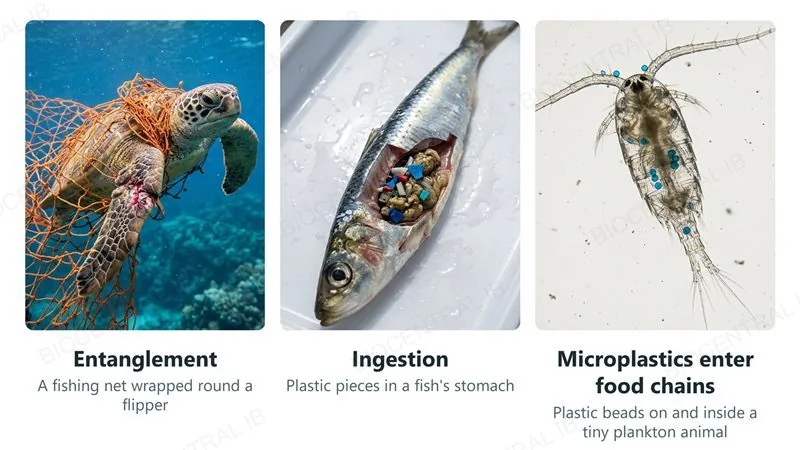
  • Entanglement in macroplastic such as fishing nets can cause injury, drowning or starvation.
  • Ingestion of plastic by turtles, seabirds and fish can block or injure the gut and give a false feeling of fullness, so they eat less real food.
  • Microplastics eaten by small animals can pass along food chains and carry chemicals with them.
  • Nature of science: popular media coverage of plastic's effects on marine life, such as the BBC series Blue Planet II (2017), changed public perception globally and drove measures to address the problem.
Three photographs: a sea turtle entangled in a fishing net, a fish with plastic pieces in its stomach, and a tiny plankton animal (a copepod) with plastic beads on and inside its body
D4.2.11

Rewilding: restore, then step back

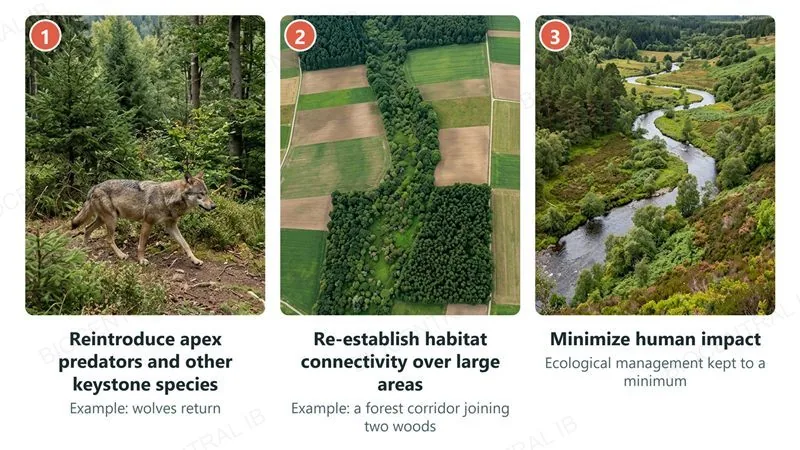
Rewilding is restoring an ecosystem's natural processes, by bringing back missing keystone species and reconnecting habitats over large areas, and then leaving nature to run itself with as little human management as possible.
  • Conventional conservation manages toward a fixed target; rewilding restores processes and lets the outcome emerge.
  • Method 1: reintroduce apex predators and other keystone species to restore top-down control, as with the otters.
  • Method 2: re-establish habitat connectivity over large areas, such as wildlife corridors, so species can move and interbreed.
  • Method 3: minimize human impact, keeping ecological management to a minimum: some is allowed, but only what the restored processes need.
OutcomeA self-sustaining ecosystem that needs little human effort.
Three numbered photographs, one per rewilding method: 1 a grey wolf in a forest (reintroducing an apex predator), 2 an aerial view of a forest corridor joining two woods across farmland (habitat connectivity), 3 a wild river valley left to nature (minimal human impact)
D4.2.11

Hinewai: let the gorse do the work

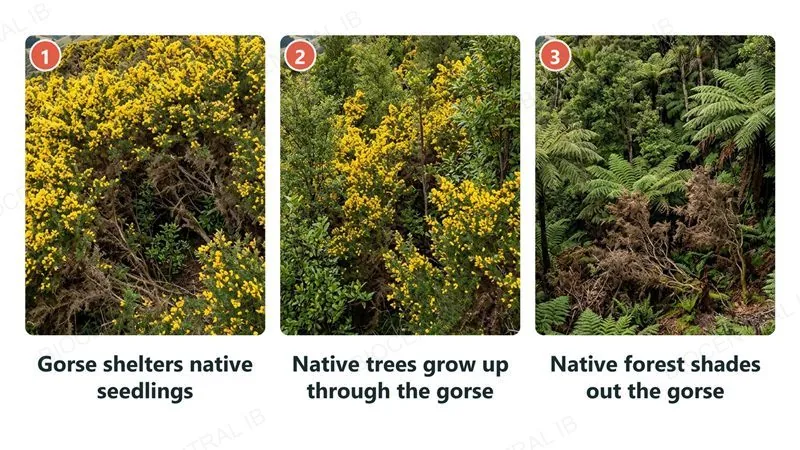
At Hinewai Reserve on New Zealand's Banks Peninsula, botanist Hugh Wilson let introduced gorse grow as a nurse canopy so native forest could return beneath it.
  • From 1987 the former farmland was not cleared of gorse or planted; the gorse was left in place.
  • Shade and shelter under the gorse allow native tree seedlings, whose seeds arrive from surrounding forest, often carried by birds, to establish.
  • Over time taller native trees grow up through the gorse and shade it out, so forest returns with little cost or management: rewilding by working with natural processes and keeping human impact small.
Three numbered photographs: 1 gorse in flower sheltering native seedlings, 2 native trees growing up through the gorse, 3 mature native forest with tree ferns above dying brown gorse
Quick check

A river flows past fertilized farmland. Weeks after heavy rain, fish in the river downstream are dying, although no poison was added to the water. Which explanation is correct?

Leached nitrate and phosphate caused an algal bloom; decomposers feeding on the dead algae raised the BOD and used up the dissolved oxygen
The fertilizer nutrients were toxic to the fish, so they were poisoned directly by the nitrate
The algal bloom released extra oxygen, and the fish died from oxygen poisoning
The fertilizer lowered the BOD, which starved the fish of food
Correct answer: nutrient enrichment, then a high BOD and low oxygen. Leaching adds nitrate and phosphate, the algae bloom and then die, and aerobic decomposers use up dissolved oxygen as they break the algae down. That rise in BOD leaves too little oxygen for fish.

Key vocabulary (SL and HL)

Worth being able to define in a single sentence each

Tipping point
A threshold beyond which a self-reinforcing change pushes an ecosystem into a different state.
Mesocosm
A small enclosed model ecosystem used to test how one variable affects stability.
Keystone species
A species whose effect on community structure is far larger than its abundance suggests.
Sustainable harvesting
Harvesting at a rate lower than the rate at which the resource is replaced.
Eutrophication
Nutrient enrichment of water, leading to algal blooms, a high BOD and low oxygen.
BOD
Biochemical oxygen demand: the oxygen used by microorganisms in a water sample.
Biomagnification
The rise in concentration of a persistent toxin at each higher trophic level.
Rewilding
Restoring an ecosystem's natural processes (bringing back apex predators and keystone species, reconnecting habitats over large areas) and then minimizing human impact, keeping ecological management to a minimum.
Percentage change
(new − original) ÷ original × 100, used to measure the extent of deforestation.
Part four

HL: Ecological succession

D4.2.12 – D4.2.15
D4.2.12 · HL

Communities that change over time

Ecological succession is the process by which the species composition of a community changes over time.
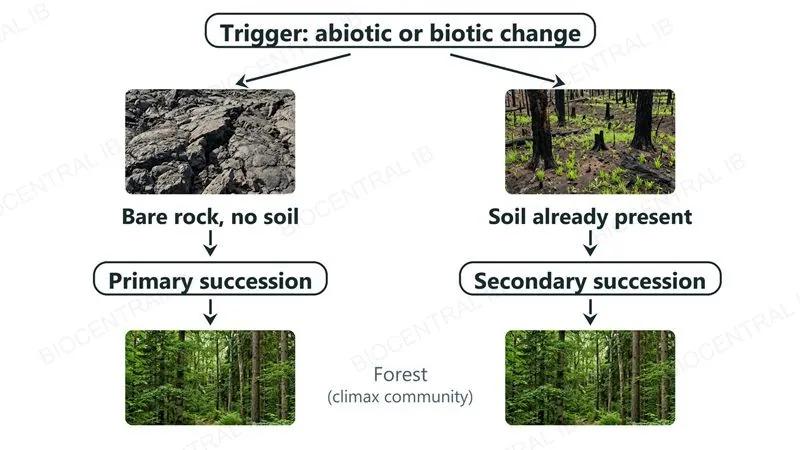
  • Succession can be triggered by a change in the abiotic environment, such as a glacier retreating, a volcanic eruption or a fire.
  • It can also be triggered by biotic factors, such as the arrival of a new species or the loss of a dominant one.
  • Primary succession begins where there is no soil, such as bare rock or new volcanic land. Secondary succession begins where soil already exists, for example after a fire or on abandoned farmland, and it is usually faster.
Why it mattersEach stage changes the environment, and earlier species often make conditions suitable for later ones.
A diagram in which bare rock with no soil leads to primary succession and burnt ground with soil leads to secondary succession, both starting from a trigger
D4.2.13 · HL

Primary succession at Glacier Bay

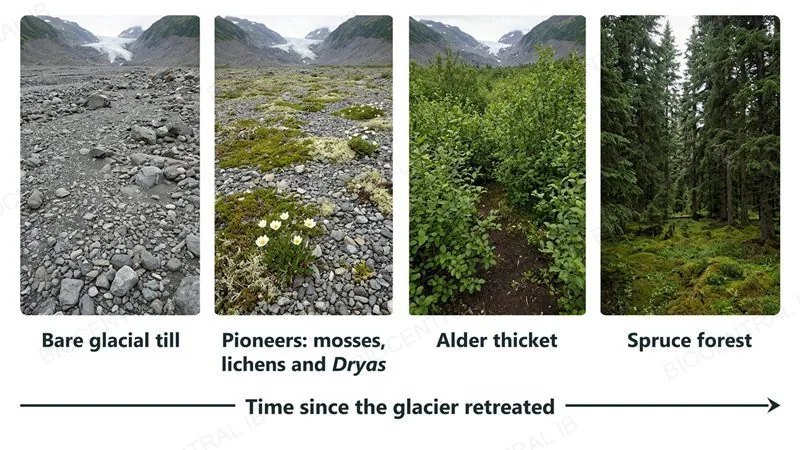
Glacier Bay in Alaska shows primary succession clearly, because sites of different ages sit side by side as the glacier retreats.
  • Bare glacial till is colonized first by pioneers such as mosses, lichens and the mat-forming plant Dryas, which hosts nitrogen-fixing bacteria.
  • Alder thickets follow. Nitrogen-fixing bacteria in the alder roots raise the soil nitrogen, enriching the soil.
  • Sitka spruce forest eventually replaces the alder, favoured by the richer soil and the shade.
  • Ecologists compare sites of known age since the ice retreated instead of waiting centuries to watch one site.
Four photographs of primary succession after a glacier retreats: bare glacial till, pioneers (mosses, lichens and Dryas), an alder thicket, and a spruce forest, with a time arrow
D4.2.13 · HL

Five things that increase

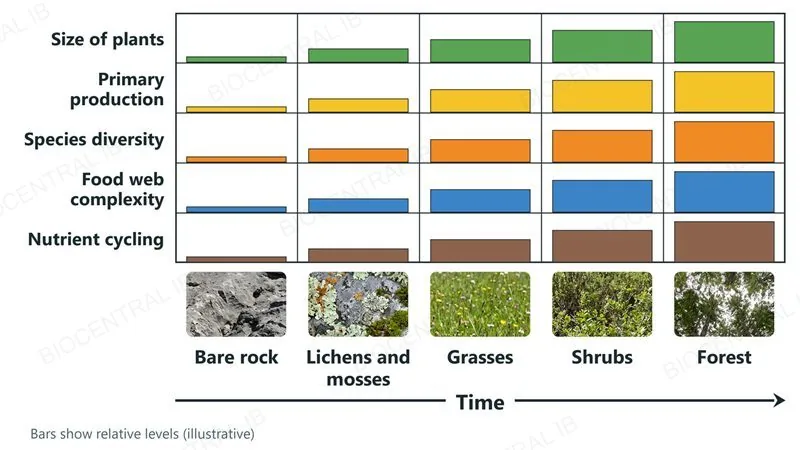
As primary succession proceeds, five features of the ecosystem increase together.
  • Size of plants: from lichens and mosses to grasses, shrubs and trees.
  • Primary production: more and larger producers capture more light energy.
  • Species diversity: more habitats and food sources support more species.
  • Complexity of food webs: more species mean more feeding links.
  • Nutrient cycling: more organic matter and more decomposers move more nutrients round the ecosystem.
Why it mattersThe community tends toward a relatively stable climax community.
Five rows of bars, one each for plant size, primary production, species diversity, food web complexity and nutrient cycling, all growing across five stages of succession
D4.2.14 · HL

Cycles instead of endpoints

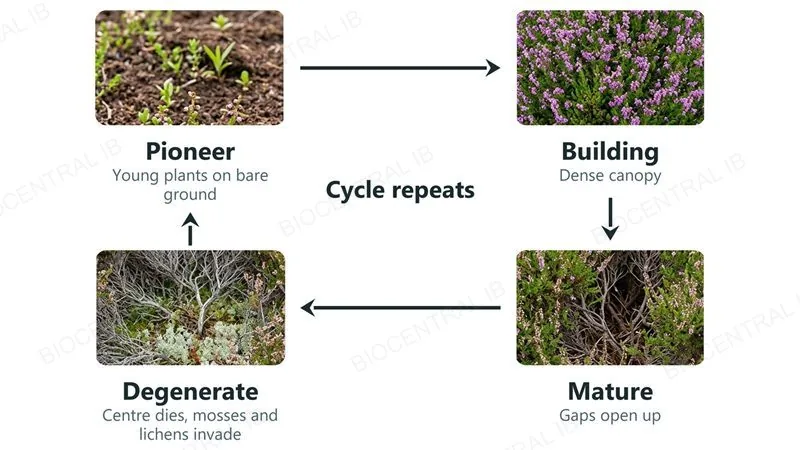
In cyclical succession an ecosystem passes repeatedly through the same sequence of communities, instead of settling into one unchanging climax community.
  • A. S. Watt studied heather (Calluna vulgaris) moorland, which cycles through four phases: pioneer, building, mature and degenerate.
  • Young heather colonizes bare ground (pioneer), forms a dense canopy (building), opens up as growth slows (mature), then dies back in the centre while mosses and lichens invade (degenerate).
  • Different patches are at different phases at the same time, so the whole moorland is a shifting mosaic that looks much the same overall.
Why it mattersThe overall ecosystem is stable even though every patch keeps changing.
Four photographs of heather in a cycle: pioneer (young plants on bare ground), building (dense flowering canopy), mature (gaps open up) and degenerate (centre dead, mosses and lichens invade), with arrows leading clockwise from each to the next
D4.2.15 · HL

Climax communities, and how humans stop them

A climax community is the relatively stable community that succession tends to produce under given environmental conditions, but human influence can prevent it from developing.
  • For a given climate and soil, succession tends to lead to a particular type of climax community, such as woodland in a wet temperate climate.
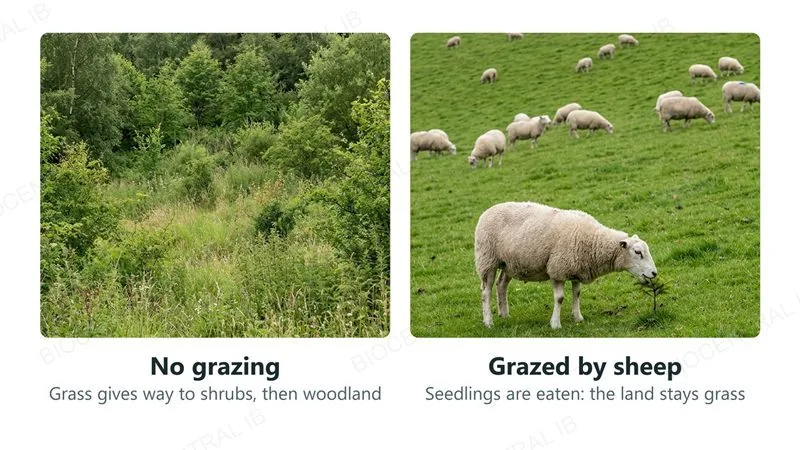
  • Arrested succession occurs when a human influence holds the community at an early stage. Grazing by farm livestock repeatedly eats tree and shrub seedlings, so grassland never becomes woodland.
  • If the grazing stopped, succession would resume, from grass to shrubs and then trees.
Why it mattersSome open habitats, such as species-rich grassland, exist only because grazing keeps succession arrested.
Two photographs: without grazing, grass gives way to shrubs and woodland; with sheep grazing, one sheep bites a tree seedling and the land stays short grass
D4.2.15 · HL

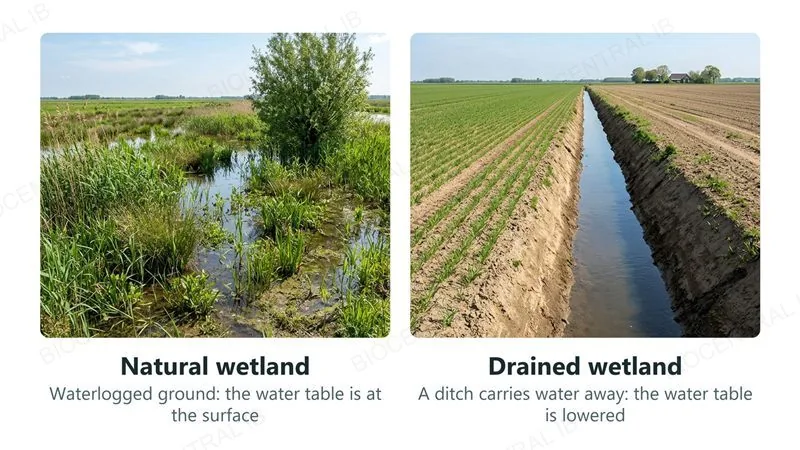
Draining a wetland ends its succession

Drainage of wetlands is a second way human activity prevents a climax community from developing.
  • In an undrained wetland, waterlogged conditions and accumulating plant remains gradually build up soil, and succession proceeds from open water and reeds toward wet woodland.
  • Drainage lowers the water table, so the waterlogged conditions and the specialist wetland species are lost.
  • The drained land no longer follows its natural succession: it is kept as farmland or another human-maintained community.
Why it mattersBoth examples show climax communities are a tendency, not a guarantee: human influence can prevent them.
Two photographs: a natural wetland with standing water, reeds and a willow, and a drained wetland with a straight ditch and a dry crop field
Quick check · HL

A hillside is open grassland, kept grazed by sheep for centuries. After the sheep are removed, tree seedlings establish and shrubs spread. What best explains why the hillside was grassland rather than woodland?

Grazing repeatedly removed tree and shrub seedlings, so succession was arrested at an early stage
Grassland was the climax community for the local climate, so removing the sheep should have changed nothing
Cyclical succession returned the hillside to the pioneer phase every few years
Primary succession cannot occur on grassland, so trees could never establish
Correct answer: arrested succession. Livestock kept eating the seedlings, holding the community at a grassland stage. Once grazing stopped, succession resumed toward woodland, showing that grassland was not the climax community.

Key vocabulary: HL

Worth being able to define in a single sentence each

Ecological successionHL
Change in the species composition of a community over time.
Primary successionHL
Succession that begins on bare substrate with no soil.
Climax communityHL
The relatively stable community that succession tends toward under given conditions.
Cyclical successionHL
A repeating sequence of communities instead of one unchanging climax.
Arrested successionHL
Succession held at an early stage by human influence, such as grazing or drainage.

Where this shows up again

D4.1
Genetic diversity is listed as one requirement for ecosystem stability (D4.2.2), and evolution by natural selection depends on heritable variation within a gene pool (D4.1). Explain how a loss of genetic diversity within a population (e.g. through a population bottleneck) could reduce an ecosystem's overall stability.
C4.2
Eutrophication (D4.2.8) disrupts the normal flow of energy and cycling of matter described in C4.2. Using the concept of biochemical oxygen demand, explain how excess nutrient input increases decomposer respiration and why this can collapse an aquatic food web.
C4.1
Keystone species maintain community structure through top-down control (D4.2.5, C4.1.17). Using the sea otter/sea urchin/kelp example, explain how removing a keystone predator can shift a community from top-down to a different, degraded stable state.
D4.3
Deforestation of the Amazon is presented as a possible ecological tipping point (D4.2.3). Climate change (D4.3) can also push ecosystems past tipping points via positive feedback loops. Compare the feedback mechanism in Amazon dieback with one climate-change-driven tipping point studied in D4.3.

D4.2 Stability and change — one-page recap

Screenshot this slide to revise from

Stability & its requirements
  • Stability is long-term persistence of structure and function despite change; some ecosystems have lasted millions of years.
  • Four requirements: energy supply, nutrient recycling, genetic diversity, climate within tolerance levels.
Tipping points & models
  • Amazon: forest recycles its own rain by transpiration; deforestation feeds a positive feedback loop toward a tipping point. % change = (new − original) ÷ original × 100.
  • A sealed-glass mesocosm lets energy through but not matter.
Keystone species & sustainable use
  • Keystone species (sea otter) have effects far larger than their abundance.
  • Harvest must stay below replacement (Brazil nut, Atlantic cod); farming: erosion, leaching, inputs, agrochemicals, carbon footprint.
Pollution
  • Eutrophication: leached nitrate and phosphate, algal bloom, high BOD, low oxygen.
  • Biomagnification of persistent toxins (DDT, mercury); non-biodegradable plastic fragments into microplastics.
Restoration
  • Rewilding: restore natural processes by reintroducing apex predators and keystone species and reconnecting habitats over large areas, then minimize human impact, keeping ecological management to a minimum.
  • Hinewai Reserve (New Zealand): gorse acted as a nurse canopy for native forest with minimal management.
HL · Succession
  • Succession is triggered by abiotic or biotic change; primary succession raises plant size, production, diversity, food-web complexity and nutrient cycling (Glacier Bay).
  • Cyclical (heather) and arrested (grazing, wetland drainage) succession show a climax is not guaranteed.

Stable is not still, and stable can be lost

Ecosystems that lasted millions of years can be pushed past a tipping point in decades. The same principles, keystone species, connected habitats and room to recover, show how change can also be repaired.
D4.2 Stability and change · BioCentral IB
Use ↓ ↑ or click to navigate
01 / 38